


















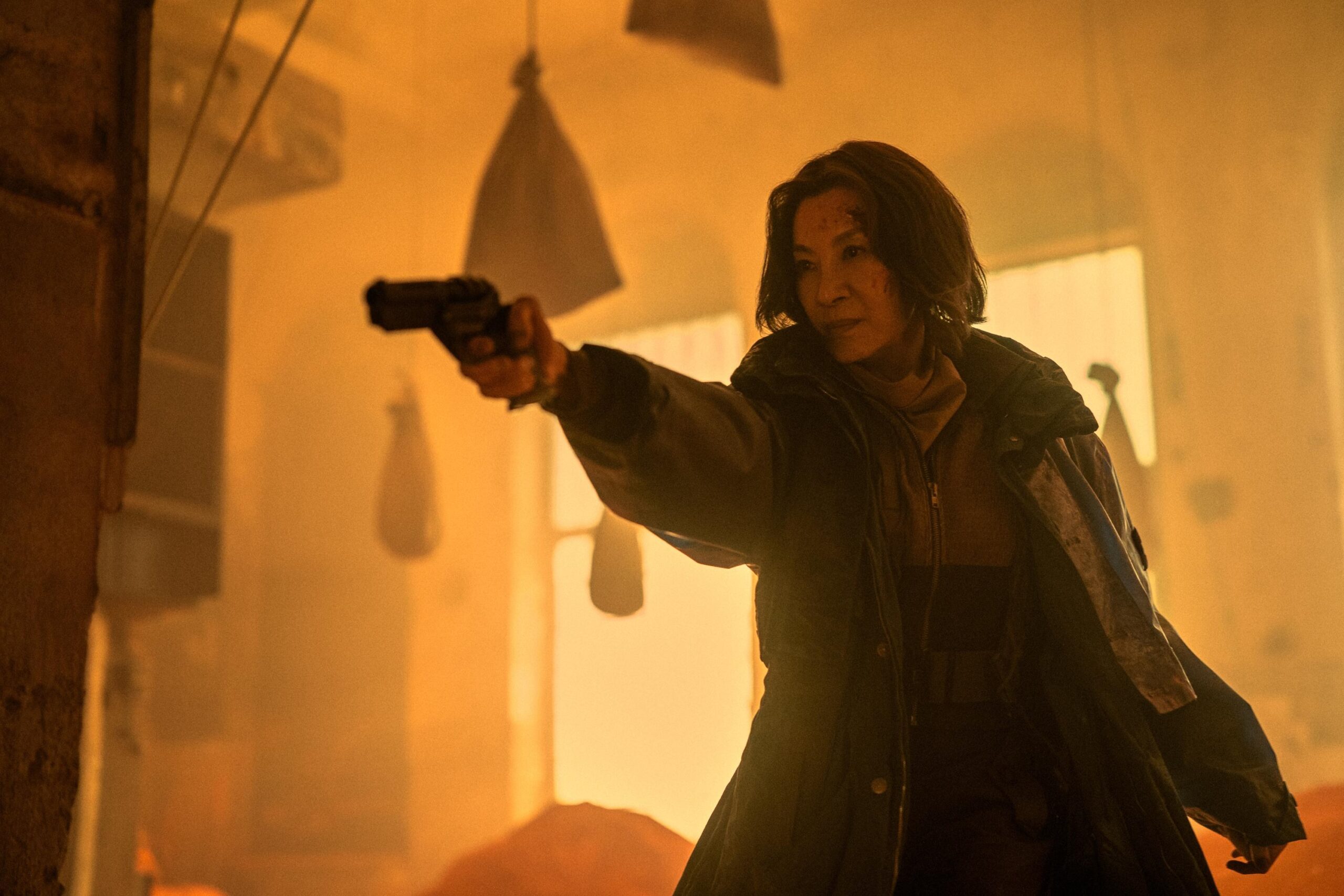
Silka Luisa rarely paused during production to think about the scale of the job she had taken on. One exception came at a screen test, when Michelle Yeoh and Hunter Schafer wore their coats for the first time.
“Once they put the coats on, it really did just transform them,” said Luisa, the showrunner of Blade Runner 2099. “The screen test was one of the few moments where I stopped myself and was just blown away by the fact that I was making Blade Runner.”
She deliberately pushed that feeling aside for most of the shoot. Luisa describes herself as a longtime fan of the films and said adapting the series for TV excited her more than it frightened her. The show is streaming now on Amazon Prime Video.
Setting the pressure aside
Any writer picking up where Ridley Scott and Denis Villeneuve left off carries a lot of weight. Luisa previously ran Apple TV’s adaptation of Shining Girls, and she said she chose not to dwell on that pressure.
“I know it seems insane almost to say no, but I just don’t think you can approach Blade Runner with fear,” Luisa said. “It’s a bold concept. It always has been. P.K. Dick took really big swings and it’s not for the timid. So any fears I had I just ignored and kept focused on the monumental task at hand. And you just stay so concentrated on moving the show forward at each step that you’re not really thinking of it in that objective sense.”
Asked why audiences keep returning to the franchise, she pointed to its blend of genre and big ideas. “It’s one of the rare properties that asks really deep philosophical questions, but within a detective noir narrative,” she said. “I think it’s the juxtaposition of both a structure that’s accessible and familiar, but then these really heady, vital questions: What does it mean to be human? How do you find connection? Just these evergreen concepts that every generation needs to grapple with in their own way and in their own time. There really isn’t anything else like Blade Runner.”
A world run by replicants, 50 years on
The series takes place 50 years after the 2017 film Blade Runner 2049. Replicants, the artificial humans from the films, came out of a brutal war in charge of society. Yeoh and Schafer star as a noir detective duo: Yeoh plays a replicant approaching the end of her life, while Schafer plays a human who keeps her humanity secret.
According to Luisa, the idea grew from a question about technology overtaking people. “The war between ‘robots’ and humans is something that has been visited in science fiction many times,” she said. “And to me what felt fresh wasn’t necessarily what the war looked like, but what the aftermath looked like. I couldn’t close my eyes and picture off the top of my head what would happen to us, what would society shift into, what is post-human. That was really exciting.”
Reversing the original setup came first, and the story was built on top of it. “Yes, it started with the idea of flipping the world, and once you do that at the macro level, you start to think about what is the more intimate story you’re telling,” Luisa said. “And if you flip the world now suddenly you have a replicant society, it’s not about a replicant trying to look human, it’s the opposite way around. And so an undercover story just seemed like a natural answer to what would be the narrative shape. It also gave me a relationship as opposed to a single person’s journey.”
The five-decade gap also gave the writers some freedom, she said. In her view each film reshaped what came before, and Scott himself “took a big leap from the book.”
“There definitely are touchstones from the novel in his film, but he put his own stamp on that story,” Luisa said. “And [Blade Runner 2049 director Denis Villeneuve], it’s the same thing. 2049 is mesmerizing, it’s spectacular, but in its own way.” She argues that a world viewers already know loses its effect. “If the world is too familiar, it’s not unsettling and it’s not going to give you any feeling of awe. You’ve already seen it before. And so you have to make it your own in some sense.”
Inventing the places before writing the scenes
All that room to invent made the scripts slower to write. Luisa said a large share of the early work was visual, and she had trouble writing scenes set in spaces she couldn’t yet see.
“We started to put images up in the writers room from the real world, a blend of films, unusual references from the real world, historical references,” she said. “You have to ask: What does the texture of the space feel like? Who works there? How long has it existed? What neighborhood is it in? You start to ask all of these questions, and you need to know the answers to write the scenes.”
Usually she would research a real location and borrow details from it. This time no such source existed. “Here I needed that same amount of detail, but we had to create it,” Luisa said.
Keeping a slow franchise moving for eight hours
The Blade Runner films take their time. A series running eight hours has to keep people who can pause or change the channel, and Luisa said pacing came up as one of the main topics early on.
“When you’re in a theater, it is such a meditative experience to be in that world,” she said. “And there was a fear that if you translate it to television, people won’t have the patience for that.” Her scripts leaned heavily on momentum, she said, “to the point of even not having exteriors, where you’re just jumping into scenes.”
In the edit, things swung back. When composer Leopold Ross’ score went over the cuts, the leanest versions didn’t leave the music any space. “You want to have those dreamier sections of the show that are, to me, really fundamental to what makes something Blade Runner,” Luisa said. “It’s always a question of how far you can stretch the rubber band. Everyone will debate whether the pacing is too slow or too fast, and it’s a really hard calibration.”
Luisa doesn’t say she got the balance right. Each viewer will judge whether the show holds attention while still moving slowly enough to feel like Blade Runner.
A trench for Yeoh, a bomber for Schafer
Harrison Ford and Ryan Gosling both wore jackets that audiences still recall, so the new leads needed signature looks too. Costume designer Helen Huang gave the two characters distinct silhouettes.
“For Michelle, she wanted to have something that was referencing a more traditional trench, and then for Hunter it was more of a bomber jacket,” Luisa said. Huang began with historical references and added textures suited to the show’s harsh setting. “It’s just masterful work,” Luisa said.
Yeoh’s aging replicant got the trench, and Schafer’s undercover human got the bomber. Luisa singled out that screen test as one of the rare moments she stepped back long enough to register that she was making Blade Runner.