

Right up to this July, anything you said aloud to Claude came back in the voice of Haiku, the weakest model Anthropic ships. That was never really a product call — it was a latency one. Quick model, quick answer.
The limit has since been lifted. Sonnet and Opus now power voice mode too, and it can draw on context from whichever apps and services you’ve linked to your account.
Which model you choose, though, counts for less than you might assume. The experience is shaped by the plumbing sitting underneath it.
It waits for you to finish, and it sometimes guesses wrong
The architecture behind Claude’s voice mode is turn-based: it listens, you stop, it generates. ChatGPT’s voice mode works differently following a recent OpenAI switch to a duplex architecture, which lets its GPT-Live models process speech and produce output simultaneously.
To a turn-based system, a breath looks like a full stop. Pause mid-question to gather your thoughts and Claude may conclude you’re finished, then reply to whichever half you’d already got out.
Anthropic’s own advice is to put multi-part questions one at a time rather than all in one go. Follow it. That is what separates a session that works from one where you spend it interrupting a chatbot that interrupted you first.
Starting a session takes two taps
You’ll find voice mode in the Claude mobile apps for Android and iOS, in the desktop app and on the web. According to Anthropic, the feature is at its best on your phone.
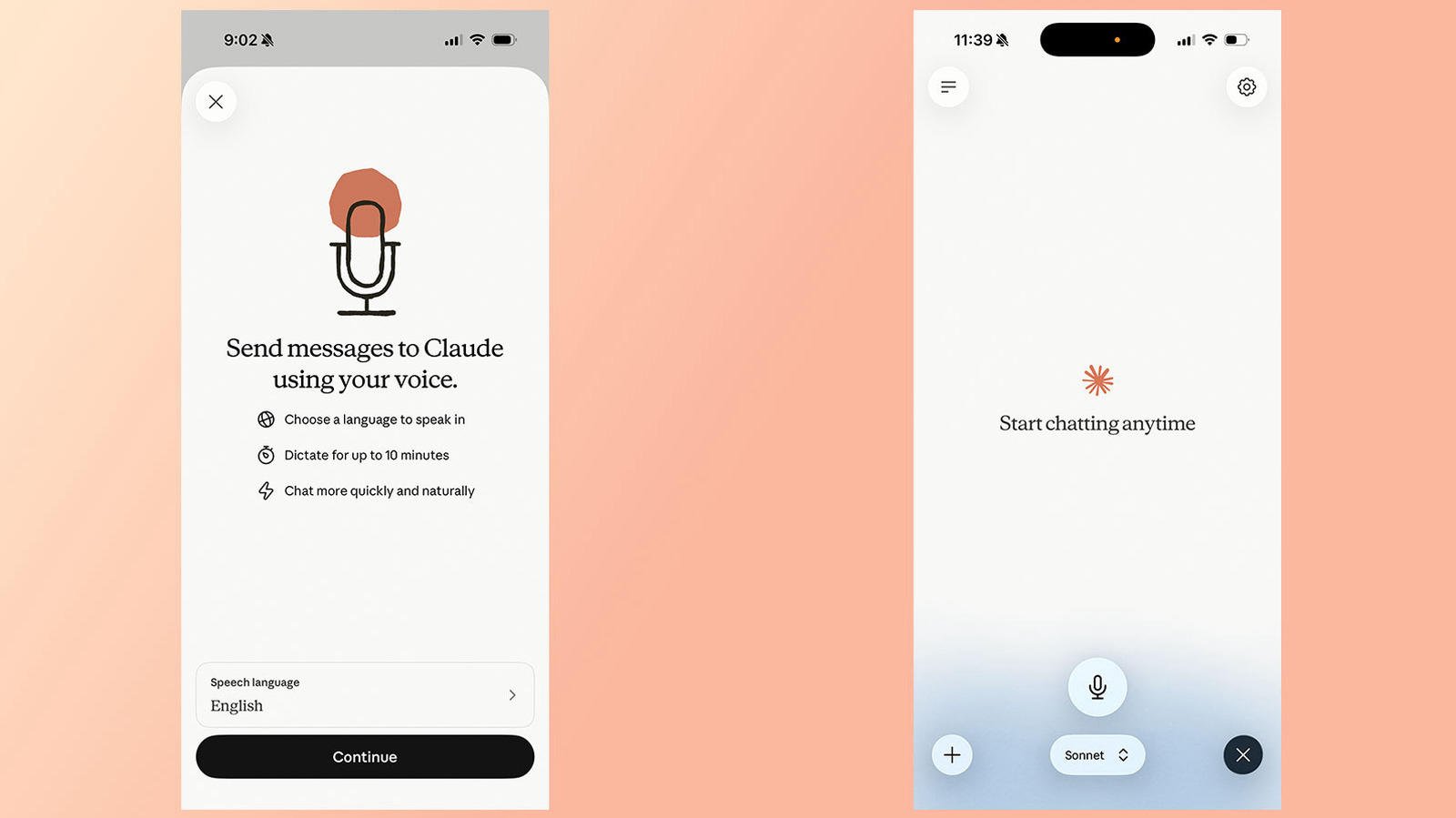
Launch the app and tap the black waveform icon in the lower right corner of the interface. Not the microphone icon directly beside it — that’s the one you’ll press by mistake for the first few attempts.
If prompted, grant microphone permissions. Then just speak. Claude produces a response once you’ve completed a prompt, and it remains in voice mode until you tap Stop.
The model picker sits at the bottom of the screen
Whichever model answers you can be swapped from the picker at the bottom of the interface. In Anthropic’s own framing, Haiku is fastest for quick answers, Sonnet is most efficient for everyday tasks and Opus is the one for complex tasks. Only paid accounts get Opus.
It can read your inbox out loud
Just as in text chat, voice mode can reach the apps and services connected to Claude — Gmail, Google Calendar and Slack among them. Ask for a summary of your recent emails, and name the app you want it to use as part of the prompt.
Point it at a third-party app for the first time and you’ll have to grant Claude permission before anything happens.
14 languages, and it won’t follow you mid-sentence
Anthropic’s voice mode covered 14 different languages as of July 2026, several of them with extra dialects on top. In full, the list reads English, English (India), English (United Kingdom), Chinese (Simplified), Cantonese, French, French (Canada), German, German (Austria), Hindi, Italian, Japanese, Korean, Portuguese, Portuguese (Brazil), Portuguese (Portugal), Russian, Spanish, Spanish (Latin America), Turkish and Ukrainian.
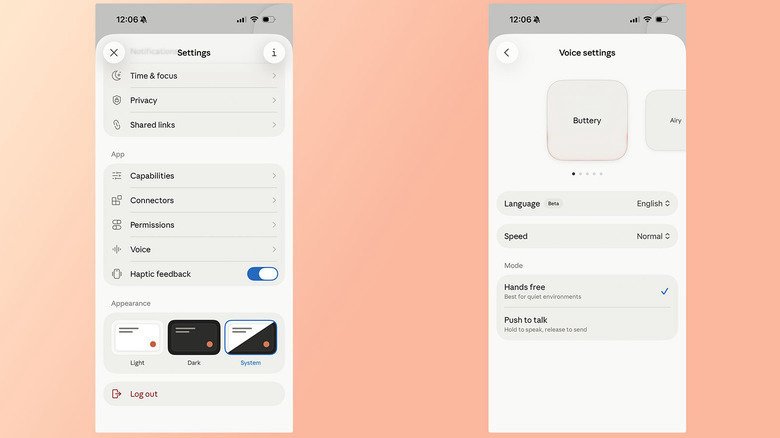
The language you pick limits the voices you can pick. Five options come with English. Two come with Japanese.
One catch is worth knowing up front: switching languages mid-sentence is something Claude cannot detect. Planning to speak in another language? Announce that intention out loud, or set the language from the Settings menu beforehand.
Five voices, three speeds and a push-to-talk toggle
Head to the Settings page and tap Voice, which sits below the App section of the menu. Each one gets a preview via a carousel at the top. The English options are Buttery, Airy, Mellow, Glassy and Rounded.
You can tune the cadence as well, choosing between Slow, Normal and Fast. There are two recording modes, Hands free and Push to talk, and Anthropic’s suggestion is that the first is best kept for quiet environments.

What a free account gets you
Claude Voice doesn’t demand a Pro or Max subscription. Haiku and Sonnet are the two models free accounts can reach, and Sonnet should carry more than enough intelligence for the majority of prompts. Sending prompts through Opus is what requires paying.
There are two further considerations for free users. Voice conversations eat into your usage limits exactly as typed ones do. And a single connection is the cap on free accounts, although none of the supported languages are withheld.
Put it on Sonnet, flip to push to talk if you’re sharing the room, and keep it to one question per breath. Waiting for your silence is the whole premise of the thing, so hand it a clean one.