

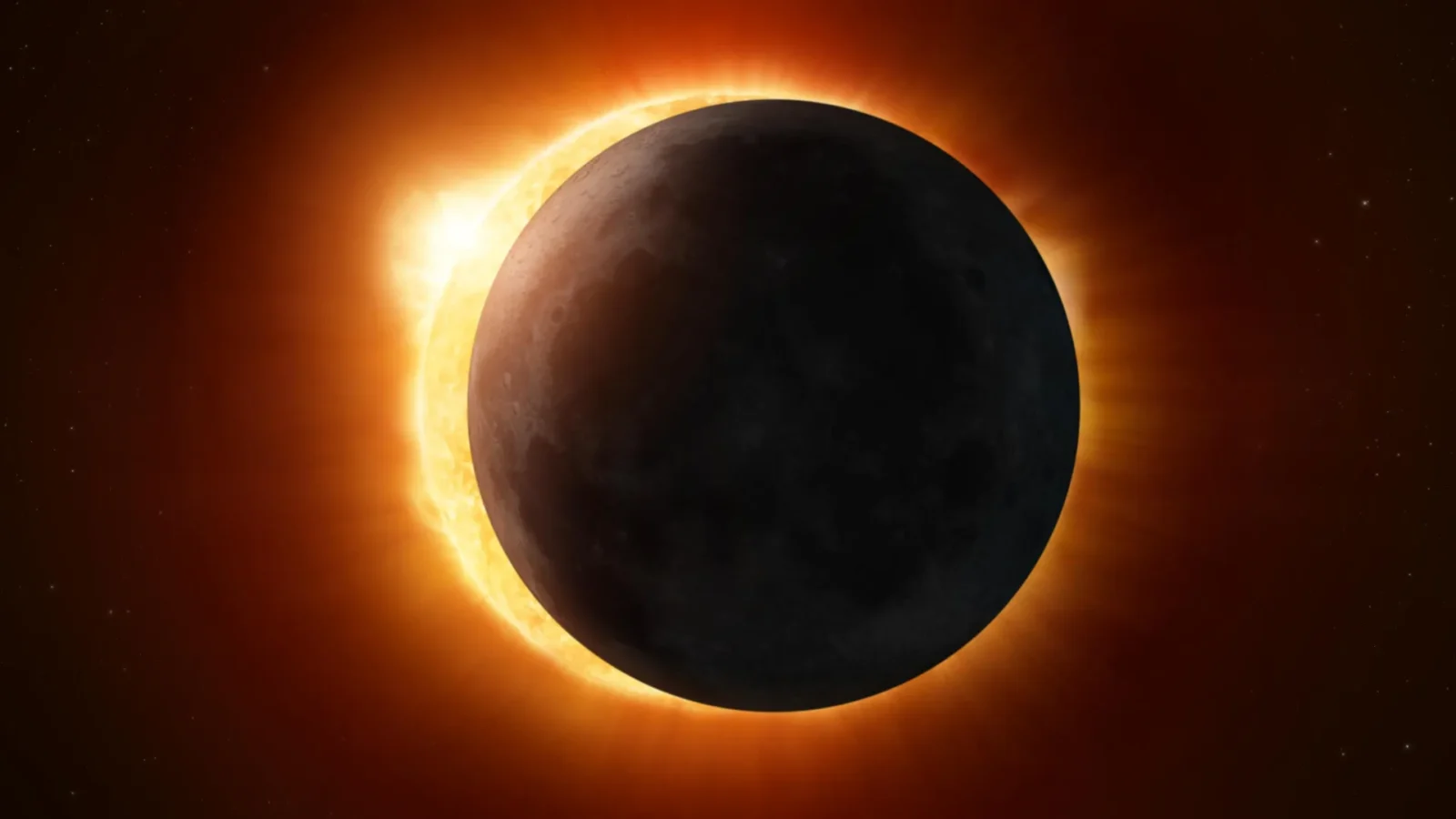
On Aug. 12, 2026, the strip of ground where the Moon covers the Sun completely barely grazes Europe. Greenland, Iceland, a sliver of northeastern Portugal, and then Spain — that’s the list. The rest of the continent is left with a partial eclipse, and that is a wholly different thing to witness.
Worth being clear about that before you make plans. Stand outside the band and what you get is a bite taken out of the Sun and daylight that turns oddly flat. Striking, sure, but not the spectacle people cross oceans for.
At Javalambre, the entire event runs 1 minute and 21 seconds
The European Space Agency is going live from the Observatorio Astrofisico de Javalambre in Teruel, Spain, where totality arrives at 2:31 p.m. EDT (11:31 a.m. PDT). Eighty-one seconds later it’s finished and the observatory is back in daylight.
Coverage begins well before that, at 1:30 p.m. EDT (19:30 CEST), on ESA Web TV and the agency’s YouTube channel, and should sign off around 2:45 p.m. EDT (11:45 a.m. PDT). The broadcast is in English from start to finish.
Why a mountain observatory beat a photogenic viewpoint
Javalambre falls squarely within the path of totality, and that condition is non-negotiable. The reasoning behind the choice, though, doesn’t stop there.
Clouds rarely gather over the site and light pollution is minimal. What seals it is the unusually unobstructed view west — a detail that matters enormously here, since the Sun will already be sinking toward sunset as the Moon passes across it. A low Sun paired with a cluttered western sky would have ruined the shot.
Nor is this a visitor attraction. The two principal professional telescopes on site carry out wide-sky surveys that feed research into galaxies, dark energy and the large-scale structure of the universe. During the broadcast, observatory director Javier Cenarro will discuss the facility and its relevance to an upcoming ESA space science mission.
A handful of additional small telescopes are being carried up specifically for the occasion. Their feeds stay live throughout, letting viewers follow the Moon’s slow advance across the Sun stage by stage instead of jumping straight to the payoff.
Three feeds, because a single patch of sky can let you down
ESA is not staking the whole broadcast on Teruel. Two further live feeds originate elsewhere along the path of totality, improving the chances that at least one lens has a clean view at the critical moment.
One of them comes from ESA’s public event in Leon. The second is based in Fromista, in Palencia, where collaborator Alejandro Sanchez de Miguel is conducting eclipse observations. His affiliations span the Institute of Astrophysics of Andalusia, the Complutense University of Madrid and the Stars4All Foundation.
That kind of redundancy is the signature of a crew that has lost a shoot to weather before.
Who’s in front of the camera
Hosting duties fall to Dame Dr Maggie Aderin, an award-winning space scientist and science communicator. Joining her are ESA’s Director of Science Professor Carole Mundell, ESA scientists Andy To, Miho Janvier and Martin Hewitson, along with Cenarro.
The programme blends telescope imagery with drone footage, and ESA intends to cut to Maggie and Carole as totality arrives. That’s no accident — reaction shots during an eclipse tend to be the most compelling footage anyone comes away with.
Interview topics run from the Sun and its corona to the eclipse that helped overturn our understanding of gravity, and on to ESA’s efforts to manufacture artificial solar eclipses in space.
What’s actually happening up there
An eclipse occurs as the Moon passes directly between Earth and the Sun, blotting it out and casting a slim corridor of the planet into darkness.
Once the Sun’s brilliant disc is hidden, its faint, wispy outer atmosphere becomes visible. Stars and planets may emerge, temperatures can fall and winds sometimes pick up. Birds and insects occasionally behave as though nightfall has arrived — the sort of detail that rattles people more than anything happening overhead.
Being in Spain but away from an observatory is hardly a bad outcome. Conditions nationwide are forecast to be excellent as the eclipse sweeps from west to east. Anywhere else in Europe, load the stream at 1:30 p.m. EDT and set a second alarm for 2:31 p.m. EDT — the moment everyone remembers is shorter than the ad break preceding it.