

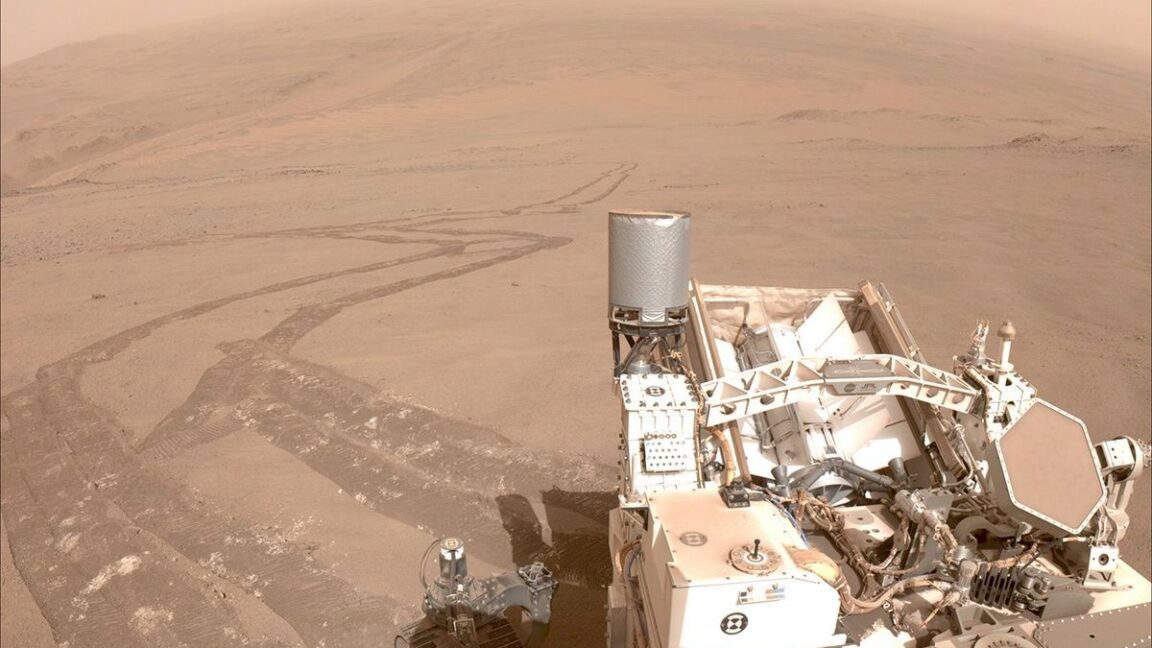
Roughly nine out of every ten meters NASA's Perseverance rover has covered on Mars were driven without a single instruction from Earth about where to go. For its predecessor Curiosity, that figure sits at around 10 percent.
That difference is why a record is due to fall sometime next week. Perseverance, on the surface since February 2021, is closing in on 45.16 km (28.06 miles) of driving across the Martian surface — farther than any vehicle has ever traveled on another world. The mark being taken belongs to Opportunity, which fell silent and stopped communicating with NASA in 2018 after years of service.
Perseverance will have done it in about a third of the time.
The computer, not the wheels
“The real enabling technology has been its auto navigation system,” said Steven Lee, the project manager for the Perseverance rover at NASA’s Jet Propulsion Laboratory, in an interview.
Anyone who has followed the self-driving car industry will recognize the arrangement. Cameras on the rover photograph the ground ahead, an onboard computer pushes those images through algorithms, and the software settles on the safest path. Terrestrial vehicles enjoy conveniences Perseverance will never have: maps, road signage, painted lane markings. What Mars supplies instead is boulders and sandy slopes — though it also supplies no other traffic and no bad drivers, which is worth something.
Curiosity, which launched nine years before it, is largely a twin of Perseverance, with comparable imaging hardware and comparable algorithms. Where they part ways is the processor. Curiosity’s computer belongs to an earlier generation, and portions of its chipset date back to the 1990s, according to Lee. It is too slow to think while it moves, so for the most part it doesn’t. Fifteen years of surface operations have taken it 38.6 km.
Thinking with the wheels turning
Perseverance carries a somewhat more modern Vision Compute Element, and the practical result is that it can sense and process while its wheels keep rolling. This is not a story about speed — top wheel speed is roughly 150 meters per hour.
The saving is in waiting. Parking to wait on navigation commands sent by drivers on Earth is dead time, and Perseverance spends far less of its mission doing that.
“It is very enabling for the science,” said Vivian Sun, the mission’s deputy project scientist. “Not to sell the rover’s other advanced capabilities short, but the driving in particular has allowed us to have a larger scope than previous missions.”
Two rovers, two ways to work
Each mission asks something different of its wheels. Curiosity set down in Gale Crater and has been working its way up Mount Sharp at a deliberate pace, covering little ground and devoting its time to systematic, detailed measurements as it climbs.
Perseverance came down in Jezero Crater, where the science targets are spread out. It travels between them, and on more than one occasion it has arrived at a new site ahead of schedule, catching the scientists waiting on it by surprise.
There is plenty still queued up. Jezero’s rocks rank among the oldest in the Solar System — older than anything found on Earth, reaching back roughly 4 billion years. Mars at that stage was in the closing phase of the “heavy bombardment” era, when rock was still flying around the inner planets in enormous quantities, although conditions were starting to calm.
“It’s the first time we’ve been able to investigate this terrain in situ, and that’s been very exciting,” Sun said.
Sizable lakes, and perhaps oceans, are believed to have existed in that period. Perseverance is combing the ancient terrain to establish what the geology and environment were actually like, and how welcoming the planet may once have been to life. Among the scenarios scientists have raised is something along the lines of the Mojave Desert with water flowing through it. The debate is not settled. What has changed is how much data there now is to argue over.
The wheels held up. The actuators are the open question.
Curiosity is still operating after almost 15 years, and its team spotted genuine wear on its wheels only a few years into the mission. That prompted redesigned wheels for Perseverance, and Lee said no appreciable wear and tear has shown up.
The item that stays on the watch list is the actuators inside the wheels. They were life-tested to 20 km of driving, and NASA is currently certifying them for at least 100 km, and possibly beyond that.
Everything else favors the rover. It draws its power from an RTG and carries no propellants, no consumables and no lubricants — nothing that can run dry. That, Lee said, is why it could go on driving itself around Mars for many years yet.