


Nvidia’s new open data engine, Flora, can annotate an hour of robot video for 72 cents, according to the company. Running the same job through OpenAI’s GPT-6 Astra costs roughly $88.50. On paper that settles it. The benchmarks behind the claim are less tidy.
Flora is open source, and the models are on Hugging Face. Nvidia said the engine is already part of training for its GR00T models, where it labels as much as 200,000 hours of video a day on 512 GB300 GPUs.
The 72-cent price is an estimate
Nobody measured those costs in production. Nvidia projected them, using an assumed rental rate of $10 per GPU per hour. A different cloud bill gives you a different per-hour figure.
Even if you accept the estimate as given, the gap is wide. Nvidia said Flora scored slightly better than GPT-6 Astra in a 50-video test, and Astra was allowed its full reasoning capacity. Claude Opus 5 did much worse on the same test while still costing about $42 per hour.
Matching or edging out Astra for about 1/125th of the price is a strong sales pitch. The test, though, covered only 50 videos, and the company that ran it sells the GPUs.
Why robots need three kinds of labels
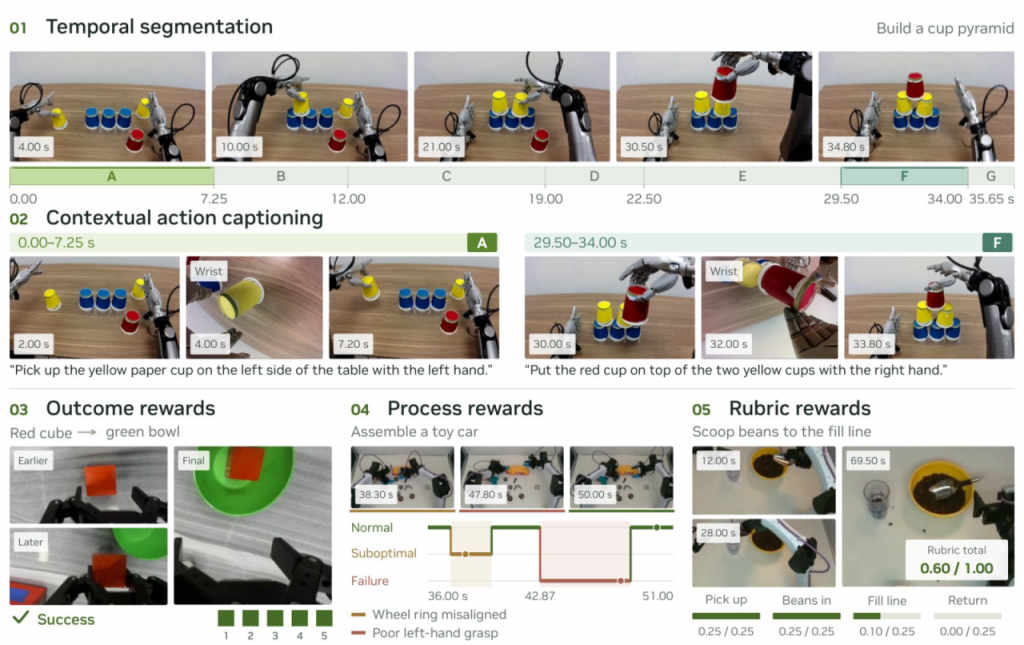
Big robot AI models learn from video, and that footage needs text annotations. Nvidia’s GEAR research lab sorts them into three types. The first records which action happens at what time, and teams use it to pick training data. The second scores a robot’s progress step by step, so the robot can learn by trial and error. The third decides whether a task succeeded, which is how deployed robots are monitored.
Most current tools cover one of the three. Large language models such as GPT-6 Astra can handle several, but they cost too much at the volumes robotics teams work with. The paper says Flora handles all three.
Three Qwen models, one job each
Under the hood, Flora is three fine-tuned Qwen3.5 models. A 9B model splits each video into action segments. A 27B model then writes a description of every segment, using context from what came before and after it.
The third piece is another 27B model, Flora-Rewarder, and its role changes with the prompt. It can rate how well an episode went on a 1-to-5 scale, label every half-second step as normal, suboptimal or failure, and score episodes against rubrics the user defines.
Flora’s wins, and Astra’s
Flora’s best result is in spotting failures. Flora-Rewarder catches 53.3 percent of failed steps inside an episode. No rival tops 11.7 percent, and Astra catches none at all. The trade-off is false alarms, with Flora marking about 11 percent of normal steps as errors.
Flora’s error rate on RoboRewardBench is 27.8 percent lower than Astra’s. The paper puts this down to tasks that were only partly finished. If a robot tips a bottle over but doesn’t knock it off the table, Flora awards 3 out of 5 points, the same as the human reference. Astra awards one.

Astra keeps the lead in rubric-based scoring and trajectory ranking. Results on the public WGO-Bench are mixed. Flora is best at finding where actions start and stop, but Astra beats it on overall score, and Gemini 3.8 Flash beats it on description accuracy alone. According to the researchers, most of Flora’s gains come from temporal localization.
The referee on Nvidia’s own benchmark is also a contestant
DenseCaptionBench is Nvidia’s own benchmark. Flora tops every metric there for human recordings, and places second to Astra on robot videos.
The researchers admit a flaw in the method: GPT-6 Astra grades the descriptions and is also one of the models under test. Anyone quoting those figures should keep that in mind.

Strong on short actions, weaker on long ones
One test video packed in lots of short hand movements. Flora picked out 34 of the 37 separate actions, and Astra found four.
Longer actions are a problem. Flora sometimes breaks them into too many small steps, and its descriptions can be wrong. In one clip a robot hand wipes a plate with a cloth, and Flora said it was folding a napkin.
Free software that sells GPUs
Nvidia presents Flora as an open alternative to paid services such as Scale AI’s Physical AI Data Engine. Researchers can use it to grow their own robotics datasets and to try out ideas like transferring human demonstrations to robots.
The reasoning is easy to follow. Nvidia is putting billions into open AI models so developers stay on its hardware and keep buying its chips, and Flora is part of that strategy. For some time the company has also tried to fill the gap in robotics training data with simulation and automated data processing. At GTC earlier this year it demonstrated a pipeline that prepares, multiplies and scores training material automatically. Flora feeds that pipeline detailed labels and reward signals taken from video.
Flora also extends Nvidia’s effort to cover the entire robotics value chain, from hardware and training data through simulation to the models. Google is working on the same stage: its recently announced Gemini 4 Argon also picks out work steps in training videos and flags failed actions.