

In Brief:
- According to CEO Robby Yung, The Sandbox SAND $0.07566 ▲ +78% (official site) has put nearly three years into Sandbox Studio, an AI-assisted editor pitched at professional developers rather than no-code hobbyists, with a public release tentatively set for October.
- Titles created in Studio aren’t meant to stay inside The Sandbox. The plan is for creators to export to the web, Telegram, mobile app stores and Steam.
- Prompt-to-game automation isn’t the objective, Yung said: “The goal here is not to automate game creation. Because that’s how you get AI slop.”
Nearly three years of rebuilding have gone into The Sandbox’s creation toolkit, and the version landing this fall is aimed at developers already fluent in Unity and Unreal rather than the no-code audience the platform spent years cultivating.
Speaking in a podcast interview, CEO Robby Yung said a public launch of Sandbox Studio is provisionally scheduled for October, following a run of controlled game jams.
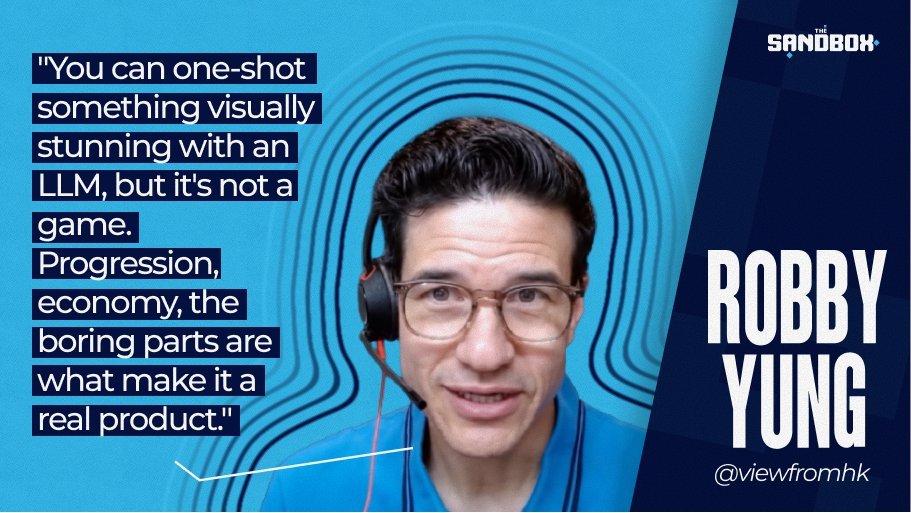
An LLM can create a demo that looks incredible. But it’s not a game: progression, monetization, multiplayer… the boring parts are what make it a real product.
Watch the full conversation with @viewfromhk CEO of The Sandbox, and @blockchaingmgThe SandboxView on X ↗
Accessibility was the strength of the original Game Maker. It was also a ceiling on what a professional studio could produce. “If you were an actual game developer, then those tools actually acted as a constraint,” Yung said.
On where the AI work stops, he was blunt. “The goal here is not to automate game creation,” Yung said. “Because that’s how you get AI slop.” What studios are being sold is AI that absorbs the repetitive work: debugging, testing, content updates and porting a title to multiple platforms.
Build in one place, ship in many
Games made in Studio won’t be confined to The Sandbox. Creators are meant to export to the web, Telegram, mobile app stores and Steam, overturning the original premise that people build for the company’s own virtual world.
Yung’s reasoning is arithmetic rather than ideological. Locking down distribution makes little sense, he said, when The Sandbox doesn’t currently have an audience large enough to support most professional developers. Better to treat several platforms as a revenue multiplier on a single title.
Who’s inside so far
Entry has been kept deliberately tight. Roughly 30 established community creators were let into the alpha through a game jam that drew more than 12,000 applications, with as many as 10 more admitted each week.
Among them are builders experienced with Roblox, Unity and Unreal Engine, along with developers already working in Cursor, OpenAI Codex and Claude Code.
Beta sign-ups opened Aug. 6 and the beta itself went live Aug. 12, alongside Engine v14, which reorganized scene structure around a unified SceneNode system and turned prefabs into first-class objects. The Alpha Creator Game Jam ran July 2 through July 31 with a $5,000 prize pool, and winners were named Aug. 7. The beta jam, themed “Overgrown,” closed submissions Sept. 11 with $7,500 on the line and Larry Hryb — for 15 years the voice of Xbox — as lead judge.
What October is supposed to carry
The roadmap for the public launch lists multiplayer, monetization, more than 10 genre templates and kits, asset and skill collections, refined onboarding, full platform and backend support and a larger voxel library. An agent called Agent Nova powers the AI-assisted creation. September was set aside for sync multiplayer work covering four-player competitive matches, lobbies, matchmaking and per-match servers.
SAND is being folded into the monetization framework for digital purchases, subscriptions and developer transactions. An Economic Layer Platform using token bonding curves for creator monetization is slated for late 2026.
LAND is being repurposed. Games published on LAND get featured catalog placement weighted by tier, and those creators receive preferred monetization mechanics and a larger share of what their games earn. The company hasn’t disclosed the revenue splits. Publishing without LAND remains possible.
Thirty staff, or maybe two
Yung expects the tooling shift to shrink teams. Citing a conversation with Fenris Creations CEO Hilmar Veigar Pétursson, he suggested serious studios may soon have no reason to employ more than 30 people, and that one- and two-person teams will use AI to ship games that used to require far larger organizations.
The interview also took up whether the brand survives a move away from voxel art, and why Yung thinks blockchain games are well positioned to take advantage of AI.
The Sandbox put the case against demo-ware plainly in a post on X: “An LLM can create a demo that looks incredible. But it’s not a game: progression, monetization, multiplayer… the boring parts are what make it a real product.”