

In Brief:
- Games for a Living (GFAL) will open the public beta of World War II: TCG on iOS and Android on Nov. 28. Members of the GFAL community get a closed test starting Nov. 26.
- The card game has been unavailable since 2022, after its backend provider GameSparks closed. Two co-founders of FrozenShard Games, the original developer, are now GFAL executives.
- Once the beta ends, GFAL plans to let players own and trade eligible cards on the GFAL Marketplace, and using a wallet will be optional. No marketplace date has been given, and GFAL hasn’t said which cards will be tradable.
After more than three years offline, World War II: TCG is coming back to phones. Games for a Living opens a public beta on Google Play and the App Store on Nov. 28.
In a post on X, the studio’s @GFAL_Official account wrote: “The wait is almost over! WWII: TCG Open Beta launches on November 28. Build your deck, command iconic WWII units, and join the battle on mobile.”
The wait is almost over!
WWII: TCG Open Beta launches on November 28. Build your deck, command iconic WWII units, and join the battle on mobile.
Thanks to @BCGbiz for covering our return! 👇@GFAL_OfficialView on X ↗
The open build isn’t the first test. The Barcelona studio said its community gets a closed beta from Nov. 26, two days before the public launch on Nov. 28.
Beta progress will be wiped
GFAL plans to gather gameplay feedback during the beta and reset player progress afterwards, so nothing earned in the test will carry over.
The full mobile launch will follow the beta, though GFAL hasn’t set a date. A PC version is also planned for Steam and the Epic Games Store.
Tradable cards, optional wallet
Web3 features arrive once the beta is over. According to GFAL, players will then be able to own and trade eligible digital collectible cards on the GFAL Marketplace.
Taking part in web3 will be optional, the company said. Building decks and competing won’t require a connected crypto wallet.
GFAL has yet to publish a launch date for the marketplace or the rules that decide which cards qualify for trading.
Part of a three-game test slate
GFAL announced the revival in October, alongside Diamond Jewels Solitaire and the football management game Legends. Its roadmap has all three entering testing in the fourth quarter.
Solitaire is slated for a beta, while Legends gets an alpha.
What took the game offline
FrozenShard Games launched World War II: TCG on iOS on March 6, 2014, and on Android on June 19, 2014. A Steam version arrived on Feb. 23, 2019.
GameSparks ran the game’s backend. After that service shut down, FrozenShard said in a 2022 notice that it had searched for a replacement provider. It decided a migration would be too complex, since so many of the game’s features relied on the existing backend.
In September 2022, FrozenShard pulled the game from Google Play, the App Store and Steam.
FrozenShard’s own founders are behind the comeback. Co-founder Christian Gascons is now GFAL’s chief operating officer, and fellow co-founder Marc Tormo is its chief creative officer.
How the original worked
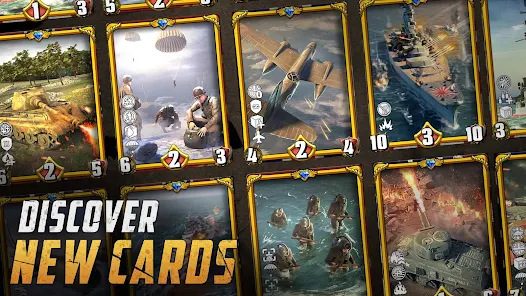
Players built decks from infantry, tanks, aircraft, ships and submarines modeled on historical units and equipment, such as Germany’s Tiger tank and Japan’s A6M Zero fighter. The original had five factions: German, Russian, Japanese, American and British.
Units from different armies could share a deck, and their abilities could be combined with equipment and orders cards. Every turn came with three action points, spent on actions like deploying cards or promoting units already in play.
Promoting a unit boosted its stats and could give it new abilities. If a promoted unit was destroyed, it returned to the deck with its upgrades and could be drawn again.
Historical missions, ranked multiplayer, crafting and co-op raids were also part of the original.
The project began on Kickstarter, where 199 backers pledged $18,001.