

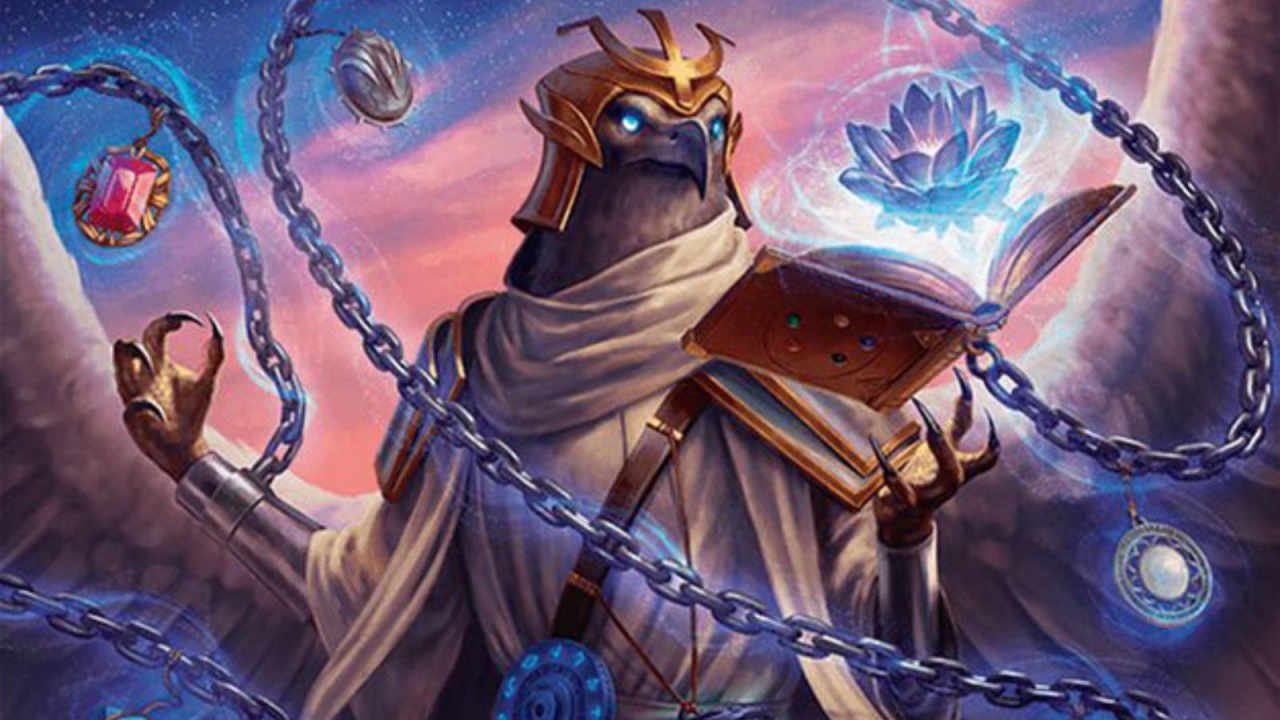
Wizards of the Coast once printed a card that summons the Power Nine. Not a wink in their direction. Not a toned-down tribute. Ancestral Recall, Black Lotus, all five Moxen, Timetwister and Time Walk, shuffled into your library by a three-mana blue bird wizard called Oracle of the Alpha.
That card is only possible because Alchemy is. And Alchemy is on its way out.
Wizards has now confirmed that the format retires in early 2027, drawing a line under the most divisive experiment in Magic: The Gathering history. It arrived on MTG Arena in 2021 with a pitch: a digital-native frontier where cards could be retuned overnight and mechanics such as Conjure, Seek and Perpetual could operate free of tabletop limitations.
Purists loathed it. Pulling the Power Nine out of nowhere, permanently rewriting card stats across zones, patching first-player win-rate gaps by hand — none of that resembles how Magic is meant to behave. What it did deliver was a metagame for digital players that shifted at the pace of a software patch, plus a broader definition of what a Magic card could be in the first place.
The dedicated queue is going away, even as Alchemy’s fingerprints remain on Historic, Timeless and Brawl. These are the 10 cards that sum up the entire odd era.
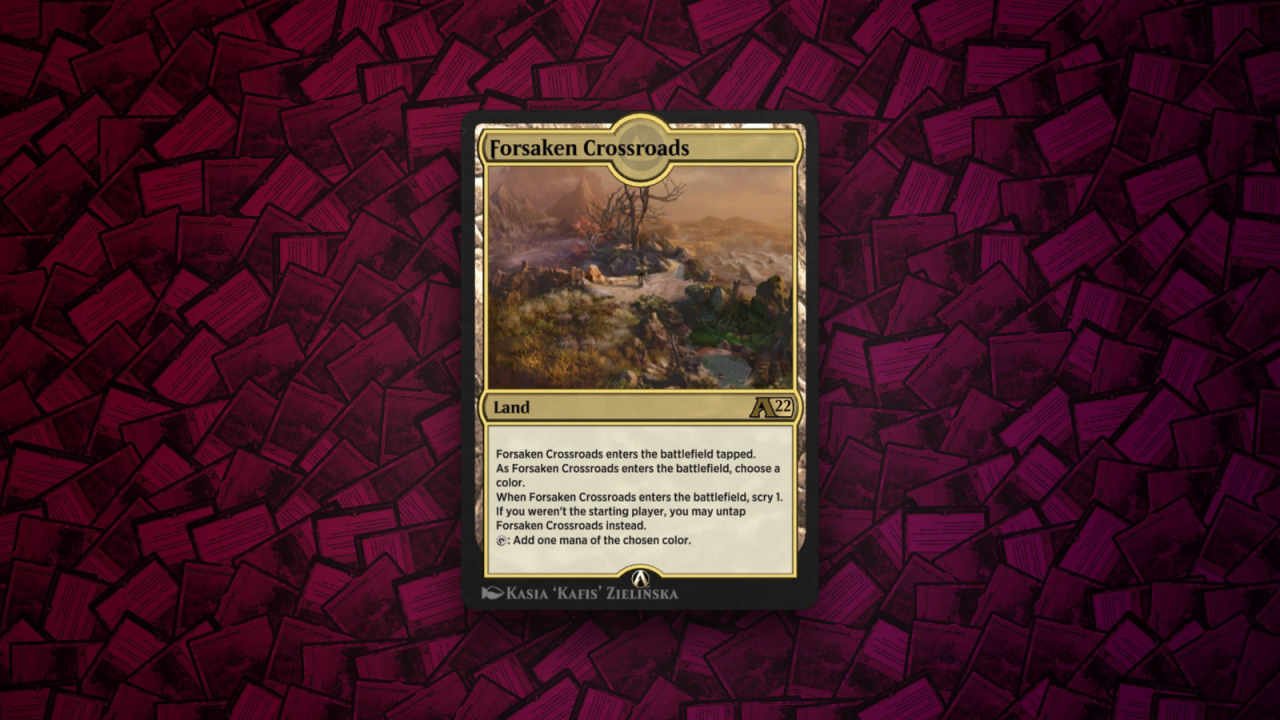
10. The land that conceded Magic has a fairness problem
Of everything on this list, Forsaken Crossroads is the dullest to look at. It is also the clearest evidence of Alchemy’s willingness to prod at Magic’s foundations.
It arrives tapped, hands you a color of your choosing and scries on entry. If you weren’t the starting player, you’re allowed to untap it right away.
Sit with that for a moment. Here is a land built expressly to soften the penalty of going second. Magic rarely acknowledges the play/draw imbalance this openly. Rather than pretend the problem didn’t exist, Alchemy designed a card around it.
Crossroads ended up relevant far beyond its home format, turning up in Historic, Brawl and other Arena environments. It never single-handedly wins a game, and that’s precisely why it belongs here. Printing monsters wasn’t Alchemy’s only mode. Now and then the compelling idea was the understated one.
9. A one-drop handed a digital-only upgrade
Symmetry Sage is the first entry that isn’t exclusive to Alchemy, and you can’t separate it from the format’s approach to rebalancing. Wizards took the digital printing from a 0/2 to a 0/3 and raised the power it hands out via its Magecraft trigger, which sets a creature’s base power to 3 each time you cast or copy an instant or sorcery.
Just like that, a one-drop that was already intriguing became a genuine threat in aggressive blue decks.
People tend to undersell this side of Alchemy. Wizards could ship an alternate version of a card for digital play while the physical copy in somebody’s binder stayed untouched. The Sage found its best home in Historic, alongside cheap wizards able to abuse that power-setting ability.
It wasn’t a card created for the format. It was proof that digital rebalancing could rewrite an existing card’s competitive identity on the spot.
8. One-mana removal, with strings attached
Start with one of Magic’s strongest effects, bolt on a suitably peculiar downside, and Fragment Reality is what comes out. A single white mana, instant speed, exile a nontoken artifact, creature or enchantment. Then, in the manner of Generous Gift, Path to Exile and Chaos Warp, your opponent pulls a random creature card of lower mana value from their library.
That gamble is the entire card. You aren’t merely removing a permanent — you’re wagering that whatever replaces it frightens you less than what you exiled.
It was efficient enough that Fragment Reality escaped Alchemy altogether. Wizards eventually retuned it once a particularly ugly interaction with Leyline options produced a reliable Historic and Timeless strategy, narrowing it to targeting an opponent’s permanent.
Not many cards illustrate the format’s central promise so neatly: balance around an interaction, then adjust after the fact once that interaction turns sour.
7. The dragon discount that sticks
Fearsome Whelp appears to do nothing until you watch a few turns pass. At the start of your end step, it permanently trims the cost of the dragon spells sitting in your hand.
Tribal cost reduction is old technology, running from Dragonspeaker Shaman to the Ur-Dragon. Permanence is the wrinkle. Keep the Whelp alive for a stretch and the dragons you’ve been stockpiling become dramatically cheaper, with the discount snowballing the further the game goes.
Wizards slotted Fearsome Whelp into the early rebalances, which says plenty about how quickly that snowball could escape control. It is hardly the format’s showiest creature. It is a tidy example of Alchemy’s taste for cards that grow scarier the longer they stick around.
6. Four mana, two creatures, one extremely crowded deck
Inquisitor Captain scans as harmless. Put it in the right shell and it’s a four-mana explosion of value.
Its ability sifts a wide pool of cheap creatures spanning your graveyard, hand and library, then leans on Seek to locate two that qualify, dropping one onto the battlefield and returning the other to your library. Stuff your deck with cheap bodies and that density converts straight into board presence.
The Captain became the poster child for how Alchemy’s digital mechanics could generate interactions less predictable than ordinary Magic cards allow. Wizards rebalanced it in a batch with other early Alchemy cards, Town-Razer Tyrant, Goldspan Dragon and the previously mentioned Fearsome Whelp among them.
Even after the nerf, the shape of it remains fascinating, and it’s not something the traditional version of the game offers often.
5. Yes, the actual Power Nine
Alchemy produced no shortage of powerful cards. Almost none of them put the Power Nine into your deck.
Oracle of the Alpha does exactly that. The three-mana blue bird wizard hits the battlefield and conjures Ancestral Recall, Black Lotus, the five Moxen, Timetwister and Time Walk, then shuffles the lot into your library.
The absurdity is deliberate. The Power Nine are the most celebrated and least obtainable cards Magic has ever printed, and Alchemy concluded that in a digital setting there was no reason you shouldn’t get to play with them occasionally.
Oracle isn’t the most efficient creature here, and fixating on that misses what it’s for. Nothing else captures the liberty of Arena’s digital card pool so completely. It could never work in sanctioned tabletop Magic, which is exactly the case for including it.
4. A small doorway into Magic’s back catalog
Key to the Archive may be the finest advertisement the spellbook mechanic ever received. Four mana already buys you a handy source of colored mana, but the appeal is the curated menu it presents on entering the battlefield.
Demonic Tutor. Time Warp. Counterspell. Day of Judgment. Lightning Bolt.
Because you can’t know which one you’ll get, it never feels like a conventional tutor. Every activation nonetheless delivers a spell capable of reshaping the whole texture of a game.
Less an artifact, more a door.
3. The land-destruction dragon Wizards kept filing down
Town-Razer Tyrant demonstrated early just how far Alchemy could stretch Magic’s design boundaries. On entry, the four-mana dragon takes aim at an opponent’s nonbasic land and turns it into a ticking time bomb: sacrifice the land, or eat the damage.
Unpleasant by itself. Outright notorious against multicolor decks leaning heavily on their mana bases.
Wizards rebalanced the well-named Tyrant on more than one occasion, ultimately confining the ability to nonbasic lands and shifting the damage trigger from the opponent’s upkeep to the end step. That repair record is what makes it such a useful snapshot of the format’s early days.
Print a card like that on cardboard and you’re stuck with it. Print it digitally and the dial stays within reach.
2. The clock that refuses to stop
Rusko, Clockmaker is Alchemy boiled down into one bizarre, thoroughly irritating package.
The four-mana 3/3 does more than generate value when it lands. It conjures a Midnight Clock and keeps turning noncreature spells into further resources. Each noncreature cast grants another Clock trigger, drains your opponent and pushes your own life total up.
Try to race it. Try to grind through it. Neither experience is pleasant.
Rusko also makes the sharpest argument for why digital-only Magic feels unlike the tabletop game. The card rests on conjuring and repeatable digital effects that would be clumsy or flatly impossible to carry out with physical cards. The Clockmaker built its reputation in Historic and Brawl, yet its roots sit in Alchemy, and it demonstrates that the format was perfectly willing to pack a whole engine into a single creature.
1. The card that showed Alchemy could slip Wizards’ grip
When you need to explain how Alchemy went off the rails, Crucias is the simplest card to point to.
The four-mana Grixis creature required no assistance to take over a game. A sturdy 3/3 body, a triggered ability capable of producing a Treasure, and an unusually potent brand of card selection bolted on top.
The value itself wasn’t the issue. The choice was. Crucias let you determine what sort of value you wanted at the precise moment you wanted it, converting surplus cards in hand into whichever resource your deck lacked. Set against a standard midrange game plan, that’s a nightmare.
Wizards finally intervened and knocked Crucias from a 3/3 down to a 3/1, after black-red midrange had ridden it to one of Alchemy’s strongest-performing strategies.
There’s the format in miniature. Create something nobody could ever print on cardboard, watch it bend the metagame inside a few weeks, then reach into the code and shave a point of toughness away. Come early 2027 that option disappears, and the Oracle stops dealing out Black Lotuses to whoever asks.