

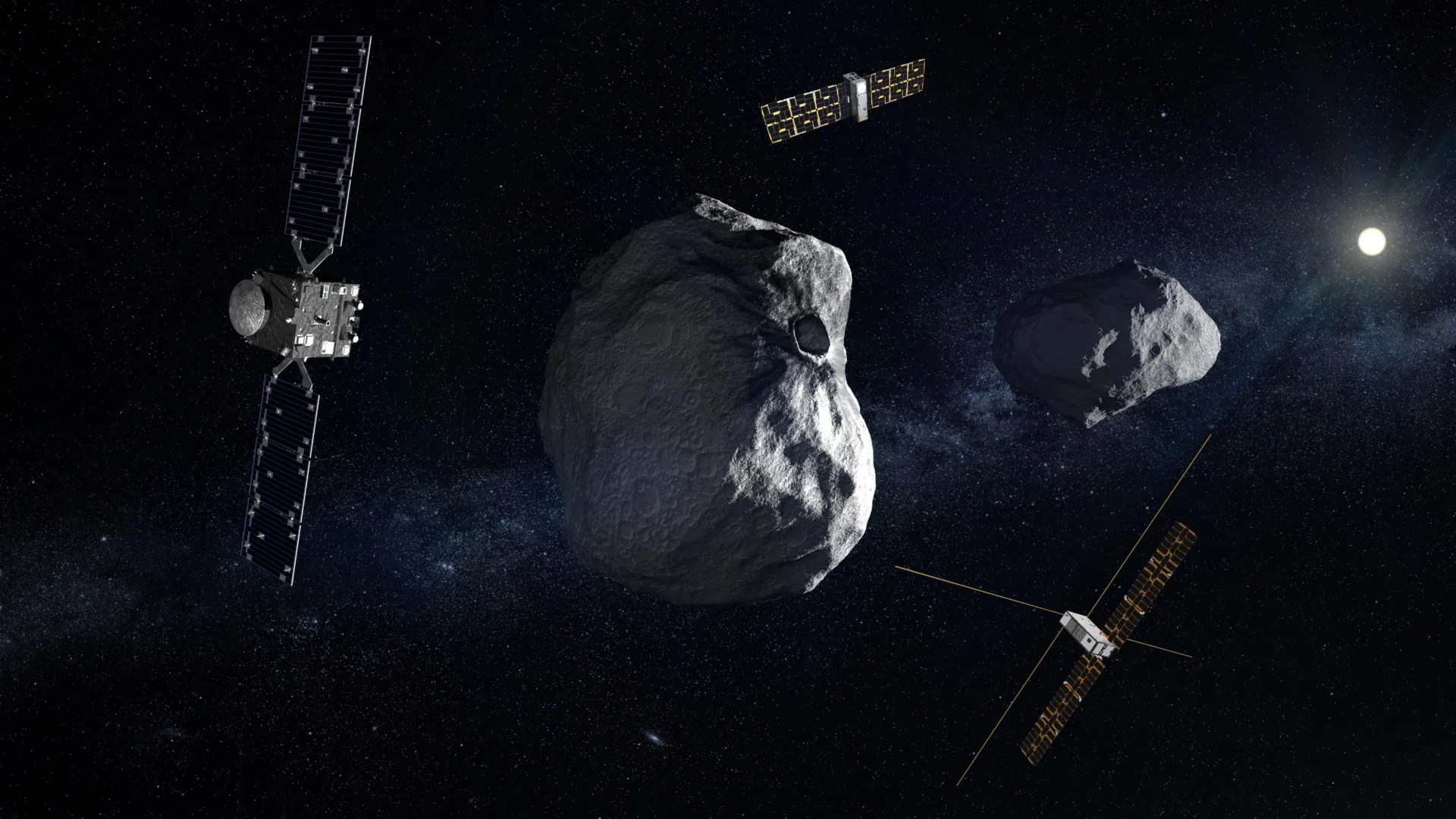
Hera travels at roughly 12 centimeters per second, about as fast as a bug scurrying over the ground. The European Space Agency’s spacecraft holds that speed while it circles a pair of asteroids, from a spot about 196.5 million kilometers from Earth.
The small-car-sized probe has arrived at the Didymos asteroid system. It now sits about 25 to 30 kilometers from the two bodies and has begun its first round of science observations.
Its focus is Dimorphos, the smaller rock of the pair. In 2022, NASA crashed its DART spacecraft into it on purpose to find out whether an impact could alter an asteroid’s course. Hera’s job is to study the aftermath.
A first full view of an asteroid after impact
ESA has named this first stage the “early characterization phase.” Its purpose is to give scientists a wide view of both asteroids and their surroundings.
“Our aim right now is to gather the big-picture findings of relevance to supporting the mission’s planetary defense goals,” said mission scientist Michael Kueppers.
Kueppers added: “During this phase, our images will reveal for the first time what a small asteroid looks like globally, having experienced a hypervelocity impact in the context of the first asteroid deflection test, when NASA’s DART spacecraft impacted it to change its orbit in 2022.”
He admitted the models disagree widely. “Previous predictions by our impact models suggested many different ways the asteroid body might react, but Hera will reveal which forecast was the correct one – if any!” Kueppers said.
Why Hera can’t fly in circles
An asteroid is a very different thing to orbit than a planet. Didymos, the bigger of the two, measures about 780 meters across, and its gravity is around 40,000 times weaker than Earth’s. Dimorphos is 151 meters wide, and its gravity is about 200,000 times weaker.
With gravity that faint, a spacecraft can’t stay in an ordinary circular orbit. Hera instead loops around the common center of gravity of the two asteroids, and it travels in straight segments.
On a cycle of three days, then four, then three again, Hera fires its thrusters as it moves away from the asteroids and makes a 90-degree turn. ESA calls the paths these timed burns create “rectangular orbits.” They hold the probe 25 to 30 kilometers from the pair.
ESA developed the approach from lessons on its Rosetta comet mission, and it is safe by design. A failed burn sends Hera drifting away from the asteroids, so it can’t fall into them. The slow speed also means each adjustment burns very little propellant.
Next up: bowtie paths
Next month, Hera should begin its “detailed characterization phase,” which brings it much nearer to Didymos and Dimorphos. The rectangles will be replaced by more complicated hyperbolic trajectories shaped like bowties, beginning at about 20 kilometers away.
Further into the mission, Hera will deploy two shoebox-sized CubeSats. These will get closer to Dimorphos than the main spacecraft and collect more measurements, and the mission is planned to move on to landing operations eventually. Hera has several instruments of its own on board for studying the asteroid as well.
The questions DART couldn’t answer
DART struck Dimorphos on September 26, 2022. The 580-kilogram probe hit at about 6.1 kilometers per second and kicked up a cloud of debris that stretched across 10,000 kilometers of space.
The test succeeded. Dimorphos now completes its orbit of Didymos about 33 minutes faster, proof that slamming a spacecraft into an asteroid can shift its path.
What the collision did to Dimorphos itself is still unknown. The impact may have carved out a large crater, or it may have changed the shape of the entire asteroid.
The orbit also shifted far more than computer simulations had forecast. Scientists believe more precise figures for Dimorphos’ composition, internal structure and mass could account for the difference.
Those figures are needed if the technique, known as kinetic impact, is to become a reliable form of defense. Knowing how different types of asteroids respond to a strike would let researchers better predict the outcome of an attempt to divert a dangerous one.
Who’s at the controls
Hera is operated from ESA’s ESOC mission control center in Darmstadt, Germany, where controllers talk to it for about eight hours each day.
Communication goes through four Deep Space Antennas, each 35 meters wide, located in Argentina, Spain and Australia. ESA’s Flight Dynamics team uses the data Hera returns to pin down the probe’s exact position relative to the two asteroids, then writes the commands that carry it from one planned point to the next. Every one of those moves is a 90-degree turn at 12 centimeters per second.