


In Brief:
- Ronin has successfully transitioned from a sovereign Layer 1 to an Ethereum Layer 2 platform using the OP Stack, facilitated by Conduit in what is termed the largest state migration in blockchain history.
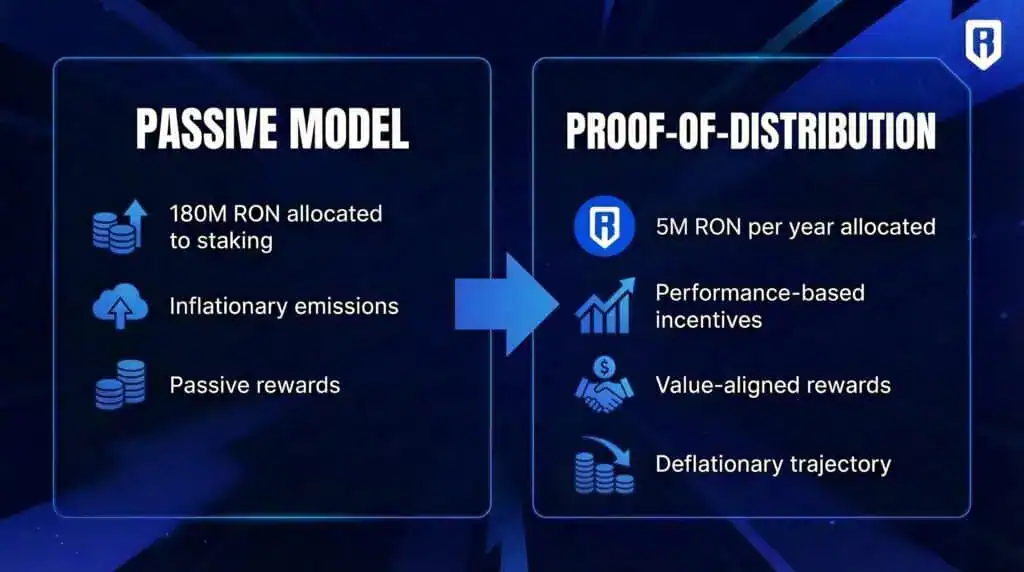
- Token emissions in the Ronin network have been drastically reduced from 45 million RON per year to 5 million RON, cutting down annual inflation to about 1.2%.
- Ronin’s Treasury now benefits from three additional revenue sources including re-allocated staking funds, sequencer profits, and a significant increase in marketplace fees.
Successful Migration and Network Enhancements
Ronin has officially completed its shift from being an independent sidechain to becoming a Layer 2 on the Ethereum blockchain using the OP Stack, as of today, May 13. This shift was executed with minimal interruption, keeping the network live and operational promptly after the transition.
Emissions Overhaul
A significant aspect of Ronin’s migration is the restructuring of its tokenomics. The annual RON emissions have been curtailed by 9x, dropping from 45 million to a mere 5 million RON per year. This reduction sets the annual inflation rate at roughly 1.2%. All future emissions will now be distributed through a new system dubbed Proof of Distribution, which allocates rewards to builders based on their contributions to the ecosystem. This merit-based system is designed to align closely with metrics that correlate with RON’s market valuation. For instance, under this new system, Craft World, an early registrant, might garner up to 40,000 RON per month from a proposed monthly pool of 410,000 RON.
Enhanced Treasury Revenue Streams
The migration has also expanded Ronin Treasury’s revenue streams. It has integrated an additional 90 million RON initially set aside for staking rewards, retained net profits from sequencer operations (after accounting for expenses), and raised the marketplace transaction fees from 0.5% to 1.25%. These enhancements are part of broader efforts to boost the treasury’s monetary base, which now discontinues direct staking rewards to individual RON holders, redirecting all benefits to ecosystem builders.
Impact on Ronin Users
For users of the Ronin network, the operational experience remains largely unchanged post-migration. RON continues to serve as the gas token, with improved transaction speeds and security boosted by Ethereum’s robust framework. The liquidity dynamics on platforms like Katana and the status of tokens such as AXS, SLP, and PIXEL remain stable, requiring no immediate action from token holders. Standard validators are set to receive their deposits of over 250,000 RON directly, whereas governing validators are slated for a governance vote to relinquish their roles following the transition. Users holding wrapped RON (wRON) on platforms like Coinbase will need to facilitate its movement from Ronin to Ethereum post-migration.
Looking Forward
This strategic pivot aligns Ronin with the recent vision advocated by the Ethereum Foundation, focusing not only on scalability but also on differentiation and customization of Layer 2 solutions. Ronin’s integration brings its significant gaming ecosystem, which includes titles like Axie Infinity AXS $0.9325 ▼ -7.2%, Pixels PIXEL $0.004866 ▼ -4.9%, and Cambria, into closer synergy with Ethereum’s vast network. To date, Ronin has managed approximately $4.2 billion in transactions predominantly from Axie Infinity, showcasing its pivotal role in Ethereum’s expanding landscape.