

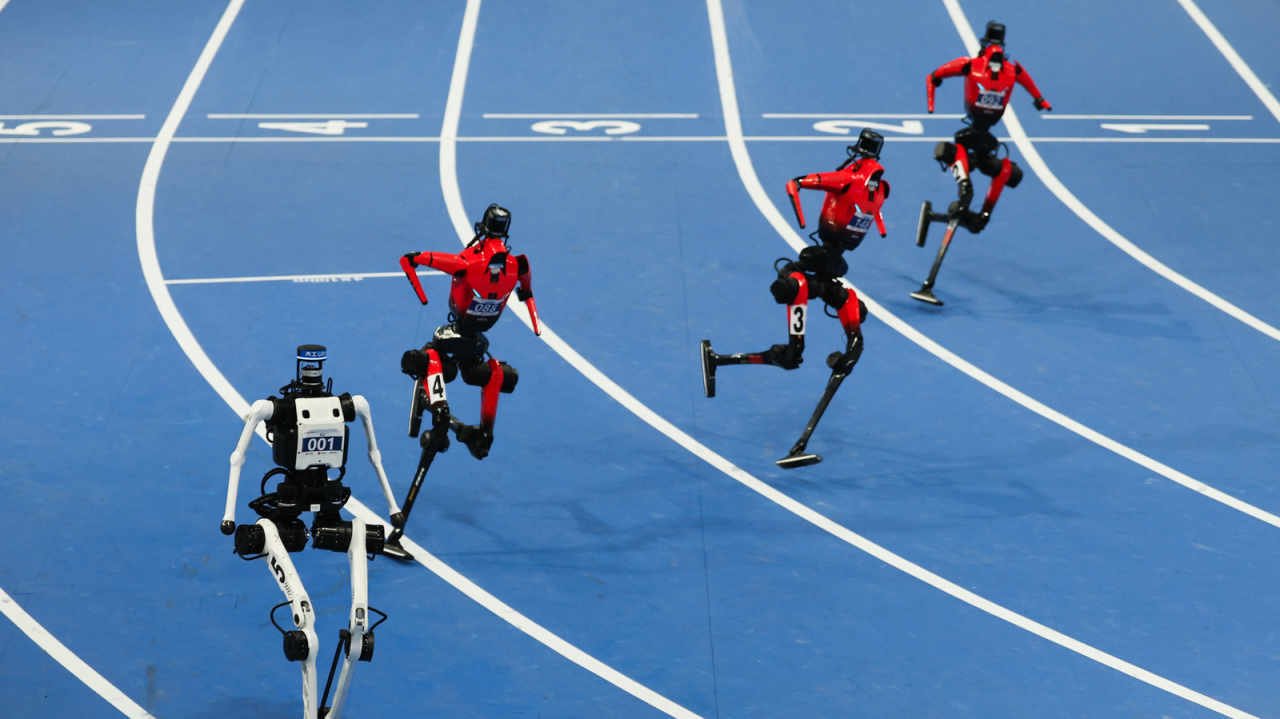
Set in 2009, Usain Bolt’s 100-meter world record of 9.58 seconds hasn’t budged. But as of this week it carries a footnote it didn’t have before: it’s the fastest a human has gone.
During a preliminary heat at the second annual World Humanoid Robot Games in Beijing, a machine named Tiangong Ultra covered that same distance in 9.39 seconds. Not the final — a heat.
The finish line is where it gets stupid
Watch the sprints and it isn’t the clock that lingers in your memory. It’s what happens after the line.
The robots blew through the finish and plowed directly into padding. A few had to be carted off the track by human handlers. Sub-9.4 speed, then an undignified faceplant into foam — again and again.
Which is why none of this should be taken as proof that humanoids are ready to clock in for commercial work. A machine that outruns every person alive but needs a crash mat to come to a halt isn’t fixing anybody’s labor shortage just yet.
Nine point three nine, from 21.5
The figure that genuinely counts here has nothing to do with Bolt.
At the inaugural World Humanoid Robot Games a year ago, Tiangong Ultra took the 100-meter dash in 21.5 seconds. Twelve months on, same robot family and same event: 9.39 seconds. That trajectory is the story, and it’s sharper than any curve the human record books have ever charted.
Beijing Humanoid Robot Innovation Center built the machine. It edged out Honor’s Lightning robot, timed at 9.47 seconds over the sprint — a gap of eight hundredths of a second between gold and silver, which is a narrower spread than you’d anticipate from a field of machines that can’t consistently bring themselves to a stop.
Lightning got its own back over 13 miles
Beijing likewise staged a half-marathon so Chinese firms could demonstrate what their humanoids manage over long distances, and the tumbles from the sprints followed them there.
Honor’s Lightning robot claimed gold in that race, crossing in 50 minutes and 26 seconds. It, too, went beyond a human record.
Endurance is the tougher engineering puzzle. A 100-meter dash amounts to about nine seconds of staying upright. Keep moving for fifty minutes and thermal management, battery draw and joint wear all get the runway they need to fail. Lightning dropping the sprint by 0.08 seconds and then taking the distance event says these machines are being tuned toward different goals.
Soccer, table tennis and boxing are also on the schedule
The Games began August 22 and continue through the 26, drawing thousands of robot entrants. Track and field is just one slice of it — soccer, table tennis and boxing are on the program as well.
Table tennis is the event I’d tune in for. A sprint rewards raw actuator speed along a straight line; returning a ping-pong serve calls for perception, prediction and fine motor control compressed into the same tenth of a second, and that’s a class of problem these robots have yet to demonstrate they’ve cracked.
Looking for a yardstick at next year’s Games? Ignore the sprint times. Watch instead for whether any of these machines can cross the finish line and slow itself down.