

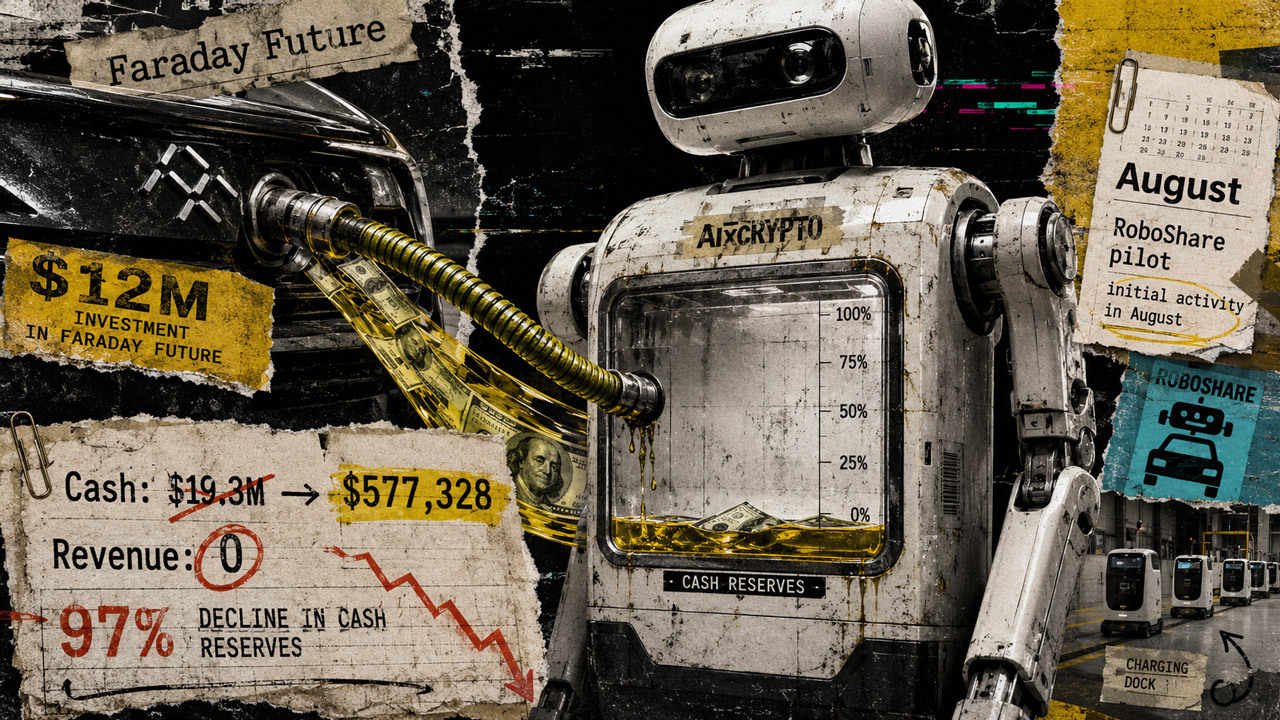
A pre-revenue company routed $12 million into securities issued by its own controlling shareholder, and closed the half-year with $577,328 left in the bank.
Compress AIxCrypto Holdings’ first six months into a single sentence and that is it. The cash and cash equivalents line fell from $19.33 million on Dec. 31 to $577,328 on June 30 — a 97% decline.
No revenue has been booked yet. The business is developing a robot-rental marketplace under the RoboShare name while carrying digital assets on its balance sheet. As of Aug. 7, the closest thing to an operating revenue path was a Los Angeles pilot still in preparation.
Where the money actually went
Operating activities consumed $7.94 million, set against a net loss of $10.27 million for the period. Yet operations were not the largest single outflow.
Listed separately in the cash-flow statement is a $12 million financing outflow for Faraday Future securities. The same statement logs $2.11 million in proceeds from digital-asset sales — crypto being sold for cash on one side while cash left for the stock purchase on the other.

That Faraday position was made through an entrusted arrangement with Gold King Arthur Holding Limited, split between $500,000 of Class A common stock and $11.5 million of Series C preferred stock.
Now the detail that carries the weight. Faraday Future is described by AIxCrypto as its controlling majority stockholder. This is not an arm’s-length portfolio holding, then. It is capital directed into the parent that controls the company — by a company yet to record a single dollar of revenue.
The crypto side didn’t help
The fair value of digital assets slid to $5.21 million from $10.25 million at year-end, and the company recorded a $2.93 million net loss on those holdings across the six months.
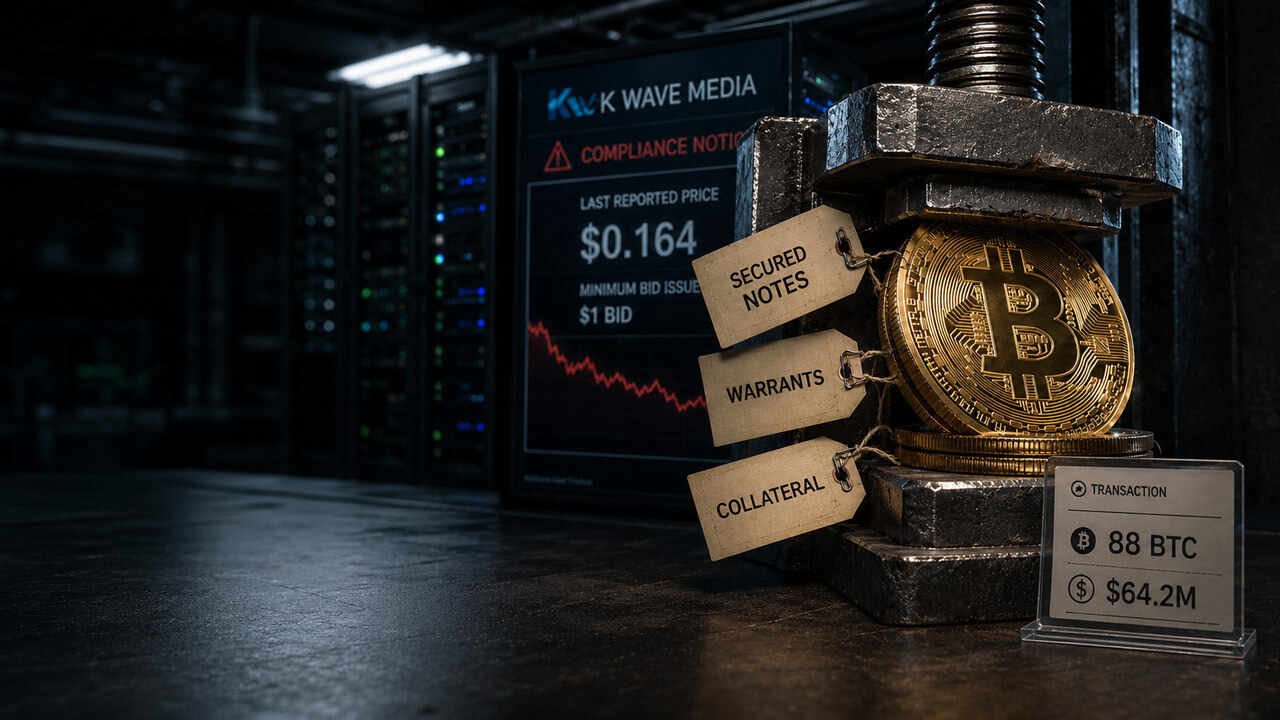
Purchases, sales, activity settled in digital assets and fair-value swings all fed into that figure, so it cannot be read as a pure measure of trading skill. The trajectory, however, is not ambiguous.
Of the June 30 portfolio, Bitcoin made up $2.70 million, or about 52%. In other words, slightly less than half of the remainder is parked in assets carrying crypto-market volatility on top of what the largest and most liquid one already brings.
No debt, but that’s not the same as no problem
The company disclosed no outstanding debt for borrowed money. Granted. Current liabilities nevertheless sat at $1.72 million on June 30, nearly triple the cash on hand.
Holding $577,328 with $1.72 million falling due is not a leverage issue. It is a timing issue — and timing bites harder when the revenue line is still described as a pilot.
That $50 million headline is a ceiling, not a bank balance
A common-stock purchase agreement has been announced that could supply as much as $50 million. The mechanics deserve more attention than the headline figure.

According to the preliminary registration statement, no draws may take place until effectiveness, and any that do stay subject to notices, market conditions and further requirements. What is on the table is a maximum commitment, not money already banked.
The pricing is the more revealing part. Shares are purchased at 93% of a three-day low volume-weighted average price, with an additional 3% draw fee layered on. That hands the buyer a 7% discount to a reference price that is already depressed, after which the company surrenders another 3% simply to access the funds.
On top of that, issuance is limited to 4,044,975 shares until shareholder approval becomes effective. Actual proceeds could therefore fall well below $50 million — and whatever does arrive brings meaningful dilution with it.
What RoboShare has to prove
RoboShare and its website were unveiled by AIxCrypto in June. In the most recent results release, the company pointed to initial marketplace activity during August and revenue in the third quarter, subject to operational readiness, execution, and applicable revenue-recognition requirements.
Those caveats carry genuine weight. Aiming for revenue within a quarter is not the same event as recognizing revenue within it, and there is still no demonstration that the marketplace can produce recognized revenue quickly enough to ease the potential reliance on crypto sales or discounted equity.
Neither funding route is free. Offloading digital assets erodes a portfolio that has already lost $2.93 million over the half. Tapping the equity facility means issuing shares at a discount.
What to watch instead of the next press release
Product announcements can be set aside. The proof that would shift this picture is rentals actually completed, customers returning to the marketplace, and revenue appearing in AIxCrypto’s financial statements.
Absent any of that, the figures to keep in mind are $577,328 in cash against $1.72 million of current liabilities — with $12 million already committed to the majority stockholder’s stock.