

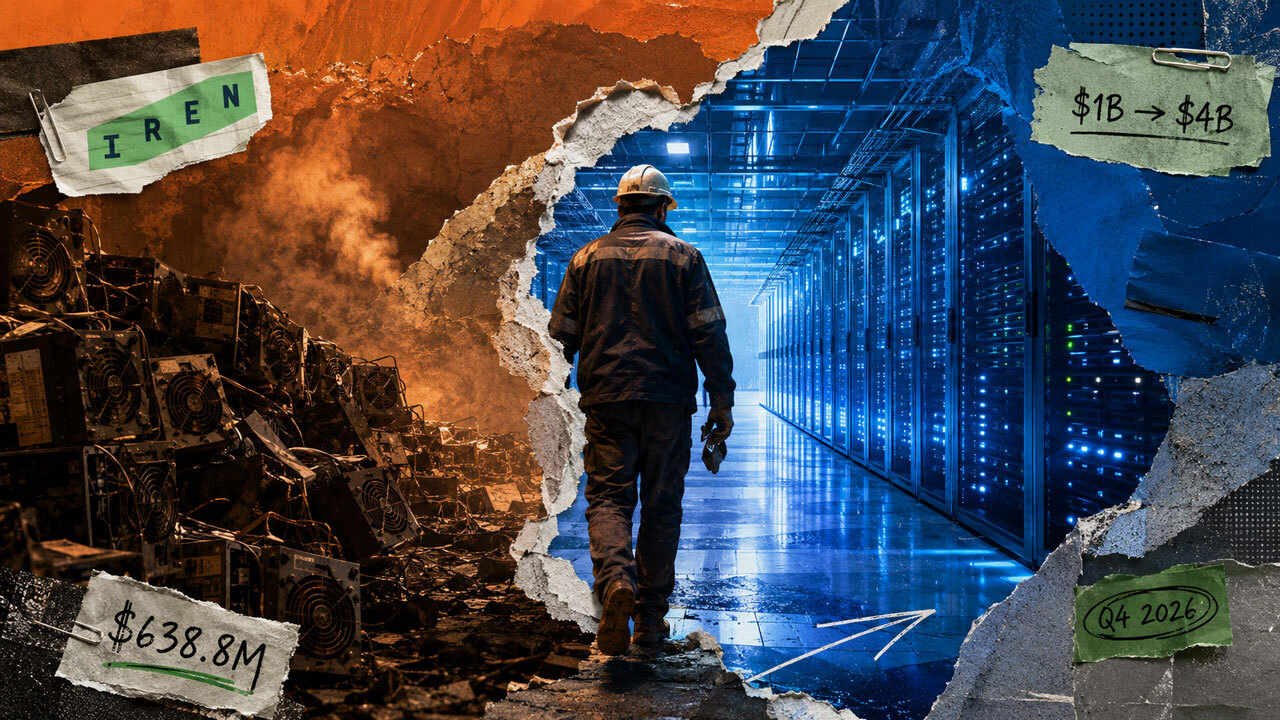
To clear room for AI tenants, IREN wrote down $638.8 million worth of mining rigs. Bitcoin still supplied 82% of the company’s income.
That contradiction sits at the heart of the fiscal 2026 results the company filed on Aug. 27. Of $707 million in revenue for the year, $578.2 million — roughly 81.8% — came from mining Bitcoin. AI Cloud Services accounted for $128.8 million.
IREN describes itself as a business mid-transformation. Its own figures suggest the transformation is still ahead of it.
The impairment isn’t cash, but it isn’t nothing
That $638.8 million write-down is non-cash and stems chiefly from retiring miners as data center sites were repurposed for AI workloads. The filing also shows a $702.6 million net loss, driven in part by the impairment along with other items.
Not a dollar of the $638.8 million actually walked out the door. The charge simply assigns an accounting price to equipment pulled offline before its successor business was fully up and running. The machines that generate income get scrapped before the ones that will generate income are switched on.
A $4 billion target against $1 billion of actual operations
By Aug. 26, operating annualized run-rate revenue — ARR — stood at $1 billion, while contracted ARR tied to the company’s 2026 capacity reached $4 billion. IREN wants that bigger run rate live by Dec. 31.
Quadrupling today’s operating level, with roughly four months to do it.
How that $4 billion figure is built matters. IREN calculates ARR by taking contracted GPU pricing and multiplying it across a full year of hours, storage and related services included. That makes it an operating metric rather than GAAP revenue, and the company itself cautions that booked revenue could come in materially below it.
Bridging the difference hinges on hardware and facilities actually arriving and being signed off, and on IREN’s assumptions about utilization and pricing proving accurate.
Revenue starts at the end of a long checklist
The Form 10-K lays out the order of operations. As a rule, revenue only begins once data centers are constructed and energized, gear is installed and commissioned, performance testing wraps up, and customers formally accept the capacity.
Skip a rung on that ladder and payment stalls — the invoices don’t. Setbacks can push revenue further out while financing and operating expenses keep running, and they can activate delay or service credits.

Microsoft accepted one horizon out of four
Deliveries come in stages. August saw Microsoft accept Horizon 1. Horizons 2, 3 and 4 were slated for phased handover during calendar Q4 2026, with contractual grace periods running into the start of calendar Q2 2027.
Keep an eye on those grace periods. They’re written in precisely because every party knows timelines can slide.
380MW that still hashes
As of June 30, installed Bitcoin mining capacity remained at roughly 23.2 EH/s spread over about 380MW. IREN’s stated goal was to substantially finish shifting that data center capacity to AI Cloud Services before the year closes.
In other words, the very megawatts behind $578.2 million in mining revenue are supposed to be powering another company’s GPUs inside of a few months.
The financing carries its own clock
Slippage has a direct price tag. To fund GPUs for the Microsoft agreement, IREN secured a delayed-draw loan priced at one-month SOFR plus 2.25% alongside senior notes carrying 5.96%, with tranches subject to conditions.
Separately, a Mackenzie facility of up to $2.4 billion comes at a fixed 9% and matures 30 months from each applicable staged funding date. That 9% keeps accruing regardless of whether any customer has accepted a thing.

Two names, most of the book
IREN says Microsoft and NVIDIA jointly account for a substantial majority of its contracted revenue. Fresh customers broaden the client list, yet acceptance, performance and counterparty exposure stay concentrated.
Swapping commodity Bitcoin income for contracted AI income trades price risk for counterparty risk. There’s a cost to either one.
What to actually watch
The contracts IREN holds could, on a run-rate basis, stand in for the mining business. What the filing doesn’t demonstrate is that the swap has already happened.
The evidence to look for next isn’t a fresh ARR headline. It’s customers signing off on the deployments that remain, and the GAAP AI revenue that starts flowing from them. Until Horizons 2 through 4 make it through commissioning and acceptance, IREN remains a Bitcoin miner sitting on a hefty AI order book and a $638.8 million hole where its old machines used to be.
Bitcoin is +0.67% over the past 24 hours and currently sits at rank #1 by market cap.