

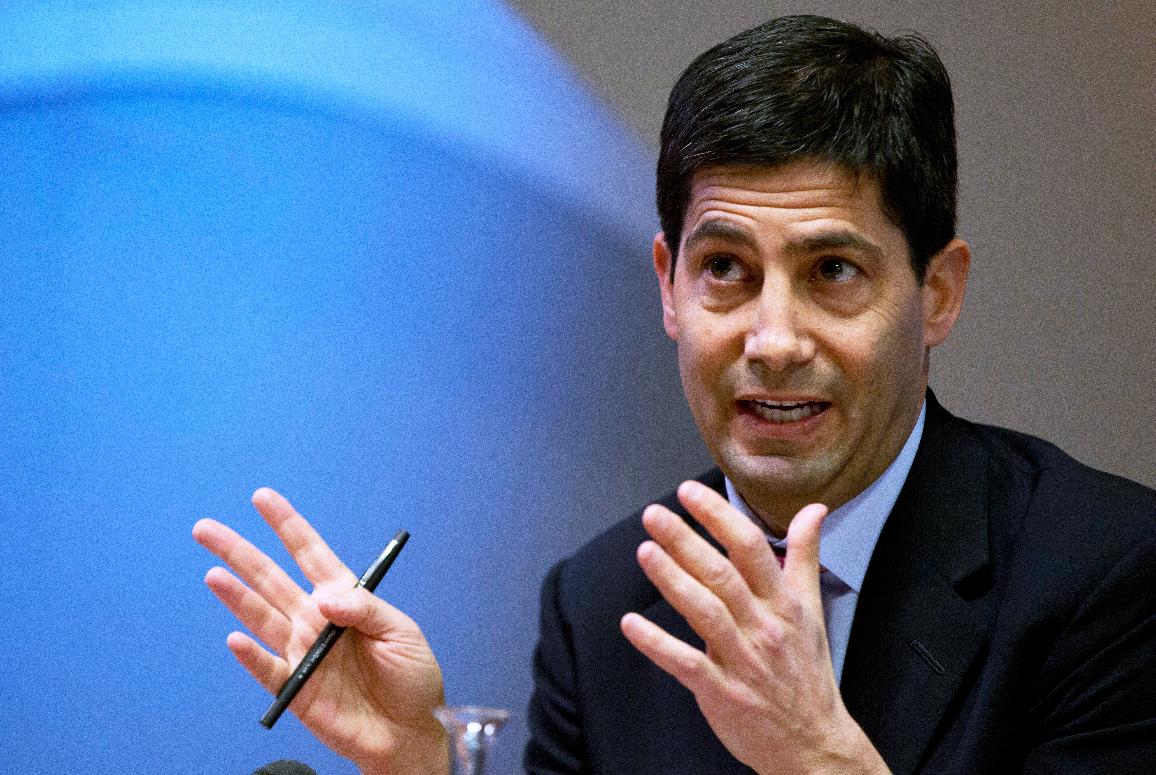
On Monday, Federal Reserve Chairman Kevin Warsh described three ways artificial intelligence could play out. The first is a boom and the second is trouble for jobs. In the third, the technology doesn’t live up to its promise.
Warsh spoke in San Francisco to a task force he assembled to look at productivity and employment. He told the group that AI “will have significant impact on the economy, with important implications for monetary policy down the road.”
He said he has a point of view. “I stress that while I’m not here to offer predictions, I’m not exactly impartial about American leadership in a time so filled with both challenge and possibility,” Warsh said in remarks prepared for the productivity and jobs task force.
The downside case for the AI trade
The third scenario is the one in which, in Warsh’s words, AI could “disappoint.” He spelled out what that would look like.
“After significant capital investment and stock market gains, expected returns could turn down and equity valuations could fall, leading to an economic slowdown and a more notable rise in unemployment,” he said. “In time, the economy would recover, but without the productivity gains.”
Central bankers rarely say this kind of thing in public. Expectations around AI have driven stock market valuations up, and companies have raised capital to stay in the race. In Warsh’s bad case, those bets fail and workers pay for it through job losses.
The best case and a weaker one
Since he took over as Fed chair, Warsh has promoted the hopeful version. There, AI lifts productivity, acts as a disinflationary force and pushes real economic growth above its current range, with employment holding close to full capacity.
He also described outcomes he called “less positive.” The main one is automation replacing workers and driving unemployment higher.
A different term for AI
Warsh avoided the phrase artificial intelligence in his remarks. He said “super intelligence” and described it as “an entirely new force in economic life and society” that is already reshaping economic activity.
His choice of words matches a recent order from President Donald Trump directing the U.S. government to use “super intelligence” almost exclusively instead of AI.
The lineup
Business leaders, economists and academics sit on the conference’s panels. The event ends with a fireside chat between Warsh and Marc Andreessen, who leads the task force and is an AI advocate and co-founder of Andreessen Horowitz.
Warsh has created five task forces in total. The remaining four deal with Fed communication, data reliance, balance sheet policy and inflation frameworks.
According to Warsh, the San Francisco stop was his first visit to a regional bank.