

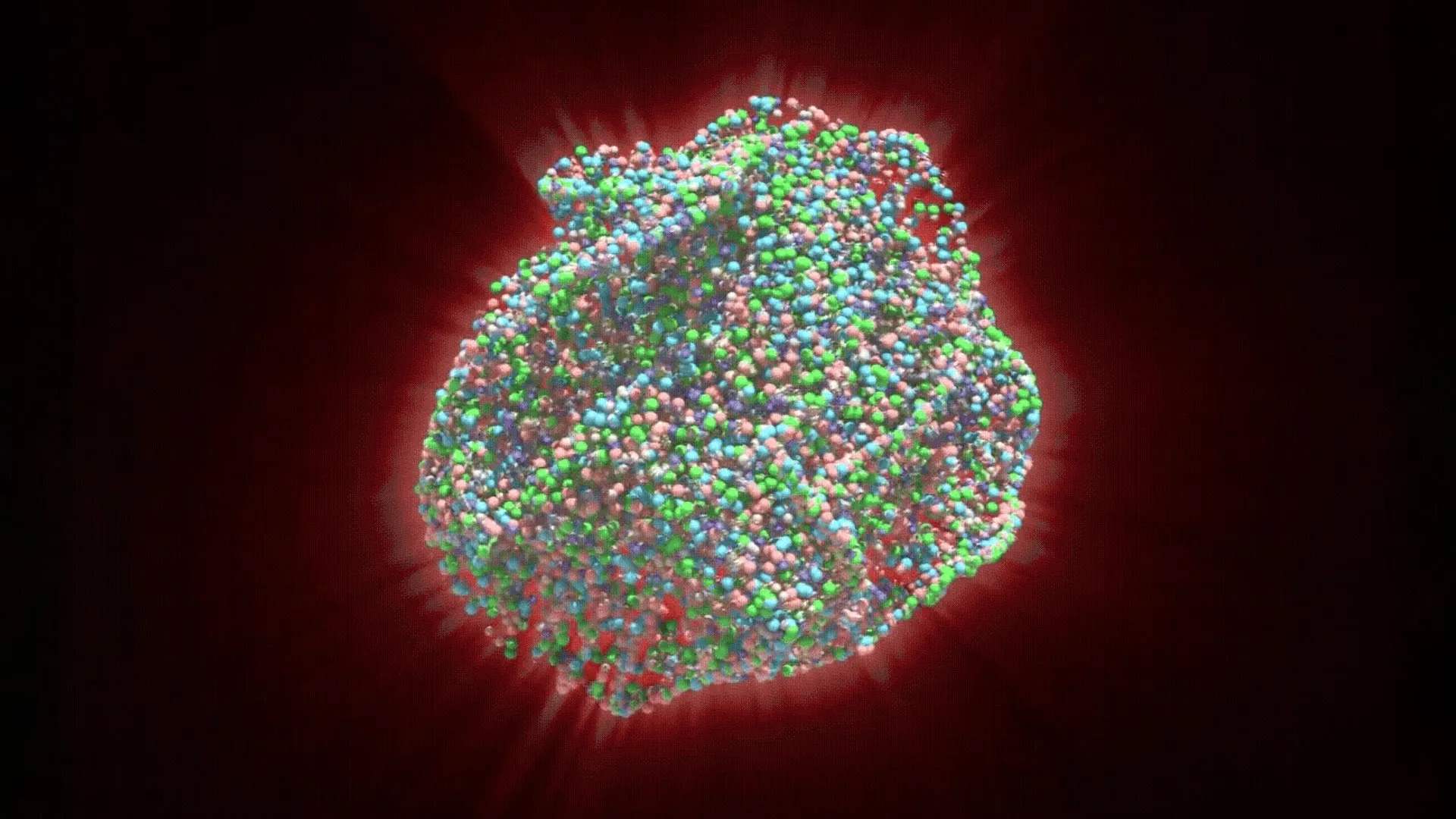
Physicists long assumed that recreating the matter of the newborn universe meant colliding lead nuclei. All four of the Large Hadron Collider’s major experiments now report signs that oxygen and neon can do the job.
Each of the four collaborations (ALICE, ATLAS, CMS and LHCb) found evidence that quark-gluon plasma can appear when these far lighter nuclei smash together. The findings come one year after the LHC carried out its first oxygen collisions.
The results cut against an old assumption about how much force it takes to produce one of the most extreme substances physics knows of. They also give researchers new ways to probe the universe’s first moments.
Why lead was supposed to be the minimum
Quark-gluon plasma, or QGP, forms under huge heat and pressure. At temperatures more than 100,000 times hotter than the center of the Sun, protons and neutrons lose their usual structure and come apart into quarks and the gluons that normally hold them together.
The entire universe is thought to have existed in this state for the first millionths of a second after the Big Bang. Close to 14 billion years on, the LHC can recreate those conditions for an instant by firing atomic nuclei into each other at very high energies.
Lead became the default for good reason. A lead nucleus weighs more than 200 times as much as the protons the LHC normally collides, so lead collisions were the obvious route to the extreme conditions QGP was believed to require.
Cracks in that view have been showing for some time. Earlier this year, ALICE, the collaboration focused on quark-gluon plasma, found a further sign of QGP in proton-proton and proton-lead collisions. A year before that, LHC researchers reported the first hints of the plasma in oxygen-oxygen collisions. The latest work goes beyond those hints, with several independent signals across both oxygen and neon.
Jets that come out lopsided
The clearest way to test for QGP is to track energetic quarks and gluons as they travel through it. The hot, dense medium saps some of their energy on the way out, an effect physicists call parton energy loss.
ATLAS observed this plainly. The team examined pairs of particle jets, the narrow sprays of particles produced when energetic quarks and gluons fly out of a collision, in oxygen-oxygen and neon-neon runs. The two jets in each pair carried unequal energy, a sign that particles lost energy passing through the surrounding material.
The mismatch was largest in central collisions, where the nuclei meet head-on. Those collisions should create a larger volume of plasma, giving particles more material to cross and more energy to shed. That is the pattern QGP would produce.
Preliminary ATLAS results agree. When the researchers studied charged particles recoiling against photons, they saw a similar connection between energy loss and how central the collision was.
Fewer particles where plasma should be thickest
ALICE, CMS and LHCb came at the same process from a different direction, looking at how the plasma seems to reduce the output of certain energetic particles.
CMS saw suppressed charged-particle production in both oxygen-oxygen and neon-neon collisions relative to proton-proton collisions. That shortfall is consistent with particles losing energy inside QGP.
In a separate study, LHCb examined particles made of a charm quark paired with a lighter quark, comparing how strongly their production was suppressed in oxygen collisions and in neon collisions. The heavier neon collisions showed more suppression, which matches the expectation that bigger collisions create more plasma and drain more energy from particles moving through it.
Suppression by itself isn’t proof, though, since other physical processes could cause a similar effect.
ALICE dealt with that by comparing neutral pion production in oxygen-oxygen and proton-oxygen collisions. The comparison produced unambiguous evidence of parton energy loss in oxygen-oxygen collisions, the strongest individual result supporting the idea that small nuclear collisions can create QGP-like conditions.
Melting the weakest bonds first
Another signature comes from particles made of a heavy quark and its corresponding antiquark. These pairs can bind for a short time after a high-energy collision, with some bound more tightly than others. Inside plasma, the loosely bound ones should come apart more readily.
Measuring which bound states are suppressed, and how strongly, gives physicists a separate check on whether QGP formed.
CMS saw this uneven suppression in upsilon mesons, which combine a bottom quark with its antiquark, by comparing oxygen-oxygen and neon-neon collisions. LHCb reported preliminary evidence of the same effect in proton-oxygen and oxygen-oxygen data.
Particles that pick a direction
ALICE has one further possible signature, this time based on the directions particles travel after the collision.
In preliminary oxygen-oxygen results, baryons (particles made of three quarks) favored particular directions more strongly than mesons (particles made of two). This is known as anisotropic flow: particles don’t scatter evenly but emerge in patterns set by conditions inside the material the collision produced.
QGP is the leading explanation. Particles with intermediate momenta leaving the plasma can inherit collective motion from the quarks they’re made of. With three quarks against the mesons’ two, baryons can carry more of that flow, which fits the gap ALICE measured.
What changes for the physics
The jet imbalance, the particle suppression, the melting of bound states and the flow pattern all lead to one conclusion: early-universe matter can form in collisions far smaller than those traditionally used to study it. Some of the results remain preliminary, and the teams are still analyzing data from lighter nuclei in search of more evidence on how QGP forms and behaves.
In practice, physicists no longer need huge nuclei to study this state of matter, and smaller systems are now an option.
More data is on the way. CERN is upgrading the LHC into the High-Luminosity LHC, a more powerful machine that will let scientists gather substantially more collision data and examine the properties of quark-gluon plasma in finer detail.