

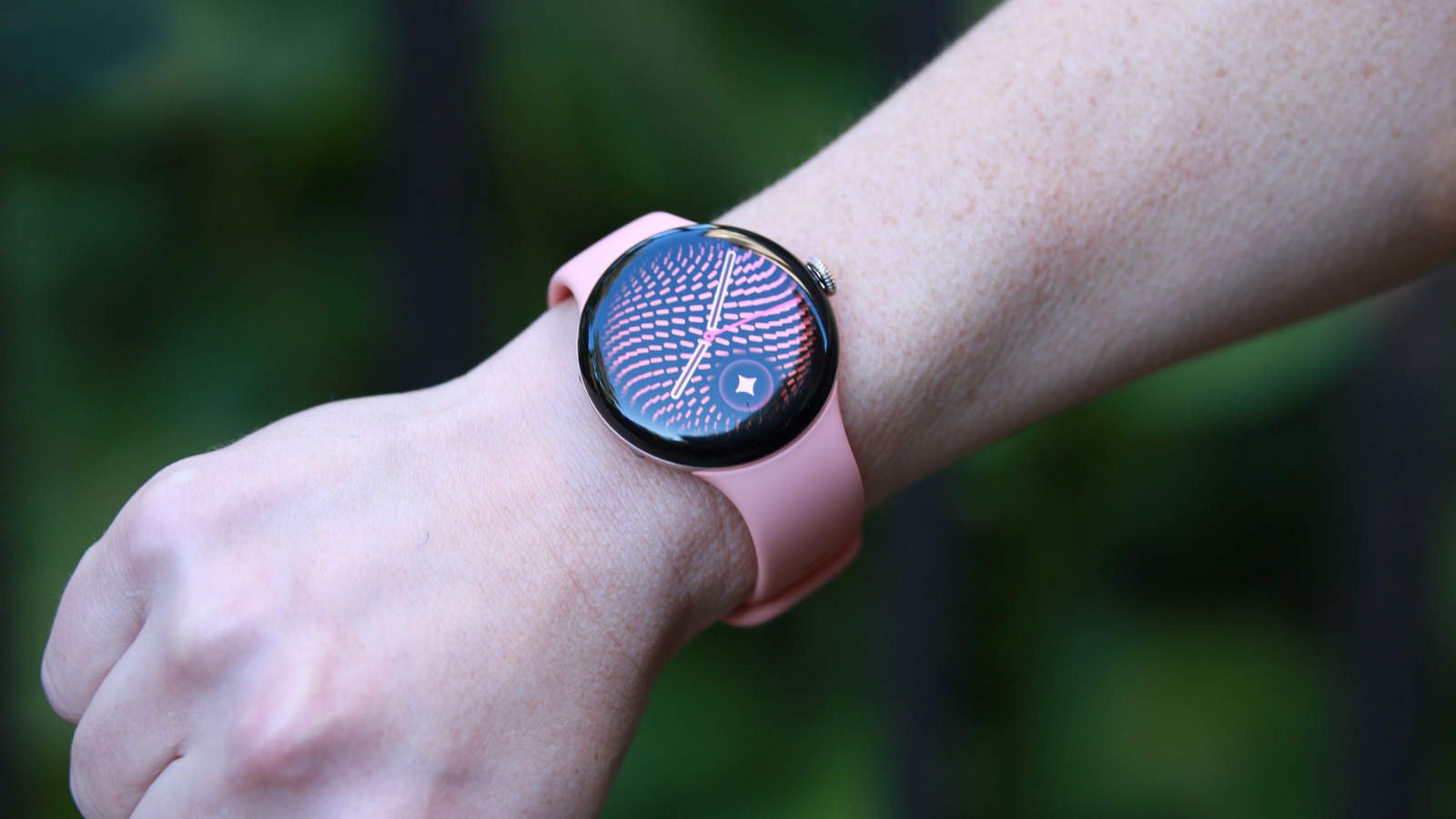
A week in, and the full picture of the Pixel Watch 5 still isn’t available to me. That’s not me hedging. Google’s custom workout builder, blood pressure trend reports and insulin resistance tracking aren’t due until September, so a meaningful slice of what’s supposed to be new about this watch simply isn’t on my wrist.
What follows, then, is a review of the watch as it ships today. I’ll revisit this piece once the remaining pieces arrive, and if they shift the score, I’ll adjust the number and flag it. My expectation is that they won’t.
The condensed take: the Pixel Watch 5 is a very good smartwatch that’s nearly indistinguishable from the Pixel Watch 4, carrying a small set of real upgrades plus one that amounts to a party trick. There’s enough here to warrant the $50 bump in price. Already wearing a Watch 4? Stay put.
On-device Gemini is the reason to care
Back when I tested the Pixel Watch 4, Gemini flatlined the second I headed out for a run without my phone. Requests to log a workout or start a timer went nowhere, leaving me to halt mid-stride and thumb through watch faces like an animal.
Not anymore. Gemini now takes care of the basics with no connection at all — timers, launching workouts, music playback, flipping water lock or Wi-Fi on and off, opening particular apps. No phone required, no cellular required, and the whole thing feels appreciably snappier because of it.
The look got a refresh too. While you’re speaking to the assistant, the bottom portion of the display glows, in keeping with Google’s Neural Expressive design language. It makes your own words easier to read and otherwise keeps to itself.
The gestures are better than they sound
Pinching twice in mid-air to summon At A Glance turned into my go-to within about two days. Nothing to tap, no awkward twisting of the wrist.
Previous Pixel Watches already handled double pinch and wrist turn, but this year Google extended what those gestures can do. Double pinch pulls up At A Glance from the watch face, opens the notification center, and scrolls content whenever a scroll bar appears — in Gemini’s replies, in your workout metrics, in the wallet app. It also switches Maps views and drives the Recorder app.
Wrist turn has become universal back navigation, and for me that’s the headline change. Rotating the watch away from yourself as a way of saying “no thanks” is intuitive in a way that gesture systems rarely manage. A back gesture that works everywhere is one of those areas where Google’s interface instincts outclass Apple’s, in much the same way that swiping in from either edge of an Android phone screen returns you to the previous page.
The At A Glance chips sit in the lower half of the display, not unlike Apple’s smart stack hints. Whenever the system reckons something is time-sensitive, a small button appears: a Lyft ride pulling up, a workout in progress, a boarding pass. Apps that tap Android’s Live Update feature ought to appear here, and a swipe up expands the view.
The GPS tracking noticed me dodging a golf cart
Google’s claim is that it engineered the “most accurate GPS route-tracking ever on a Pixel Watch.” The company drew on a global network of GPS reference stations and traces rays from GPS satellites through 3D building models to offset interference. The dual-frequency hardware carries over from last year, but Google says the new approach makes the Watch 5 two times more accurate than earlier models — and more accurate than both the Apple Watch Ultra 3 and the Garmin Fenix 8 Pro.
The Ultra 3 comparison is still on my to-do list. What I did do was walk a waterside path in Bayonne with an Apple Watch Series 11 strapped to the opposite wrist, which is a nearer price match regardless, and Google’s tracking did look marginally better. Both produced detailed maps. The Pixel logged my zigzagging; the Apple ironed it flat.
Twice I veered off the trail — once around a flock of geese, once to avoid a golf cart tearing across a bridge. The geese detour registered on both watches. Only the Pixel recorded me getting out of the cart’s path.
This isn’t a referendum on my obstacle-avoidance skills. Mapping every step correctly means your distance figure is truer, and that flows through to pace and cadence. Personally, I don’t require more precision than today’s watches already offer, and I’d argue trends deserve your attention more than any single reading. Even so, it’s a shrewd move that looks well implemented. I’d like to try it among dense city blocks before signing off completely.
Where Apple still wins on workout data
Google and Fitbit wearables have long outdone Apple’s at spotting on their own that I’m exercising. On a lengthy bike ride along the Delaware river, all three devices I had on picked up the activity without being asked. It was the Apple Watch that logged the fullest data set.
Some of that comes down to a privacy consent chain. Auto-detected walks, runs and rides tend to omit location, since you never consented to being tracked. Apple asks you to confirm the activity it spotted, which in practice secures your sign-off on the location data. That’s my interpretation, at least.
Since I’d tapped “Record outdoor cycle” on the Series 11, it reported 7.54 miles at an average of 8.8 MPH with 35 feet of elevation gain, along with a map of the trail. From the Google Health app I got 216 calories burned, an average heart rate of 104 bpm and 21 cardio CARDIO $0.00007827 ▲ +3.8% load points — figures Apple surfaced as well.
On the return leg, where I remembered to kick off a bike workout manually on the Pixel, it recorded distance, route, elevation gain and speed without trouble.
One evening I walked in the door to a notification applauding my elliptical session. Matching up the timestamp, the watch had classified my walk home as elliptical work. I guess my hips do lie. Correcting it required a single tap on a suggested chip in the app, and Google relabeled the exercise.
The AI watch faces only change the font
Feed Google’s new watch face generator a prompt and it spits out a clock. That’s the sales pitch. What you actually get is narrower.
Whatever you type, the only thing it alters is the styling of the clock font. Complication sizing and positioning remain fixed. Your choices amount to which complications occupy the four arcs encircling the clock, plus a color palette — that’s the whole menu. “Flowery nature vibe” and “woodland elves prancing around a magical forest” each return numerals in a different typeface.
My own prompts did yield attractive results, elves included, along with one I framed as “smiley faces and emoji faces in a celebratory vibe.” I still ended up back on the Photos watch face, loaded with shots of myself and the people I care about.
Two new faces have arrived, Weave and Chronograph. Both look good, and the new Multicolor complication option injects some personality. Even so, Apple’s faces are the better-looking set, especially those with dynamic clock sizes, and Google’s selection of styles is bigger.
Widgets are another matter entirely. The pages you reach by swiping sideways can be rearranged to taste, and I had a morning workout log, a recording shortcut, a timer and my favorite contacts all sitting within a swipe or two. The buttons are big and easy to land on, which counts for more on a watch than on any other device.
Setting it up took more updates than I expected
Before any real testing could begin, I had to update the Android software on the paired phone — a Pixel 11 Pro — followed by the Pixel Watch app, then the Google Health app, then reboot both devices.
After that came the Play Store on the watch itself, where I updated no fewer than eight apps, among them Health, ECG, Gemini, Messages, Pixel Watch Manager, Wear OS and Wear Media. Whenever a feature turned up missing or broken during testing, the remedy was yet another toggle tucked away in settings. Gemini. Gestures. Proactive Intelligence.
Take that as a heads-up. Pick up any smartwatch on release day and you’ve committed yourself to an afternoon of updates and settings menus.
Sleep tracking got 15 percent more accurate, allegedly
I slept with it on and was informed I’d managed 8 hours and 37 minutes, which I’ll happily accept. Google has revised its machine learning models and maintains that the resulting accuracy gain — 15 percent, by its reckoning — makes sleep tracking fundamentally more dependable.
Verifying that is beyond me. Was it genuinely 50 minutes of deep sleep where a Watch 4 might have logged 48? This is gooey science at best. Follow your trends, not your minutes.
Almost all of what’s new here is headed to the Pixel Watch 4 as well — sleep breathing quality, blood pressure and insulin resistance trend tracking, the custom workout builder and “advanced strength training” among them. None of it was available for me to test. Nor does it alter the buying advice.
Google has also built on the loss of pulse detection alerts it launched in 2024 with a feature it dubs breathing emergency detection. For now it’s limited to a handful of European countries, and barring a sustained drop in my oxygen saturation, there’s no way for me to put it through its paces. Our editor in chief Aaron Souppouris has volunteered as tribute.
Battery anxiety isn’t really a thing here
Charging speed on the Pixel Watch 5 is unchanged from the previous model, which is no problem, since the Watch 4 was already fast. In the space of a few minutes I went from around 3 percent to roughly 20 percent and headed into a 45-minute workout class without fretting about losing my metrics.
So far it’s held even with the Apple Watch Series 11 in my testing, with both stretching to nearly two full days. Various software builds have been running throughout this review, so consider that provisional; I’ll revisit it once things stabilize.
Set against the Fitbit Air that I’ve worn every day since reviewing it in May, the Pixel’s endurance falls short, meaning more trips to the charger. The Fitbit tops up quickly enough that it never crosses my mind, though it does mean hauling a charger around with me.
The hardware is the Watch 4 with a nicer chip name
In physical terms, this is the Pixel Watch 4. Google’s own comparison chart notes a minor display distinction, crediting the newer model with a 320ppi AMOLED panel while the older one is simply labeled “custom.” Day to day, they’re identical.
Peak brightness reaches up to 3,000 nits, matching last year. At that level it’s perfectly legible. Switch to battery-saving mode and the dimmed screen genuinely made words hard for me to pick out.
Inside sits a Snapdragon W5 Gen 2 Accelerated, as against the Watch 4’s Snapdragon W5 Gen 2 — the same silicon with additional memory and modestly higher clock speeds. Both carry IP68 dust and water resistance.
That domed glass case and display continue to make the Pixel Watch feel more fragile than a Galaxy Watch 9 or an Apple Watch Series 11. I’ve yet to break one, and the repairable design means it doesn’t keep me up at night. This is still the only mainstream smartwatch with a screen and battery you can replace, and that’s worth something.
The review unit I received is peachy canyon, a match for my Pixel 11 Pro in the same finish. Less delightful: after a week, dark staining had crept along the edges of the band. My new black purse leeching color may be the culprit. Swapping in a replacement band costs anywhere from $50 to $200.
Who should buy it
If you own a Watch 4, sit this one out. Everything that matters is coming to your watch regardless.
For everybody else, this is a solid smartwatch with gestures that are actually useful, on-device Gemini that at last works with your phone left behind, and route tracking that spotted a golf cart the Apple Watch didn’t. I remain uneasy about the Google Health features walled off behind Premium, although the app is a perfectly clear place to store your metrics even without AI Coach.
The extra $50 buys enough to justify itself. Just don’t expect the September features to be waiting inside the box.