

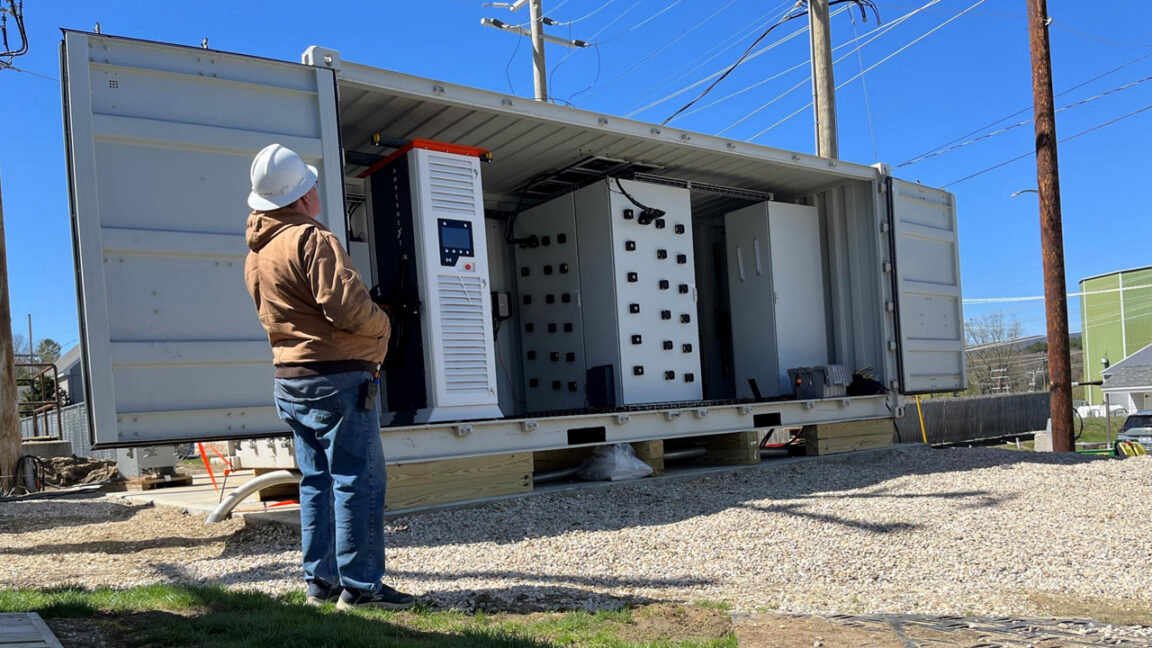
Inside a shipping container in Lenox, Massachusetts sits a transformer measuring roughly 1 meter by 1.5 meters by 2 meters. Drawing from a live grid line, it has pushed as much as 1 megawatt while charging an electric vehicle battery — dropping the voltage and turning AC into DC inside a single enclosure. It arrived in May 2026 and heads back to North Carolina in September.
As demonstrations go, it’s the strongest signal so far that the hardware utilities have spent years hoping for may end up coming from firms with no transformer business today.
The 1880s design still running your grid
Today’s transformers are put together by hand, and their core design traces back to the 1880s. Workers wind two copper coils by hand around a steel core; the resulting electromagnetic fields raise voltage for long-haul transmission or lower it for homes and businesses.
Mass manufacturing isn’t an option for the biggest units. Every one is built to order for the substations of a particular utility.
Hence the delivery times, which now stretch to several years. That backlog does more than hold back new grid capacity for growing demand — it’s also delaying swap-outs of transformers that have already aged out.
Semiconductor switching instead of hand-wound copper
Solid-state transformers handle voltage conversion through high-frequency semiconductor switching, and materials such as silicon carbide make them suitable for mass manufacturing. They weigh less and take up less room. Because the designs are modular, components can be swapped or upgraded. And one unit can perform several functions simultaneously.
It’s that final capability that drew interest from the firms constructing the largest AI data centers. Those sites are shifting toward direct current power architectures to supply server racks packed with power-hungry AI chips, and a solid-state transformer can pull AC directly from the local distribution network and return the DC those racks require — with no additional device handling the conversion.
“It’s kind of this one magic box that eliminates a lot of the infrastructure and also provides one control location that eliminates a lot of the interoperability challenges that you may see in a traditional data center, where various components within the data center are trying to regulate the same thing,” said Srdjan Lukic, a professor of electrical and computer engineering at North Carolina State University. “Now you have one conversion stage outside the data hall and then you just go straight to the rack.”
Where the money went
According to Lukic, data centers are the “killer application for solid-state transformers right now.” Three US companies — Amperesand, Heron Power and DG Matrix — have collectively raised more than $280 million over the past year to bring the technology to market.
What developers are being sold isn’t just an elegant piece of engineering. As Lukic described it, the approach reduces the copper and other materials a build requires, and the tighter footprint frees floor space for other uses.
Whether the benefits reach everyone else comes down to manufacturing. Successful commercialization could loosen the transformer supply squeeze across the board, leaving more units on hand for grid work entirely unrelated to AI.
“There are relatively few specialized companies that manufacture [conventional] transformers, while solid-state transformers are like an electronics device,” Lukic said. “It completely opens up the space for who can play in the transformer space, and also opens up where transformers can be manufactured.”
What’s actually inside the Massachusetts box
Three pieces make up the unit being tested: an active front end that interfaces with the grid, an AC/DC converter, and a high-frequency isolation transformer capable of shifting voltage in either direction. That isolation component proved the toughest challenge, Lukic explained — it was custom-built to absorb the “full stress of the grid, the full distribution voltage” within so small an enclosure.
Visually, it’s unremarkable. “It looks like a big transformer box with a slightly different form factor, a big blob of what looks like steel,” Lukic said. “It replaces three blobs of steel with one blob of steel and removes a lot of the wiring and trenching that you would typically have to do for an electric vehicle application.”
Testing is happening at a power delivery laboratory operated by the nonprofit Electric Power Research Institute, and it wraps up a partnership with the New York Power Authority dating back to 2018. Eight years to run a single megawatt-class unit through one summer of live testing says plenty about the pace of this field.
The part that could reach your house
Plenty of engineering and commercialization hurdles remain. Lukic is betting that data centers purchasing these units first will “derisk” the technology for everybody else — a diplomatic way of noting that the AI buildout is footing the bill for the shakedown cruise.
“Beyond data centers, we can think about electric vehicle charging in densely populated areas,” Lukic said. “A lot of loads within our homes are now DC, so having that ability to distribute DC in modern homes will have some significant benefits.”
For anyone looking to gauge whether this pans out, the things to watch are the NC State unit’s return trip in September and what the data reveals about how it fared through a Massachusetts summer. The rest is press releases about funding.