

Connect a handset with a 20W ceiling to a 100W brick and what you get is 20W. That single sentence contains the entire fast-charging problem, and it explains why the wattage figure stamped on a charger’s packaging tells you next to nothing by itself.
These days “fast charging” is an umbrella term. Tucked underneath it are USB PD, PPS and SuperVOOC — the last of which sounds like a limit break from a Final Fantasy game. The terminology is chaotic. The actual buying decision hiding beneath it isn’t.
How we ended up with an alphabet soup
Charging over USB began life as a slow trickle of power. Then mobile devices took over, the demands placed on charging systems shifted to match, and individual manufacturers wandered off to invent their own solutions. The result is Qualcomm’s Quick Charge, Oppo’s SuperVOOC and Xiaomi’s HyperCharge — all marketed as some flavour of fast charging, no two of them identical.
Don’t read anything into the port. USB-C on a device is no guarantee that fast charging is supported at all. Plenty of USB-C hardware tops out at slower rates, while other devices rely on quick-charging methods that have nothing to do with PD. The deciding factor is the silicon inside the phone, not the shape of the hole at the bottom of it.
Squeezing everything out of fast charging comes down to pairing the device with a suitable cable and a suitable charger. Should your phone speak a fast-charging protocol that your charger doesn’t, that’s the end of the story. Piling on more wattage at the wall won’t rescue it.
USB PD is the closest thing to a universal answer
USB Power Delivery is as close to a standard as this space gets, spanning phones, tablets, laptops and a number of gaming portables. If you’re assembling a charging setup around one thing, make it this.
Later revisions extend the headroom. The maximum supported power was lifted to 240W with USB PD 3.1, and USB PD 3.2 is the most recent version of the specification. Those ceilings were written for laptops and monitors rather than handsets. Phones come nowhere near needing them, and thermal limits alone would render 240W both impractical and pointless inside a phone.
USB PD is supported on the iPhone 17 series. Fast charging on Samsung and Google handsets is built around USB PD and its PPS feature.
PPS is the part that matters on Android flagships
Among the more sophisticated USB PD features that turn up in a phone is Programmable Power Supply. It allows the device to request finer, more granular adjustments to voltage and current as it charges, which can lift efficiency and ease the heat situation.
PPS underpins the 60W “Super Fast Charging 3.0” system in Samsung’s Galaxy S26 Ultra. Google’s Pixel 11 handsets reach their top advertised rates over USB-C PPS charging, and a 45W PPS charger is what the Pixel 11 Pro is designed for. Android flagship owners hunting for a single do-it-all USB-C charger should be looking at PD with PPS.
Quick Charge is still here, but it lost
Among the earliest fast-charging systems for Android phones was Quick Charge. It’s still around, but USB PD ended up with far wider adoption across the mobile industry — so much so that later Quick Charge releases support it directly.
Nor does spotting a Qualcomm chip inside a phone mean Quick Charge is what it uses. Other fast-charging systems are available to manufacturers, and they take them.
Proprietary approaches haven’t gone quiet either. SuperVOOC-derived technologies power OnePlus and Oppo devices, while certain Xiaomi models run HyperCharge. Reaching the top advertised figures generally calls for a matching proprietary charger and, more often than not, the correct cable as well. USB-C PD charging typically works on these phones too, though the speeds you see may sit well short of the headline claim.
Treat the wattage on the box with suspicion
A handset advertised at 80W or 100W is not drawing that much power all the way from flat to full. Peak rates arrive while the battery is still fairly depleted, after which the rate drops away quickly as the cell fills. What’s printed is a peak figure rather than an average, and nearly all the marketing lives in the gap between the two.
The claim that fast charging destroys your battery is one you’ve likely encountered. It doesn’t necessarily hold up. Lithium-ion cells do lose capacity as the years pass, and heat — which fast charging tends to produce more of — accelerates that. Modern phones, however, are engineered to handle it, watching temperatures, throttling power where needed and tapering the rate as the battery nears capacity.
The fair caveat: when you’re not in a rush, fast charging brings no long-term benefit either. Other things being equal, a gentler charge that keeps temperatures lower treats the battery better.
Your habits matter more than the protocol
How you manage temperature and how you charge shape battery lifespan far more than whichever fast-charging protocol your device happens to speak. Avoid parking devices at 100 percent indefinitely. Avoid charging a phone that’s already hot in direct sunlight.
Playing games while tethered to the wall is a stress case of its own. Certain phones — the Galaxy S26 line among them — include a setting that suspends charging during gaming sessions and diverts the incoming current to running the device instead. The charge level sits still, and the phone isn’t battling heat from two directions at once.
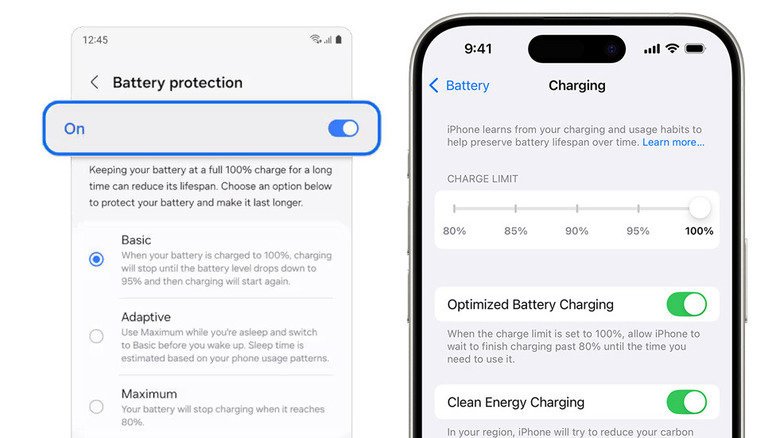
Easiest of all are the protections already baked in. Optimized Battery Charging on Apple devices studies your routine and can hold off on charging beyond 80 percent when it anticipates a long stint on the cable. On iPhone 15 and later you can also dial in a custom charge ceiling anywhere from 80 to 100 percent. Samsung offers Battery Protection, and Pixel handsets ship with Charging Optimization, which bundles Adaptive Charging together with an 80 percent cap.
What to actually buy
If you’re buying a single charger: USB-C Power Delivery with PPS, with a wattage rating high enough for your thirstiest device. That covers a broad sweep of current phones plus a good many tablets and laptops.
What it won’t do is unlock peak proprietary speeds on every OnePlus, Oppo or Xiaomi handset. That’s the compromise involved in owning one brick that handles everything you own decently rather than a single device flawlessly. The names are a mess. The purchase is one line item.