

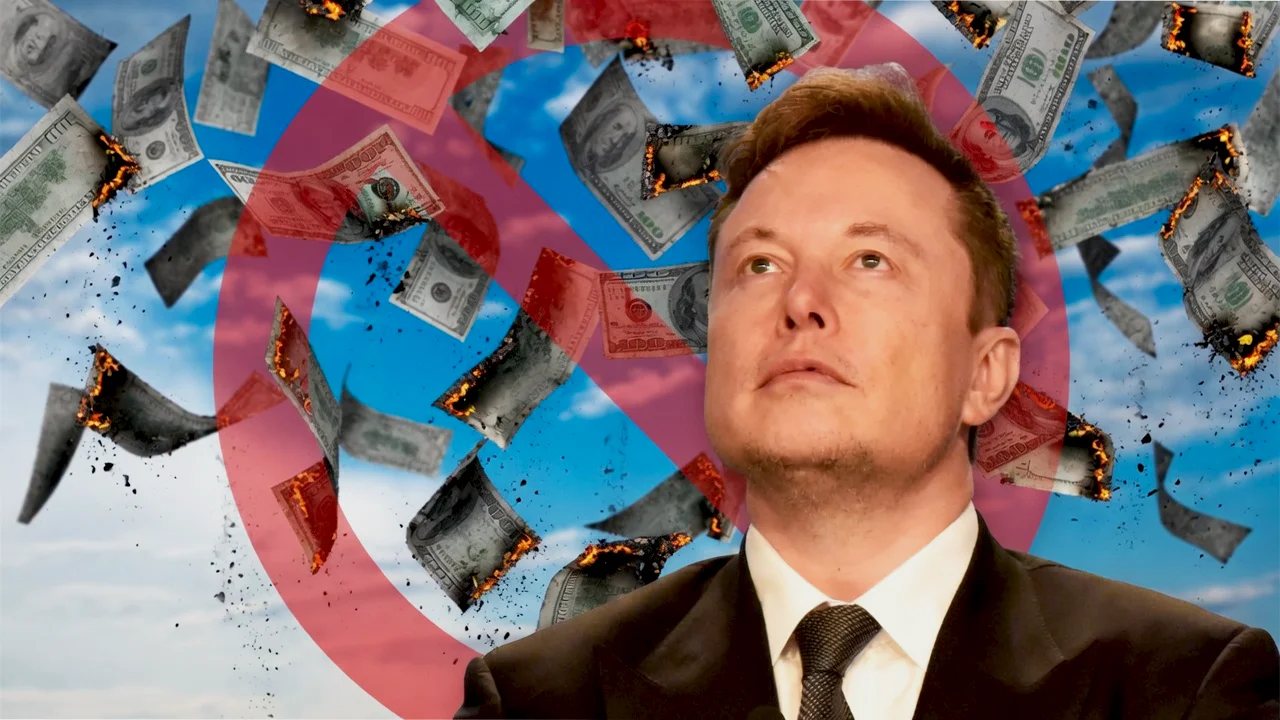
According to Elon Musk, whatever is sitting in your bank account has roughly ten years left to mean something.
In an interview with The Economist, Musk sketched out a scenario in which money loses most of its significance over the coming decade, giving way to an economy powered almost wholly by artificial intelligence and humanoid robots.
So goes the claim. What makes it worth examining is the part he concedes he cannot account for.
Abundance is the engine of Musk’s case. Machines, he argued, will churn out goods and services on such a scale as AI keeps improving that production ceases to be a constraint of any kind.
Under those conditions, most people would obtain what they need without money occupying the central position it does today. Scarcity disappears, the price signal goes with it, and there is no longer any reason to keep score the way we currently do.
The five-year claim underneath the 10-year one
Tucked inside that forecast is a second one, and it carries all the weight. Musk puts AI surpassing the sum of human intelligence within the next five years.
The rest of the argument rests on it. Should machines out-think humanity collectively by 2031, the shift would reach beyond economics into how people live and work.
A blueprint is something Musk makes no claim to have. He acknowledged he cannot spell out exactly how an economic system like that would operate.
Admitting that mid-forecast, on a prediction of this magnitude, stands out. The destination he states with confidence; the mechanism he leaves openly unspecified.
What the critics keep pointing at
Pushback has been substantial, and it lands in the same place every time. That AI will lift productivity considerably is something plenty of experts accept. Where they part ways is on whether that resolves anything.
How much money is worth doesn’t hinge solely on the volume of goods coming off the line. Natural resources, energy, land and the way wealth is shared out all feed into it.
Robots don’t make those constraints go away. A factory can run around the clock and still leave you short of lithium, grid capacity, or space to site the thing.
Distribution, meanwhile, belongs to politics rather than manufacturing. Plentiful output is not the same as plentiful access.
Distant scenario, not a schedule
That gap explains why a good number of observers shelve Musk’s forecast under distant possibility instead of settled outcome. They read it as one scenario among several, not something anyone regards as inevitable.
The source is also worth keeping in view. The valuations of the companies Musk runs rest on precisely this narrative holding up, and a forecast in which AI and humanoid robots restructure civilization doubles rather conveniently as a sales pitch.
Told honestly, the story is smaller than the headline suggests. AI improves, productivity rises, and the cost of a great many things comes down.
What none of that does is repeal land, energy and questions of ownership. Until somebody explains how it manages that, the 10-year countdown on money is best treated as a thesis missing a chapter.