

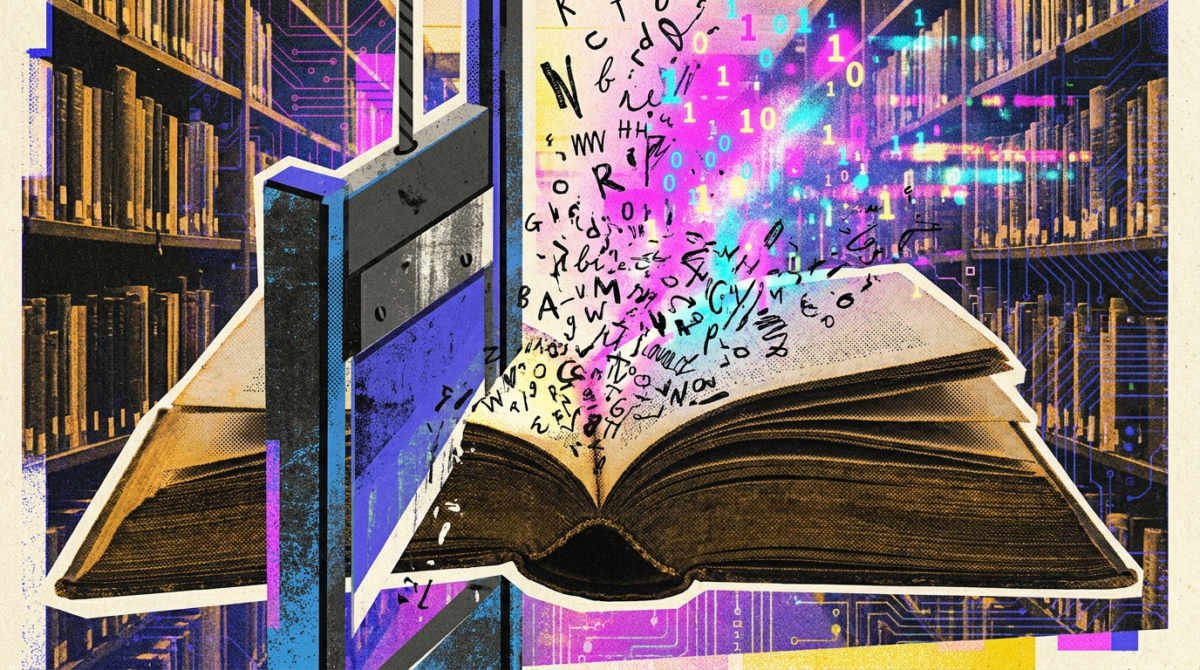
Someone slipped an AirTag into a crate of rare books and tracked its journey across the country. The signal went quiet at an Amazon warehouse in Las Vegas. By every indication, the books never came out of that building in one piece.
That conclusion comes from a 404 Media investigation, which followed a bulk book sale to its endpoint using the tracker. Amazon purchases printed books in bulk, scans them to produce AI training data, and destroys them along the way.
The team with a T. rex holding a book
Operating out of the Las Vegas site is a unit known as VGT3. Its logo shows a Tyrannosaurus rex clutching a book — read it as a gag about extinction or a gag about devouring them; neither interpretation does the team any favors.
According to workers, spines are sliced off the books to make scanning quicker. Stripped of its spine, a book races through a sheet scanner. It also ceases to be a book.
The resulting scans feed the training of Amazon’s Nova models. According to a spokesperson, the company sources books through commercial channels in order to improve its products.
Why printed books are the good stuff
Sellers in the trade believe AI firms are grinding through the catalog methodically, ISBN by ISBN, title by title.
Nostalgia has nothing to do with the appeal. A great many printed works have no online presence whatsoever, so they aren’t already buried in the scraped web corpus every lab has a copy of. They also tend to predate 2022, which means no AI-generated content has crept in. With training pipelines increasingly contaminated by machine-written text, a print run from the 1970s counts as clean data.
Anthropic did it first, and a judge said fine
Amazon has company. Anthropic ran a comparable operation of its own.
Litigation brought by book authors surfaced “Project Panama,” under which Anthropic acquired books on marketplaces, sheared off their spines and digitized them. Identical method, different company.
The judge overseeing that case found the scanning to be fair use and no violation of copyright. One strand of the reasoning: because the printed originals were destroyed, they were not duplicated and resold.
Consider what that means. The destruction of the book strengthened the legal case. Staying comfortably inside that ruling is cheapest when the physical copy simply no longer exists.
What actually gets lost
What both companies are doing is converting books — sometimes rare ones — into proprietary training material. Scanning isn’t the sore point. The problem is that the originals may be impossible to replace, and once the spine is gone, it doesn’t go back on.
Material that once sat on a public shelf, reachable by anyone holding a library card or $12 on a used-book marketplace, winds up sealed inside one corporation’s closed AI models. The text endures. Your ability to reach it does not.
Anyone selling rare books in bulk now has cause to ask who the buyer is — and an inexpensive way to find out. An AirTag runs cheaper than most of what’s in the box.