

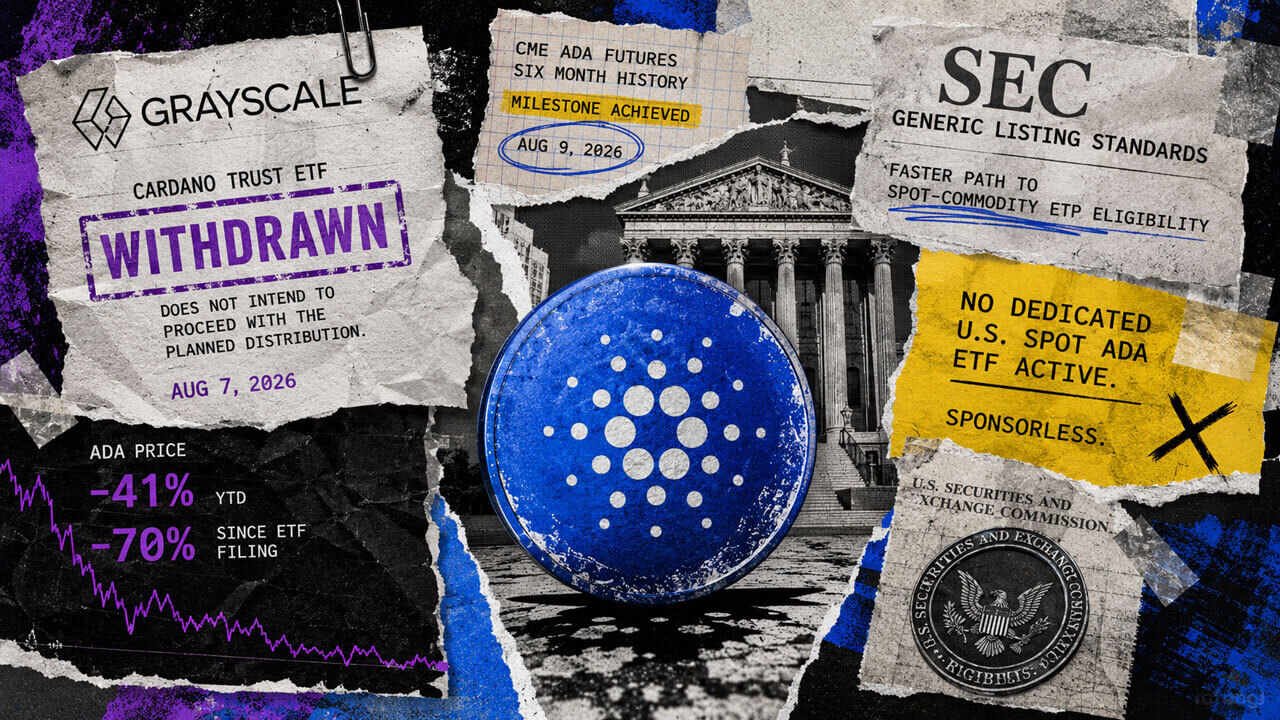
On Aug. 7, Grayscale withdrew the registration for its Cardano Trust ETF. Two days later, on Aug. 9, ADA crossed the six-month CME futures threshold that would have allowed a spot ETF to bypass the most grinding stretch of SEC review altogether.
Forty-eight hours separated the exit of the only dedicated US spot ADA filing from the moment the rule that would have eased its path came online.
Grayscale offered almost nothing by way of justification. Its filing told the SEC merely that the firm “does not intend to proceed with the planned distribution” — no rationale, no read on the market. The withdrawal was voluntary.
Three minutes, three tokens
ADA wasn’t the lone casualty. That same afternoon, Grayscale submitted matching withdrawals for Hedera and Polkadot roughly three minutes apart, which looks far less like a judgment aimed at Cardano and far more like a shelf being cleared.
The survivors are where it gets interesting. Registrations for Bittensor, Aave, BNB, NEAR and Zcash remained active and preliminary the following day. That’s portfolio pruning rather than a wholesale retreat. Grayscale has yet to say why it walked.
ADA’s price action offers no defense. The token has shed more than 41% year-to-date and roughly 70% since Grayscale’s initial ETF filing. Those figures sit comfortably inside the wider chill around altcoin products, but they don’t reveal what Grayscale was actually weighing.
Nothing to unwind, which is the point
One detail deserves precision: the Grayscale Cardano Trust ETF registration never took effect. The filing says outright that no securities were issued or sold under it.
Meaning there was no fund in operation. No stash of ADA being liquidated in a vault. No investors redeemed out. What expired was a permission slip, not a product.
That distinction carries more weight than it first appears. A live spot ETF turns brokerage and institutional appetite into real ADA buying every time fresh shares are created. That conduit has now gone dark, and with no other single-asset spot filing currently on record, it remains dark until another firm steps up.
The substitutes don’t substitute
A Cardano ETF does exist. Volatility Shares operates one constructed mainly from CME ADA futures, and the fund’s own prospectus states that it does not invest directly in ADA.
Its size reveals how little demand that structure is soaking up. As of July, combined net assets across the standard and leveraged versions stood at roughly $1.26 million. ADA’s market cap is around $7.1 billion. Work out that ratio and the futures wrapper rounds to zero.
Basket products are even slimmer. Grayscale’s own CoinDesk Crypto 5 ETF cut ADA during its January rebalance, replacing it with BNB after the underlying index reselected its five constituents. Franklin Templeton’s Crypto Index ETF continues to hold ADA, though at 0.69% of net assets — about $70,709 worth as of the close of last year.
Neither vehicle allows ADA demand to arrive on its own terms. Inside a basket, ADA is assigned whatever weight the index dictates.
What a real fund would move
Measure the possibilities against the current $7.1 billion cap and the missing channel takes on concrete dimensions. A $25 million ADA ETF equals roughly 0.35% of market cap. A $100 million vehicle gets to about 1.4%. At $250 million the figure nears 3.5%, and a $500 million fund passes 7% — the level at which ADA turns into a visible allocation product instead of a line item.
Share creations, hedging and secondary trading all blur any direct link between fund inflows and spot purchases. Even so, the ladder conveys the scale of what nobody is currently assembling.
The shortcut Grayscale left on the table
Under the SEC’s generic listing standards, qualifying commodity-based trust shares can list without the exchange submitting a separate Section 19(b) proposed rule change for that specific product.
That’s precisely the costly step being avoided. The bespoke 19b-4 route, governed by Exchange Act Section 19(b)(2), stretches from an initial 45-day review window out to as much as 240 days should proceedings be instituted and extended. One accepted route to qualifying is six months of regulated CME futures history — and ADA reached that on Aug. 9.
Cardano’s sole dedicated spot applicant headed for the exit just before the rule that could have cut months from its timeline switched on.
Two ways this goes
The optimistic reading is a handoff. Some other issuer files on the back of ADA’s now-qualifying futures history, drawing on the same six-month CME record Grayscale had available. A fresh application picks up the accelerated review window without reconstructing the regulatory argument from zero. Grayscale’s departure costs ADA time, not the route itself.
The pessimistic reading is quieter — and more likely if you’ve tracked issuer behavior this year. Sponsors chase tokens with more obvious demand, Solana, XRP, Dogecoin and BNB among them, and Cardano goes unclaimed. Futures wrappers hold near their present size, baskets keep ADA at a rounding-error weight or cut it loose, and the missing spot filing begins to be interpreted as a verdict on ADA’s institutional standing rather than a quirk of timing.
ADA has fallen 3.88% over the past 24 hours and ranks #14 by market cap.
Cardano met the standard the SEC erected to make a spot ETF achievable. The unresolved question is no longer a regulatory one. It’s whether any single sponsor examines a $7.1 billion asset with a qualifying futures record and concludes the paperwork is worth the trouble.