

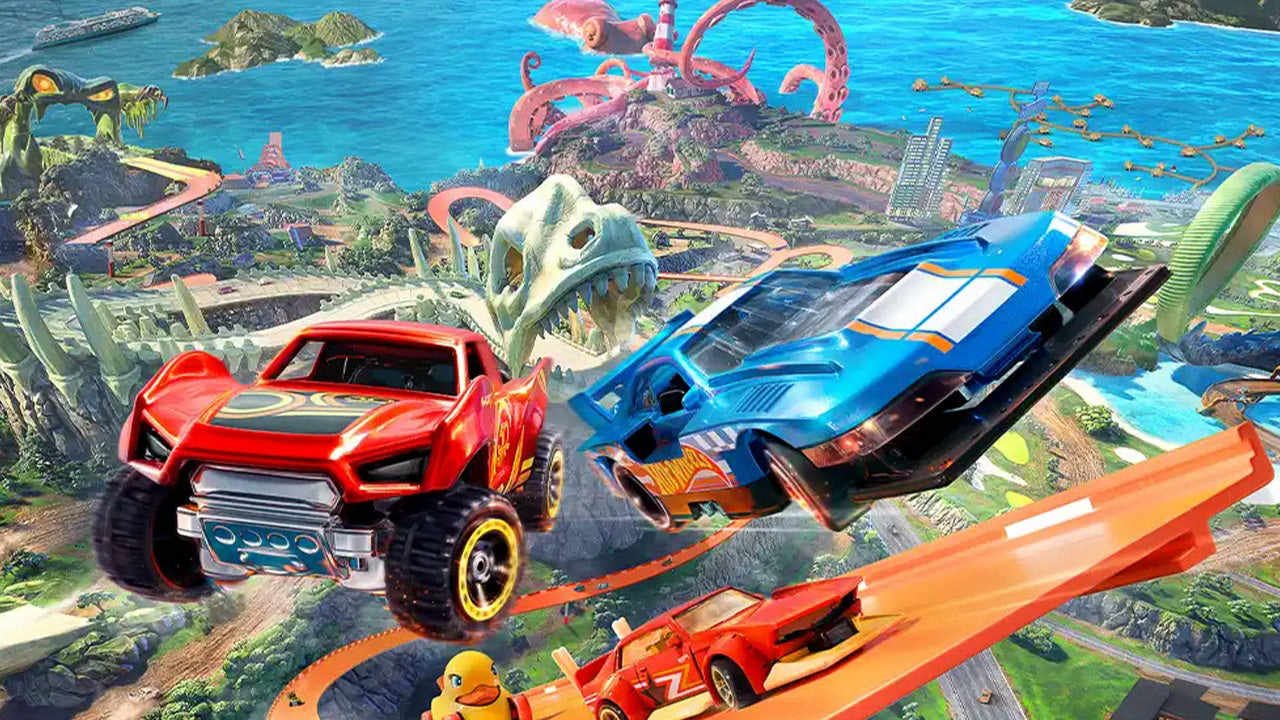
Your next waypoint sits 800 metres out. Your car, in theory, measures three inches nose to tail. Those two numbers refuse to sit comfortably together, and that wobble is basically a diagnosis of everything ailing Hot Wheels Infinite Rush.
Having spent two Hot Wheels Unleashed games perfecting a toy-car racer, Milestone has torn it down and reassembled it as an open-world thing, with Burnout Paradise serving as the unmistakable template. On paper, that pitch is terrific. Criterion’s classic remains one of the most worshipped arcade racers ever made, even though it proved to be the final genuine Burnout we’d receive.
With a pad in your hands, the pitch curdles. Infinite Rush sacrifices far too much of the flair and weirdness that made Unleashed stand out, and what remains is competent without ever becoming compelling.
The cars still look real
A few seconds is all it takes to recognise a Milestone Hot Wheels game, because no other studio renders these castings this way. Zinc or plastic, every finish catches the light with exactly the right authenticity.
That’s been true since the series debuted in 2021, and it still works on me. They genuinely look real.
So why don’t they get scratched anymore
This is the alteration that irritates me most: the cars no longer pick up any wear. Take the chequered flag and your model is every bit as showroom-fresh as it was on the starting grid.
All that accumulated damage in Unleashed — the scratches, the rubs, the scuffed plastic, the kerb rash — was doing something. A car that looked like it had bounced down the driveway a dozen times felt bedded into its world, convincing as a genuinely play-worn toy. Next to that, Infinite Rush comes off as slick and free of consequence.
Is there a setting buried somewhere that I’ve overlooked? A deliberate design decision, or a licensor who changed their mind? Whatever’s behind it, it’s an odd regression and I don’t care for it.
A garage tilted toward the toy aisle
About a third of the 150-car line-up looks to be fresh rather than carried over, which is a good thing. With nearly 60 years of castings available, endlessly trotting out the same models would be a strange choice.
Even so, the mix is skewed. Current and recent models take up most of the space, alongside a reasonable helping of early-to-mid-2000s castings, AcceleRacers among them, while the ’70s, ’80s and ’90s remain badly short-changed. Nothing here gives a Gen X parent or grandparent something to bond over with a kid.
I understand that older players aren’t the target demographic for a licensed Hot Wheels title. But my sons’ collection reads like a core sample of the toyline’s history — new cars, cars from my own childhood, older ones handed down by uncles and even a great uncle. My hunch is that’s fairly typical. At times Infinite Rush feels less like digging through the brand’s back catalogue and more like browsing whatever’s currently pegged on a shop wall.
The pop culture machines that were staples of Unleashed have vanished as well. Ferrari showing up is a nice touch, considering the Prancing Horse was absent from the actual Hot Wheels range between 2015 and 2025, but having zero movie and TV cars feels stingy.
Four classes, and one of them is the good one
The class structure comes over from Unleashed 2, cut down from six to four: Versatile, Speeder, Drifter and Titan. Every one of them demands that you drive around its particular foibles.
Titans bring power at the cost of bulk, offset by unusually long boost meters. Empty one completely and your baseline speed gets choked while the engine splutters back into life. Versatile racers spend their drift bar in lumps, meaning a boost can’t be cancelled once it’s underway — awkward in the grid-shaped city sections where you need to aim at something specific mid-charge.
Drifters get my vote, simply because they’re the easiest to throw sideways, which is what arcade racing ought to be about. The remaining classes are less enjoyable to slide, and there appears at times to be a speed penalty for sliding them properly. On several corners it was flatly quicker to Hail Melon my way through, Ross Chastain-style, than to drift the thing. That shouldn’t be possible in an arcade racer.
Four islands that blur into one
The generic feel of the open world is the core issue. You don’t get one sprawling map to pick apart the way Burnout Paradise or Forza Horizon 6 offer. What you get instead is four discrete islands of modest size, each with its own light theming.
Wheelswood leans commercial and downtown. Tentacle Bay is a second urban space with a little more countryside at its fringes. Gearville is desert industrial, while Drifty Temples takes East Asian inspiration. Recognisable stretches of plastic track wind their way through forgettable expanses of scenery and plain city blocks.
Mostly I end up tearing through the place, flattening benches and shrubbery. There are flashes of creativity — the oversized Hot Wheels Mount Rushmore over in Gearville is honestly charming — but virtually nothing holds my attention. Not even the enormous plastic animals.
The scale is the whole point, and it’s missing
Unleashed sent you racing through half-finished skyscrapers up above the cloud line. It had you gazing up at arcade cabinets that towered over your minuscule car down on the sticky carpet.
Infinite Rush offers nothing like it. Its maps never quite convince as dioramas, even packed with moulded plastic set dressing, and they never quite convince as real locations either, despite the game counting down your next waypoint in metres.
The side content that supposedly justifies all this real estate is largely filler. Photograph challenges plant you on the exact spot you need. Checkpoint collections would be considerably less trivial if traffic were a threat, but it isn’t — ploughing through cars scarcely costs you any momentum.
There was a better version of this idea
Going open world didn’t have to mean incinerating the series’ sense of scale. Put the desert map on a beach. Stretch another one across the entrance hall of a toy shop. Build more of the architecture from household objects — cereal box towers next to Hot Wheels garage playsets, painted roads bridging the gaps between orange track sections.
Any one of those would have handed these environments the scale they lack. 2023’s LEGO 2K Drive pulled off the concept more convincingly overall, even if that game has since been pulled entirely from digital storefronts.
The upgrades landed in the wrong game
The frustrating part is that Infinite Rush does improve in meaningful ways elsewhere. Four-player splitscreen has arrived, and it would have been an absolute blast across the madder Unleashed maps. AI opponents can now tackle your custom tracks, a feature that would have given the earlier games serious staying power. I’d have relished watching the computer take on the ludicrous jumps I’ve built over the years, particularly because Infinite Rush caps height far more aggressively than the multi-tiered Unleashed maps with all their vertical room.
Customisation now includes wheel swapping, which lands squarely with me as a diorama-building nerd on the wrong side of 40. Yes, the cars I’ve been taking a power drill to aren’t technically mine, but my boys have moved on from them. Keep that between us.
The driving itself stands up, with difficulty scaled for absolute newcomers and arcade obsessives alike, a generous spread of things to do and an enormous collection of photo-realistic models to hunt down. The track and car creation suites are still superb and still respectful of what this hobby genuinely is.
None of that rescues the maps. This is the weakest Hot Wheels game Milestone has produced, and most of its toy-like character got left behind on the road to an open world. A giant plastic gorilla isn’t going to fix it. Nor is the octopus.