

Polygon’s Open Money Stack (OMS), a payments product aimed at businesses, now supports Solana. With it, a business built on Solana can move a customer from a bank deposit into a stablecoin balance and then back out to a bank payout without leaving one system. Fiat ramps, customer accounts and cross-chain routing all sit inside that single stack.
There’s no game here. OMS is payments infrastructure, and it’s relevant to Solana teams running marketplaces, creator payouts or any other flow where real money enters and leaves. According to Polygon, the support is already live.
What Solana teams get today
Polygon explains the stack as the path money follows through a product: it arrives, settles in the correct account, moves to wherever it’s needed and is finally paid out. Each of those stages is covered in the Solana release.

- Getting money in: regulated fiat on- and off-ramps, backed by money transmitter licenses in 48 US states, let customers swap dollars for stablecoins on Solana and convert them back. Every customer or business can be given a virtual account, which gives incoming bank transfers somewhere to land and tells the business who sent the funds.
- Holding it: Solana is now supported by Polygon’s embedded wallets, using the same API the company already offers for EVM wallets. A business can create and manage these programmable accounts on behalf of its customers, and users never see the wallet or chain mechanics.
- Moving it across chains: in a single transaction, OMS can route USDC, USDT, PYUSD, SOL and wrapped SOL between Solana, TRON and EVM chains. Polygon gives the example of an app taking USDC from an Ethereum wallet and settling in SOL for someone on Solana, or doing the same thing in the opposite direction.
- Cashing out: stablecoins held on Solana can be turned back into US dollars and sent to a bank account, to a card, or collected as cash at a corner store.
Businesses aren’t locked into the full package. A Solana company can push its entire flow through OMS, or pick out only the components it needs while keeping its existing wallet, compliance provider, ledger or settlement rail.

Who Polygon is targeting
The intended users, per Polygon, are fintechs, payment apps, marketplaces and platforms on Solana that want to process real money without becoming a bank or a money transmitter. Customers see only a payment, a balance or a payout. They never have to touch a bridge.
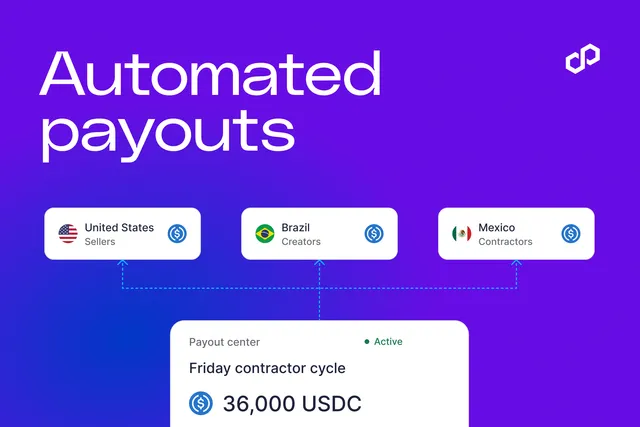
Polygon walks through a creator payments app as an example. A fan pays using a USD debit card. OMS onramps that payment, converts it into a stablecoin on Solana and sends it across borders. From there the creator can withdraw to a bank account or hold the funds in crypto.
Marketplaces can apply the same flow to seller payouts. Sellers get paid on whichever chain or in whichever currency works for them, without being pushed onto a single settlement rail.
Why Solana
According to Polygon, Solana handles more than $2T in stablecoin volume every quarter. The company’s case is that holding or swapping an asset is a separate problem from running a payments product, which also requires bank access, customer accounts, routing and payouts. OMS is built to provide those components to teams that chose Solana as their settlement layer, letting them stay on the chain their users already use.
Polygon places the launch within a bigger ambition: “to move all money onchain so that 10 years from now money moves around the world in milliseconds rather than days.” It also says that “no one chain will do it alone.”
Solana is the next chain in line for OMS support, and Polygon says more will follow. The company plans to keep adding blockchains to the stack so businesses can build on their chain of choice without redesigning their money flow to fit it.