


Both of Fidelity’s crypto exchange-traded products are now permitted to put every coin in their vaults to work through staking. The same filings that hand over that power also devote several paragraphs to a less flattering scenario: what unfolds if the funds can’t pull those coins back quickly enough.
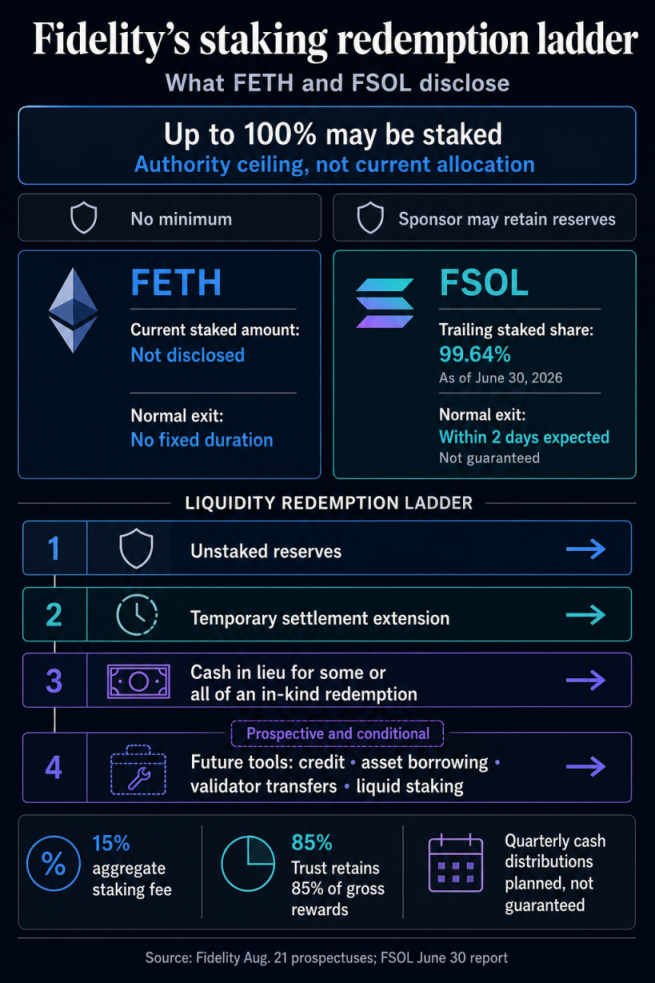
That push and pull runs through the Aug. 21 prospectuses covering the Fidelity Ethereum Fund (FETH) and the Fidelity Solana Fund (FSOL). The two documents lean on an identical blueprint — stake as much as 100% when conditions are normal, then work down a tiered list of fallbacks whenever network exits drag on.
The 100% number is a ceiling, not a status report
There is no floor written into either fund. Sponsor FD Funds Management is free to keep ether or SOL sitting idle to cover foreseeable redemptions, expenses, asset protection and its liquidity program.
Permission to stake it all, in other words, is not the same as staking it all. It simply means no rule stands in the way.
Of the pair, FSOL sits nearest the ceiling. As of its June 30 report, 1,675,797 SOL were staked against 1,687,589 SOL held, carrying a fair value of $126.3 million. The quarterly filing pegged net assets at $127.079 million and the trailing 30-day staked share at 99.64%.
FETH looked nothing like that. Its June 30 report showed 476,311 ether and $758.609 million in net assets, with no staked-ether figure listed at all. Fidelity revised the trust and custody arrangements during August, and the fresh prospectus stated that staking was expected to get underway as soon as practicable following Aug. 21. No current staked amount was disclosed.
What happens when you want your crypto back
The first line of defense is reserves. Should reserves come up short and unstaking fail to wrap up within the standard settlement window, the sponsor is allowed to stretch settlement on a temporary basis.
Where an exit remains impracticable even across a reasonable extended period, the sponsor can hand over cash in place of some or all of the crypto owed under an in-kind redemption.
The wording in the filings repays close attention. Each of these is framed as a discretionary option — not an automatic protection, and not a tool that has already been put to use.
Two networks, two very different waiting rooms
Timing risk is where the two funds diverge, and it’s the detail that ought to change how investors size them up against each other.
FSOL anticipates recovering full control of its staked SOL inside two days when conditions are normal. That outcome is not guaranteed anywhere in the prospectus.
FETH, by contrast, attaches no fixed timeframe at all. Validators on Ethereum must first exit the active set, then sit through a mandatory wait before the network’s withdrawal sweep gets to them. A rush of exit demand or trouble on the network can lengthen either schedule.
The backstops that don’t exist yet
The filings also sketch out backstops that may arrive later: a credit facility arranged with the sponsor or an affiliate, direct borrowing of digital assets, sales or transfers of validator positions, and structures built around liquid staking tokens or tradable claims on staked assets.
As of Aug. 21, neither trust had a line of credit in place. Several of those mechanisms also hinge on legal, tax or exchange-rule shifts that have yet to materialize.
Where the staking rewards actually go
Aggregate staking fees at each trust run to 15% of gross rewards, leaving 85% with the fund.
That retained portion is earmarked, in the stated order, for trust expenses, quarterly cash distributions, redemptions and further staking. The sponsor retains the ability to reshuffle that order.
Quarterly distributions would reach holders in cash once the rewards have been sold, with neither the size nor the timing guaranteed.
For anyone comparing the two, the June 30 figures draw a clear line between the live product and the theoretical one. FSOL was already operating at 99.64% staked with an expected two-day unwind. FETH disclosed no staking whatsoever, faces an open-ended exit queue, and has a launch date characterized only as “as soon as practicable.” These are not one product in two wrappers.