


Tether has stepped into private credit just as the incumbents in that market are nursing a rough quarter.
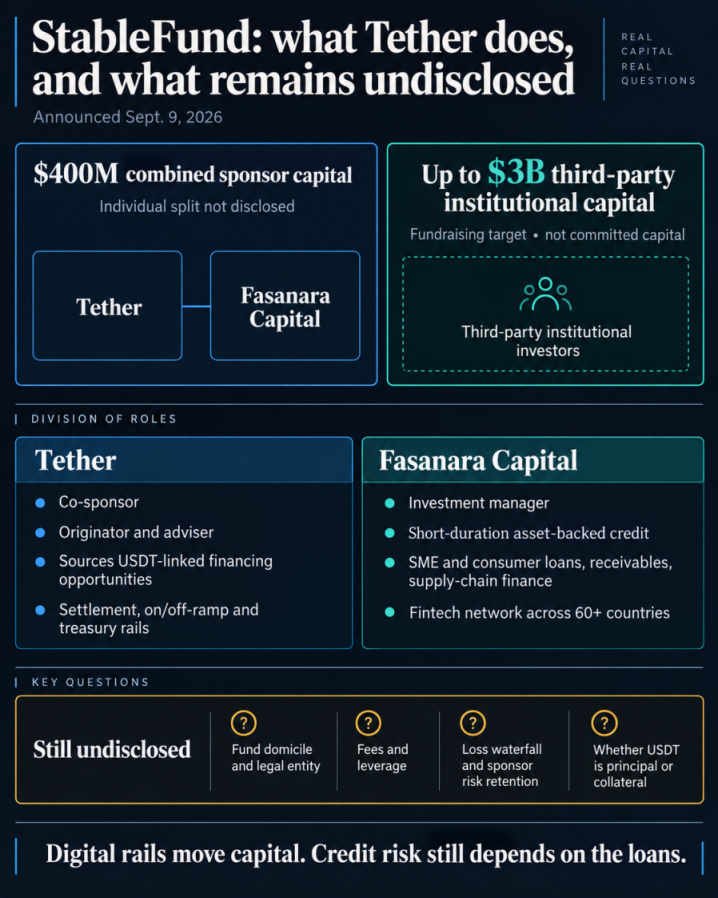
The stablecoin issuer teamed up with London-based Fasanara Capital on Sept. 9 to launch StableFund, seeded with $400 million in combined sponsor capital and targeting as much as $3 billion more from institutional backers. Portfolio management sits with Fasanara. Tether’s contribution is originating USDT-linked financing opportunities and supplying settlement and treasury infrastructure.
The market they’ve stepped into is valued at roughly $3 trillion. Cracks are also showing in it.
The defaults are the story
A Wall Street Journal analysis published in August tracked deteriorating loan health and weaker investor returns across publicly traded funds run by Ares Management, Blackstone, Blue Owl Capital and Golub Capital. Those vehicles logged defaults at their highest levels since at least 2021. At Blue Owl, the default rate climbed to 2.8% in the second quarter — a five-year high, at minimum.
The big managers reject the notion that any of this points to a wider crisis, insisting portfolio credit quality is holding up. On the raw numbers, that argument holds. Default rates still sit below what the sector saw in harsher episodes like the Covid-19 shock.
Yet the slippage is showing up at the same time as investor redemption pressure and unease about borrowers carrying heavy debt loads, software firms exposed to potential artificial-intelligence disruption among them. Tether is asking institutions for billions against exactly that backdrop — and those institutions are scrutinizing credit quality and liquidity far more closely than they did two years ago.
Tether already runs a lending book. This one is different
Credit is not new territory for Tether. Galaxy Research puts the company’s share of the $23 billion centralized crypto-lending market at roughly 60% as of the end of June, which works out to about $13.5 billion in outstanding secured loans.
With StableFund, that apparatus is being aimed at a far bigger target: lending to real businesses and consumers instead of crypto counterparties. The asset class is larger, the risk profile is shaped differently, and both regulators and allocators are examining private credit more closely than they have in years.
What’s in the portfolio isn’t corporate direct lending
Precision matters here, since the stress reports and the fund’s strategy are not describing the same slice of the market.
Fasanara, with more than $6 billion under management, intends to put the capital to work in short-duration, asset-backed loans sourced through a fintech network that reaches more than 60 countries. Financing for small and medium-sized businesses and consumers will sit in the portfolio, alongside trade receivables and supply-chain credit.
Compare that with the corporate direct lending behind the Blue Owl and Golub figures and it’s another animal entirely. Short duration means the book turns over faster; asset-backed means there’s something to seize if a borrower stops paying.
The regulator already wrote the warning
Back in May, the Financial Stability Board cautioned that private credit has never been put through a drawn-out economic downturn. Among the vulnerabilities it identified: declining borrower quality, elevated leverage, valuations that are hard to see into, and tightening connections between private funds, banks and insurers. As evidence of borrower strain, it cited the increasing use of payment-in-kind arrangements together with climbing defaults.
Funds that offer redemption options drew separate attention from the FSB, which noted that liquidity pressure can magnify stress once investors start asking for their capital back.
StableFund is set up as an evergreen vehicle, meaning it can go on raising and deploying capital instead of winding down on a fixed maturity date. Neither Tether nor Fasanara has spelled out the redemption terms publicly. That’s a notable blank for a fund launching straight into the FSB’s stated worry.
Tether sits near the front of the pipeline
Tether’s position in the structure is what sets this apart from a standard Fasanara fund. The USDT issuer wears three hats — co-sponsor, originator and adviser — hunting for opportunities tied to its stablecoin network while furnishing on- and off-ramp connectivity and treasury rails.
In other words, Tether is doing more than supplying a token for borrowers and lenders to settle in. It has influence over where the capital is aimed.
Investment manager duties stay with Fasanara, which is on the hook for deploying the portfolio. Nothing in the announcement indicates Tether will sign off on final underwriting calls. Nor does it confirm that USDT will act as loan principal, as collateral, or as the fund’s denomination.

The number they didn’t break down
One detail went undisclosed, and it happens to be the one that counts for the most.
The two firms billed the $400 million anchor as a joint commitment without saying how it divides between them. Fund leverage and fees went unmentioned as well, as did the question of whether either sponsor’s money takes losses ahead of capital raised from third-party institutions.
Every quarter that defaults keep rising across private markets makes those terms weigh heavier. Tether writing a large junior check would produce a risk profile nothing like a smaller stake sitting pari passu with outside institutions.
So long as nobody attaches a figure to Tether’s slice of that $400 million and clarifies where it ranks in the loss stack, the operational role and the financial exposure are best treated as two separate questions. Just one of them has an answer so far.