

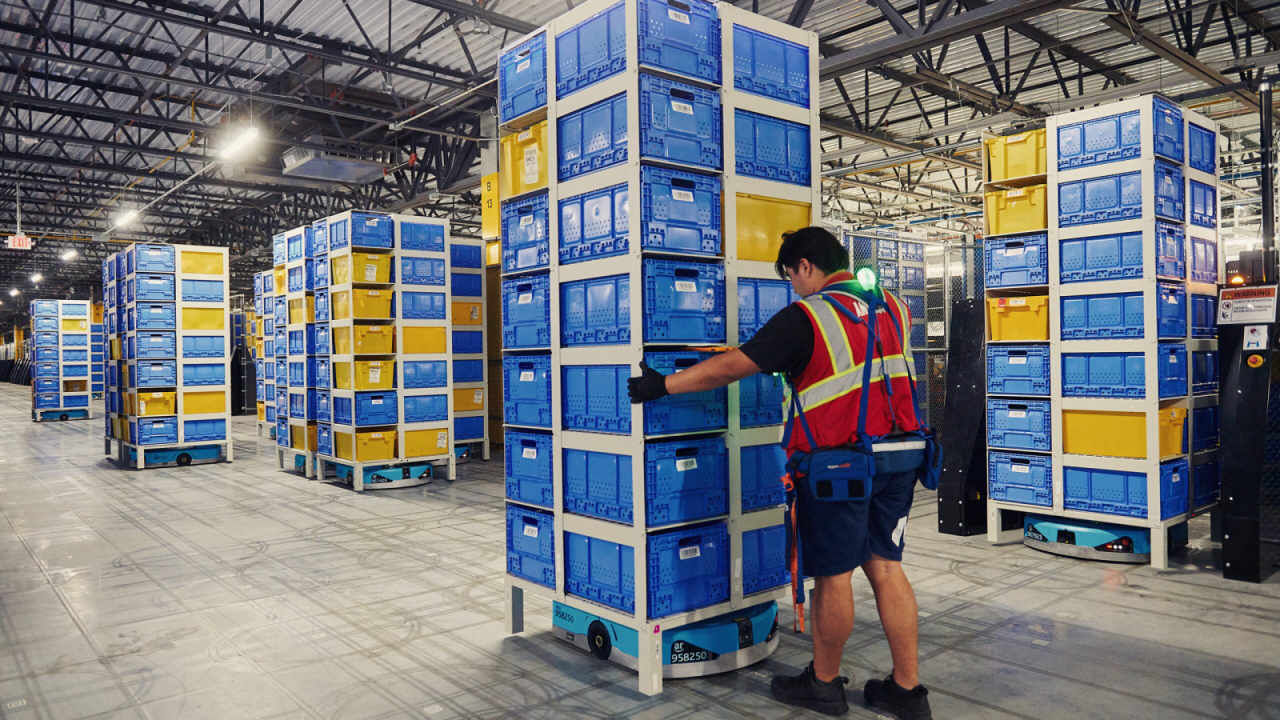
No organization on Earth operates more robots than Amazon, which has upwards of 1 million machines running nonstop inside its warehouses. Alongside them, the company employs more than 1.5 million people in full-time and part-time roles, according to its 2025 annual report, which ranks it as the world’s second-largest corporate employer.
Both of those workforces occupy the same facilities. Whether people and robots can coexist is not really the issue. What matters is who controls the tempo when they share the floor.
Research that muddies Amazon’s narrative
Some of the most nuanced findings so far appeared in April 2025 in the journal ILR Review. According to the study, severe injuries were 40 percent lower at Amazon’s robotic warehouses than at its legacy fulfillment centers. That is a significant improvement, and it lends weight to Amazon’s argument that machines are taking over the most dangerous physical labor.
The same research, however, also recorded a 77 percent rise in less severe injuries at the robotic fulfillment centers, linked to physical strain from repetitive motions.
“At least one of the mechanisms by which this appears to be manifesting is through the pace of work, in that pick rates for the robotic fulfillment centers are off the charts higher,” said Brian Greenwood, a George Mason University business professor who coauthored the paper.
According to Greenwood, the quicker tempo that comes with partial automation could mean “the robot is dictating the pace of work,” forcing employees to repeat specific movements at higher speed. “That appears to be what’s driving the strains and the sprains that we observe,” he said.
He sees this as a departure from history. “For the last 100 years, most of the automation that we’ve seen usually happens away from workers,” Greenwood said. In his view, collaborative robots are different because they operate in close physical proximity to people and because “the robot has the ability to dictate the pace of work.”
Dated figures, persistent issue
Part of the study relied on internal Amazon data that journalists at Reveal and The Center for Investigative Reporting obtained. The dataset included weekly numbers from more than 150 Amazon warehouses between 2016 and 2019. Those figures are hardly fresh, a point Amazon would readily make.
Greenwood nonetheless believes the findings remain valid. “I haven’t seen a tremendous amount of evidence to suggest that these dynamics are changing, inasmuch as you still have a tremendous amount of turnover in the warehousing context,” he said, noting that the problem extends beyond Amazon.
The researchers also combed through Reddit posts from Amazon fulfillment center staff, and a clear pattern emerged. Employees said robotic sites were easier on the body but draining on the mind, owing to repetitive motions and the quicker pace tied to higher productivity targets.
Labor groups and lawmakers have raised the alarm for years
The Strategic Organizing Center, a Washington, DC-based coalition of trade unions, released reports in May 2021 and April 2022 indicating that injury rates were higher at Amazon’s robotic warehouses than at its non-robotic sites. The analysis used injury data that companies submitted to the US government covering 2017 through 2020.
“Amazon likes to talk about its latest robots because it doesn’t want to talk about the tens of thousands of Amazon workers who are injured every year due to Amazon’s obsession with maximizing speed and minimizing costs,” Joan Moriarty, director of strategic research and Campaigns at SOC, said in an email.
In February 2021, the coalition also gathered close to 1,000 responses from Amazon employees through an online survey. “Workers consistently report that the presence of robots increases the pace of work expected in Amazon facilities, forcing them to make fast, repetitive motions, substantially increasing the risk of injury,” Moriarty said.
The US Senate Committee on Health, Education, Labor and Pensions (HELP) conducted its own probe in 2024 under the leadership of Sen. Bernie Sanders (I-Vt). Its report observed that Amazon’s internal data likewise pointed to a connection between robotic productivity and heightened pressure on workers, resulting in more injuries.
Amazon counters with company-wide statistics
Amazon has dismissed these reports as flawed, arguing that they depend on outdated data predating its latest robots, such as the robotic arms introduced over the last several years. To make its case, the company points to network-wide figures.
“All of these claims ignore the fact that since 2019 our Global Recordable Incident Rate has improved 43 percent and our Global Lost Time Incident rate, which includes the most serious injuries that require employees to take time away from work, has improved 70 percent,” an Amazon spokesperson said. “Our consistent year-over-year improvements have worked in parallel with our robotics growth across our operations network.”
What the company left out is telling. Amazon offered no breakdown comparing robotic and non-automated warehouses, which is precisely the comparison its critics are drawing.
Context is also important. According to the US Occupational Safety and Health Administration, the injury and illness rate in the US warehouse sector has generally been more than twice the average for all industries.
“You have almost 2 million people working in the warehousing sector in the United States, and it’s characterized by very high turnover and very high workplace injury rates,” Greenwood said.

The road to a million machines
Amazon’s robot fleet dates back to its 2012 purchase of Kiva Systems, an early maker of wheeled robots that deliver shelves of goods to workers rather than requiring people to walk the aisles. Kiva was renamed Amazon Robotics, which builds most of its machines in-house at sites in Massachusetts. This year, Amazon announced plans for additional production factories in Austin, Texas, and Greenwood, Indiana.
“There’s a theme of how we look at the challenges that we can help our associates and our employees with, and how we can make our customers’ lives better through these technologies,” said Scott Dresser, vice president of Amazon Robotics. “Each step of the way, [we are] tackling a hard or deep set of technical challenges to achieve that goal.”
The bulk of the million-strong fleet still moves on wheels. Hercules and Titan robots, about the size of a pool table and a baby grand piano, respectively, carry tall fabric shelving units known as pods, filled with plastic totes, to workers at their stations. The Sequoia system orchestrates swarms of these robots, and Amazon says it can identify and store items up to 75 percent faster.
Typically, these robots navigate grids of floor stickers within fenced zones kept separate from people. Proteus breaks that mold, using sensors that allow it to move more freely and work safely around humans and objects.
Packing swarms into narrow lanes also leads to robot traffic jams. To address that, Amazon built DeepFleet, a suite of AI foundation models designed to anticipate congestion before it forms.
An arms race in the most literal sense
The more significant change is the move toward robotic arms. Speaking on a July earnings call, Amazon CFO Brian Olsavsky said the company expects its robotic arm fleet to more than double this year. Dresser put the current total in the single-digit thousands, meaning arms are still a small portion of the million.
Robin, Amazon’s first in-house arm, entered testing in 2021 and launched in Lakeland, Florida, in 2022. Equipped with eight suction cups, it pulls mailers and boxes from messy piles, ranking potential picks from an overhead view of the conveyor before moving.
“With Robin, it was really that first attempt at taking a number of customer orders all in a jumble and building the advanced robotics to identify the items in that scene, to strategize on how to pick them up and build a motion plan that would be successful in placing it down on one of our mobile drive units,” Dresser said.

Manually written picking rules repeatedly fell short. A 2023 Amazon Robotics paper outlined one approach that favored bigger packages and faltered when smaller ones lay on top of them. Another prioritized packages near the top of piles but struggled with “unreachable picks” and partly buried items.
Machine learning performed better, though the on-paper margin was modest. Trained on more than 394,000 picking actions, a model reached a 93.73 percent success rate, compared with 92.28 percent for the top traditional algorithm. Over a work period involving more than 1 million picks, that difference translated to roughly 16,500 fewer failed picks. In another experiment covering 2 million picks on workstations designed to replicate the Robin fleet, the team lowered the failed pick rate by 20 percent. The research was presented in July 2025 at the International Symposium on Experimental Robotics.
Next came Cardinal, which loads packages weighing up to 50 pounds into wheeled carts headed for trucks. It began operating in Nashville, Tennessee, in November 2022.
“Think of it as a game of Tetris: You’re sorting packages, and you’re placing them into the cart, and you want to be able to pack that as densely as you possibly can,” Dresser said. “Dense containers are great from a sustainability perspective and from a transportation cost perspective.” According to Dresser, Amazon has only recently begun rolling out Cardinal at greater scale and will continue doing so over the coming several years.
Scaling from packages to hundreds of millions of items
While Robin and Cardinal manage several dozen package types, Sparrow must contend with the hundreds of millions of products that appear in customer orders. It consolidates items from partly filled totes into tightly packed ones and replenishes them as orders are picked.
“When we think about how AI applies to the physical space in robotics, Sparrow was really the first place where we truly deployed foundation models that enabled us to deal with that high diversity of products,” Dresser said. He explained that those models allow the team to recognize and categorize items and develop grasping strategies without hand-coding each product.
Since then, the team has developed a perception foundation model for products it has never encountered, along with a generalized action model that functions across arms using varying combinations of suction and finger grasping.
“If you need to build ad hoc perception models for every such task and embodiment, that just doesn’t scale,” Kapil Katyal, a senior applied science manager at Amazon Robotics, said while presenting at the Intelligent Robots and Systems conference in Pittsburgh on September 29. “So one of the initiatives we took up in our team was to design a foundation model which could work for any new embodiment of robots that we deploy, and across all of the perception tasks that we need to perform over those,” Katyal said.
Vulcan has a sense of touch
The latest arm, Vulcan, is the first to combine vision with force feedback sensors, giving it tactile awareness for handling items inside fabric pods.
“You need to be able to insert an item, create space, or pull something out,” Dresser said. “Those are really hard things to do with traditional non-touch-based systems today, like the suction-based systems that are part of Sparrow.”
Vulcan went into service in Spokane, Washington, and Hamburg, Germany, in 2025. Deployment remains limited for now, and Dresser said Amazon plans to scale it up in 2027. Amazon argues that Vulcan handles top-row picks that would otherwise require a step-ladder, as well as items sitting just above the floor, leaving workers with products in comfortable reach. That is a believable ergonomic advantage, but it reveals nothing about how quickly those workers will be expected to clear the middle rows.
The staffing calculus Amazon keeps quiet
Amazon maintains that robotics generates employment. Fulfillment centers equipped with advanced robotics generally require 30 percent more staff in reliability, maintenance and engineering positions, and each new robot factory is expected to add more than 300 jobs.
“We’ve actually increased the number of robotic maintenance technicians that we have in the network by over 30 percent, and that is a much higher-skilled, higher-compensated job,” Dresser said. “As we’ve deployed robots over the past decade, we’ve seen our operational footprint grow, creating hundreds of thousands of jobs as we expanded our network,” the Amazon spokesperson said.
In October 2025, however, The New York Times reported on internal strategy documents indicating that the robotics effort could allow Amazon to reduce its projected US hiring needs by more than 160,000 people by 2027 and 600,000 people by 2033. At the time, an Amazon spokesperson said the documents represented the perspective of only one group within the company.
Just a small share of Amazon’s US workforce has unionized, yet Greenwood said unions have “traditionally served a very good role in terms of improving worker safety.”
“Now, obviously, I understand that firms are not always excited to engage in that conversation, and I can’t say that would solve the problem here,” Greenwood said. “But developing a better relationship between management and labor is usually the best path forward to try to figure out how to reduce these injury rates, which would have benefits for Amazon as well.”
The first Amazon Labor Union, formed at a Staten Island, New York, warehouse in April 2022, has been campaigning for a Safety Bill of Rights that spells out the changes it is seeking. The accompanying image carries the message: “We are not robots.”