

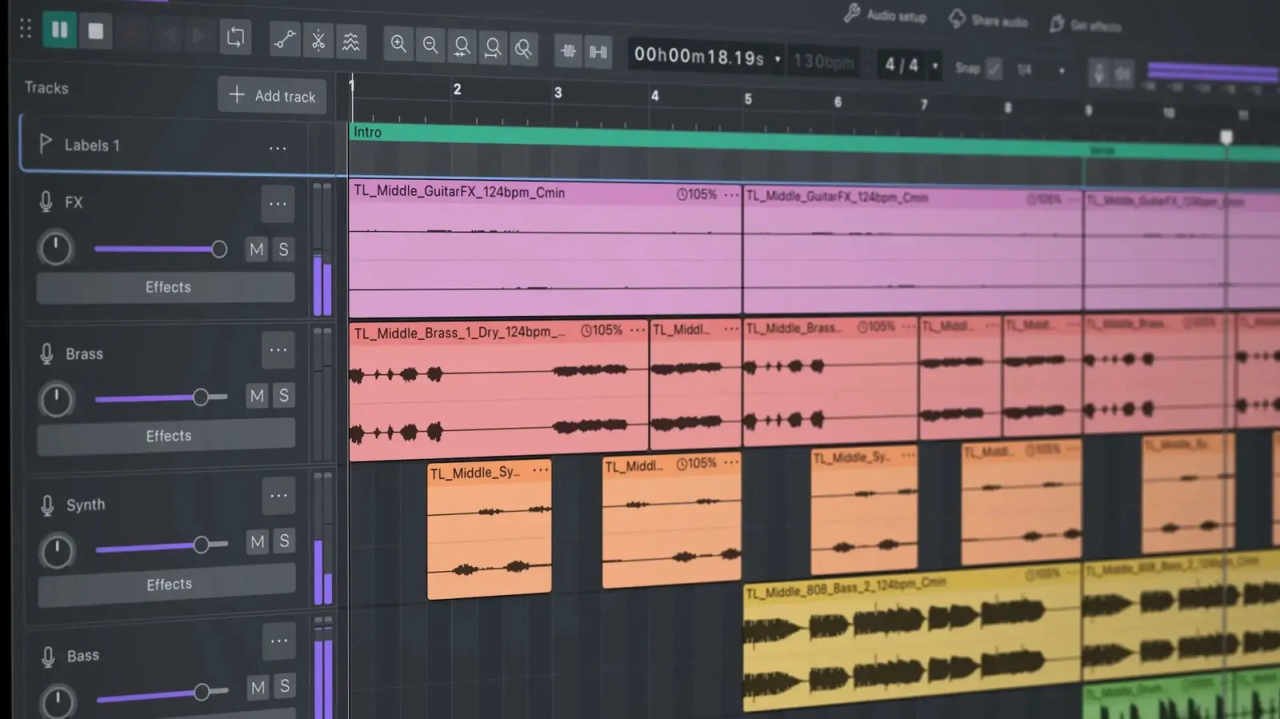
Not since Version 3.0 stirred up a commotion more than five years ago has Audacity pushed out a change of this magnitude. Version 4.0 arrives today, and the free open-source audio editor has picked up a dark mode, overlapping clips, and an envelope tool that will look instantly familiar to anyone who has ever automated a gain curve in Ableton Live.
How drastically the software would be reshaped in this release was the open question. The short answer: a lot has moved, though Muse Group’s developers appear to have gone out of their way to keep things continuous for users who would rather not relearn the program.
The dark mode is the first thing you’ll notice
Across the board the interface is more playful, with audio clips rendered in color and punchier accent colors on UI elements such as gain sliders. For software that has looked broadly the same for years, that’s a genuine break from the past.
Not a fan? There’s no need to panic. Audacity’s classic look survives as an option you can switch on during setup, meaning the new design never has to cross your screen.
Clips can finally overlap
Non-destructive editing, which the program first dabbled in with Version 3.2, gets a substantial expansion here. Overlapping clips are now possible, and trimming too far back uncovers the audio that had been hidden underneath.
You can also select several clips and trim them together by dragging a single handle, or group them for more involved edits.
The envelope tool borrows from the expensive stuff
A click drops a draggable control point for parameters like gain, and the waveform reflects the change on-screen as it happens. In practice, that means you can tell whether part of a clip is redlining while your cursor is still on the point, rather than discovering it after rendering.
A splitting tool has been added as well, cutting clips in a single click. Users of other creative software should recognize it right away, and not only in audio circles: everything from Adobe Premiere to Logic Pro offers something comparable.
Sample-level editing, and a meter on every track
Zoom deep enough into a clip and editing now goes all the way down to the sample level, which earns its keep when a clip is nearly there but still wants fine micro-adjustments.
Every track now carries its own meter too, so identifying which one is clipping the mix no longer comes down to guesswork.
Sync-lock is gone, and some people won’t like it
Of everything in this release, dropping sync-lock — the feature that kept multiple clips editable in tandem — stands to be the most divisive. Muse has introduced new keyboard shortcuts that reproduce the behavior, which cushions the loss without being equivalent to simply leaving the feature in place.
Most of Audacity 4 follows that same pattern. Anyone who has spent time in a fully featured DAW such as Ableton Live 12 or ProTools will find the editing changes familiar, and the majority of those programs run hundreds of dollars or more. Picking up this toolset at no cost, inside a program that has long been a basic audio editor, counts for something.
Plugin support has been strengthened too, on top of a longer roster of smaller tweaks. If the prospect of relearning your workflow has kept you from upgrading, enable the classic look during setup and start with the envelope tool.