


Circle has trimmed how many screens a treasury desk needs to work through to convert Bitcoin into dollars. What it hasn’t trimmed is the risk. That still lives inside a Morpho lending market, and Circle is not claiming otherwise.
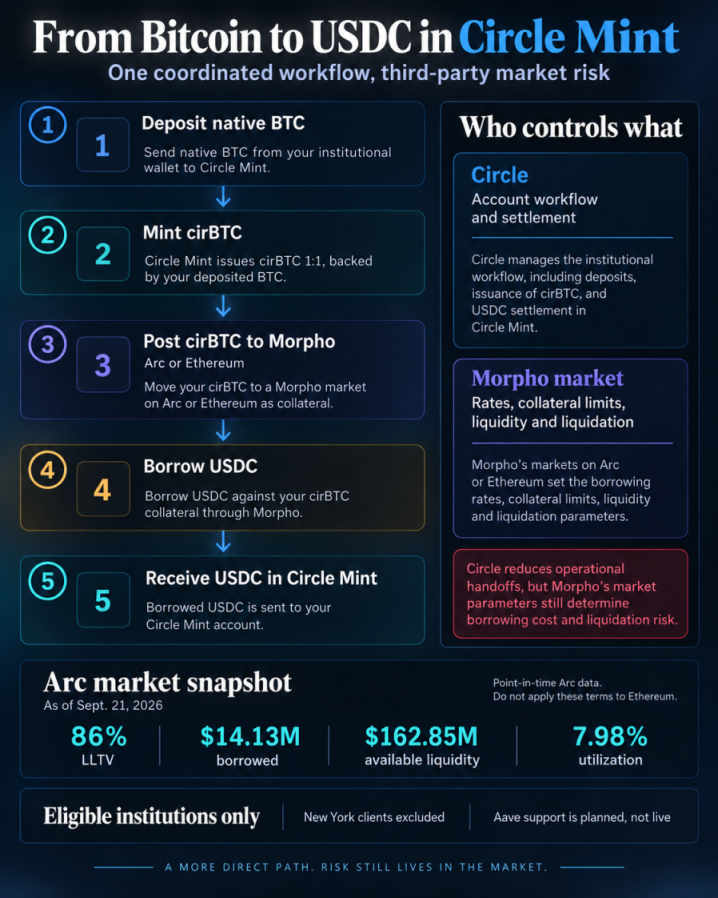
As of Sept. 21, eligible Circle Mint institutions are able to deposit native BTC, mint cirBTC, pledge that token as collateral and take out USDC, all within a single coordinated workflow. The service is available on Arc and on Ethereum.
The selling point is fewer systems to touch when raising dollar liquidity without parting with Bitcoin. The catch is that Circle operates the front door while a third party dictates the terms behind it.
Where Circle’s role ends
Under what Circle labels its Digital Asset-Backed Borrowing service, a customer deposits native BTC, mints cirBTC and supplies it as collateral from a wallet the customer controls. The USDC that is borrowed then lands in the customer’s Circle Mint balance.
Circle Mint serves as the account interface. cirBTC is Circle’s tokenized claim, backed by native Bitcoin. The lending market itself comes from Morpho, and that is where the decisions that actually matter are made.
Borrowing costs, collateral limits, liquidation thresholds, available liquidity and overall availability are all determined by the selected market rather than by Circle. According to Morpho’s documentation, every market is its own distinct combination of loan asset, collateral, oracle, interest-rate model and liquidation loan-to-value limit.

That difference is not cosmetic. Because the cirBTC sits inside the lending market, a position can become liquidatable even though the underlying Bitcoin was never sold. A cleaner interface does nothing to excuse a treasury team from tracking collateral values, utilization and borrowing costs.
What the Arc market looked like on day one
A Sept. 21 snapshot of the Arc market for USDC loans against cirBTC showed a liquidation loan-to-value limit of 86%. The market carried $14.13 million in borrows against $162.85 million of available liquidity, putting the total market size at $176.99 million with utilization at 7.98%.
The activity log recorded at least one borrow that day, meaning the market was actually in use rather than merely listed.
These figures should be read as a point-in-time snapshot. They cover Arc alone and say nothing about the Ethereum market.

The size of the cirBTC supply
As of Sept. 20, Circle’s reserve dashboard showed 948.75081803 cirBTC outstanding, backed by 951.25857454 BTC held in reserves. Roughly 397 cirBTC lived on Arc and roughly 552 on Ethereum.
Arc, Circle’s own layer-1 network, operates on a permissioned validator set. For an institution weighing which supported network to use, that is one more consideration to set beside the market terms.
Access remains tight. The service is restricted to eligible institutions, excludes clients in New York and is subject to jurisdiction and eligibility checks.
A faster route, but the same credit
The launch makes the journey from held Bitcoin to USDC shorter. It does not convert variable DeFi credit into a fixed Circle loan, and nothing in the workflow alters who takes the liquidation when collateral values slide.
Whether the service generates durable demand for cirBTC will come down to sustained borrowing activity and the market terms that persist beyond the launch-day snapshot.
Bitcoin has gained 4.75% over the past 24 hours and holds the No. 1 spot by market cap. Anyone running a treasury who reads the Circle name as a guarantee of fixed terms should open the Morpho market page before anything else. The 86% figure belongs to that market, and so does the liquidation.