

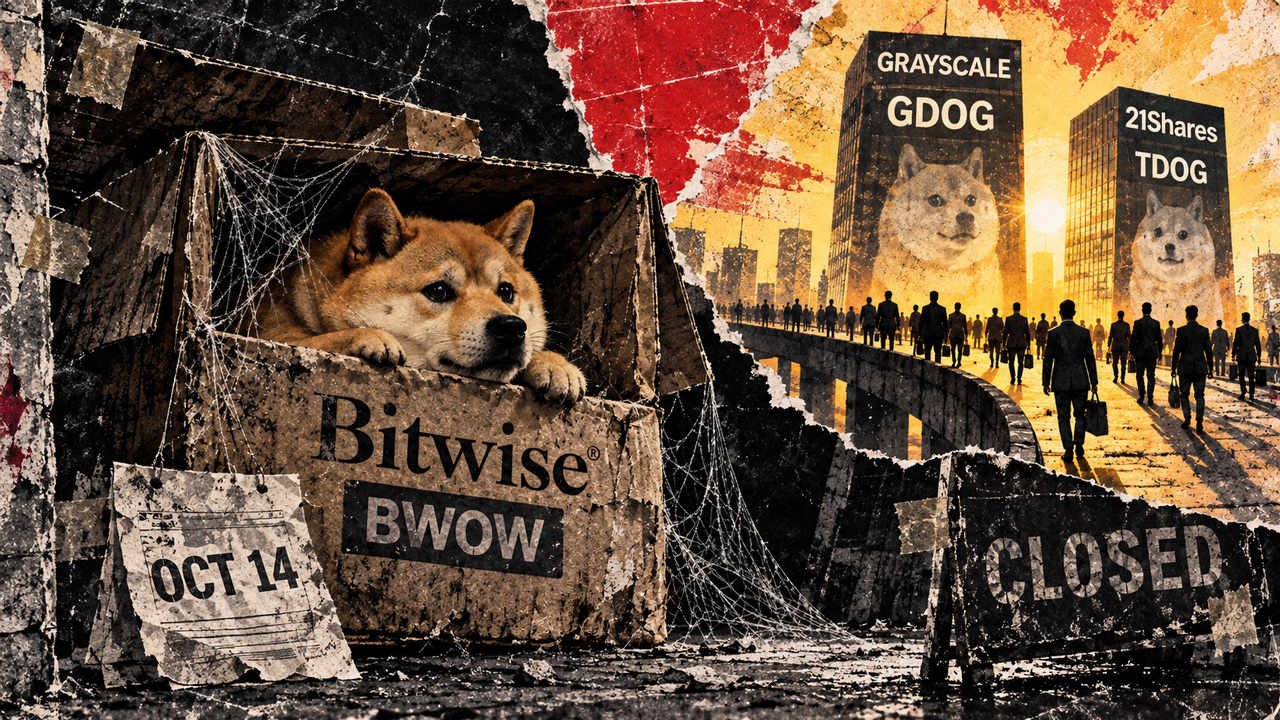
Bitwise offered the lowest-cost Dogecoin ETF available anywhere. Around $700,000 found its way in. On balance, more money walked out the door than ever arrived.
The asset manager announced on Sept. 10 that its Bitwise Dogecoin ETF, trading under BWOW, will cease trading on NYSE Arca on Oct. 14, with liquidation to follow the week after — a lifespan of under 11 months.
New shares stop being created ahead of the Oct. 15 open. Investors still holding the fund should get cash pegged to its Oct. 21 net asset value, arriving around Oct. 22. Bitwise framed the wind-down as part of optimizing its product lineup as investor needs evolve.
Stripped of the fund-industry phrasing: hardly anyone turned up.
An entire lifetime, three days of activity
One statistic captures it. Across its whole existence, BWOW logged a non-zero daily net flow on just three trading days.
Three days. Not three weeks of sideways performance — three sessions in which any capital moved whatsoever.
No inflow was recorded at all until Aug. 24, when roughly $146,000 arrived. Everything before that pointed the other direction: about $972,000 pulled on Dec. 4, 2025, followed by another $406,000 on Jan. 20, 2026.
Tally it up over nearly 10 months and you get roughly $1.23 million in cumulative net outflows from a fund that now holds around $700,000.
Being cheapest wasn’t enough
Anyone who believes expense ratios dictate where crypto ETF money goes should sit with this one. The Bitwise fee is 0.34%. Grayscale’s Dogecoin Trust ETF carries a 0.35% sponsor fee. The 21Shares fund levies a 0.50% management fee.
BWOW priced below every competitor and still came in dead last.
Grayscale’s GDOG has gathered somewhere near $11.7 million in cumulative net inflows. 21Shares’ TDOG has drawn about $1.63 million. Between them, they’re the sole reason the Dogecoin ETF category shows positive flows at all while Bitwise leaked capital from start to finish.

Grayscale’s head start is visible in the numbers
Some of GDOG’s advantage is structural, not a matter of outcompeting anyone. Grayscale’s Dogecoin trust had been running privately since January 2025 and sat on roughly $2.09 million in assets as of Oct. 31, weeks ahead of any public trading in its shares.
The listing followed on NYSE Arca on Nov. 24 — a single day before BWOW arrived. Coming to the exchange first with investors already on the books is a genuine edge, and it accounts for a good share of that $11.7 million spread.
It’s the 21Shares comparison Bitwise has no way to explain.
Launched later, priced higher, still ahead
TDOG arrived on Jan. 22, close to two months behind BWOW, and asks 16 basis points more. It nonetheless collected roughly $1.63 million in net inflows and built an asset base several times the size of Bitwise’s.
Later, costlier, and holding more money. Whatever advisor ties or distribution channels steered capital toward these products, BWOW never plugged into them.
The whole category is minuscule
Scale is worth keeping in mind, since not one of these funds is big. Cumulative net inflows across the US Dogecoin ETF market total roughly $12 million, with about $11.83 million in assets under management.
That’s everything. Every American Dogecoin ETF added together holds less than a mid-size crypto fund pushes around during a quiet week.
Dogecoin the asset is another matter entirely. The original memecoin — a proof-of-work payments network that launched in 2013 — is worth roughly $13.07 billion and ranks 11th among cryptocurrencies by market capitalization.

The real lesson here
A $13.07 billion asset propping up $11.83 million of ETF assets is a chasm worth examining. Appetite for regulated, wrapped exposure to Dogecoin simply isn’t there — not yet, anyway — and trimming a basis point off the fee won’t manufacture it.
BWOW holders should mark the calendar: Oct. 14 is the final trading day, with cash landing around Oct. 22 off the Oct. 21 NAV. Anyone who still wants Dogecoin ETF exposure afterward picks between a fund with an 11-month head start and one that charges more yet keeps adding assets.
Bitwise is exiting a market where an entrenched incumbent and a pricier latecomer both outperformed it on the one measure that determines whether a fund survives.