

Figma’s chief design officer wants one figure to stick with you: 17. According to her, that is the multiple by which teams’ output of lines of code has grown compared with the past. Over the same stretch, the number of releases has risen by only 1.3 times.
“We see Figma as the place where software teams come to decide what they build and ship. And so for that, I think one of the key things to keep in mind about what AI has changed and what it made available is the ability to build,” Loredana Crisan, Figma’s chief design officer, said. “There are 17-times more lines of code being produced today than in the past. But when you’re looking at releases, only 1.3-times more releases. A lot of that code actually is not necessarily built to ship, but really built to discover what the product is. It’s built to design.”
In other words, Crisan is talking about code whose purpose is exploring an idea, not shipping it. That argument is central to how Figma sells itself, and it shaped every announcement the company made this week at Config, its first edition of the event held in India. The bulk of the new features address a single issue: making AI agents, both Figma’s own and those built by other companies, follow a brand’s design rules rather than improvise.
A Markdown file that spells out the rules for agents
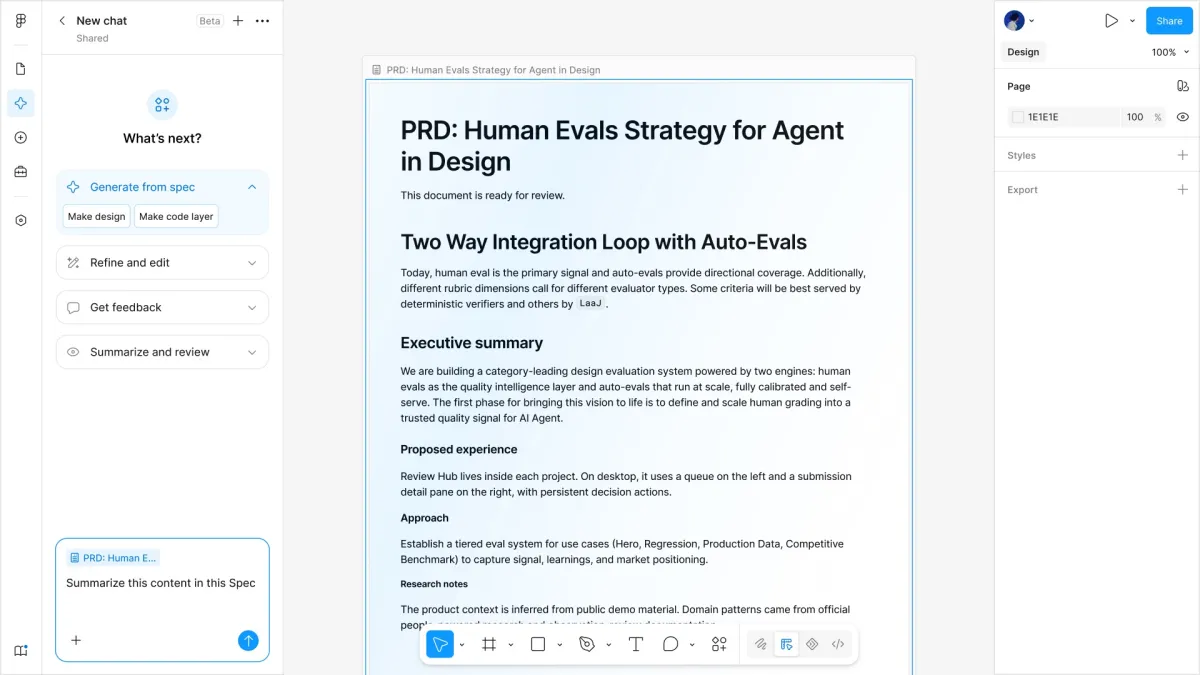
The headline launch is Figma Specs, a Markdown editor where a company can set down its design language in plain text. Teams can consult it as a reference while they work, and agents can do the same.
Specs can exist as standalone files in Figma, or they can be placed directly on the canvas alongside the work they describe. They aren’t restricted to text, either: users can point to elements on the canvas and drop FigJam diagrams, code layers and designs straight into the document.

Figma is also giving teams the ability to supply additional design context, such as design libraries, code libraries and guidelines, to govern how their design system is applied. Agents can pull from that central source so they stay inside the lines. Put simply, the color tokens and spacing logic a design team debated for months now sit in one location that a model can read.
Why Figma is suddenly after guardrails
The timing is logical. Within the past week, Figma expanded access to its agent on canvas to a broader set of users. AI is also non-deterministic, meaning the same prompt entered twice can produce two different answers. Figma is presenting these tools as a means of nudging agents toward more predictable output.
That is a sensible aim. Still, Figma’s chosen word is “steer,” which is not the same thing as control. A rules file is only useful if the agent sticks to it every single time, and teams will need to assess that once they’ve put it to work on real projects.
Code layers enter public beta
Code layers, which bring code into designs on the canvas so prototypes can be more interactive, have now moved into public beta. Figma originally unveiled the feature in private beta in June, so it has taken a few months to reach a broader audience.

Users can instruct the agent to convert a design into code, or to modify a portion of the code as they iterate on a prototype. This connects directly to Crisan’s argument about code “built to design” instead of built to ship.
Additional MCP tools and a CMS plug-in
Figma said its MCP now works with more than 20 new tools, among them Open Code, Dia, Grok Bot and Indian AI startup Sarvam.
The company is also linking Payload, the open-source headless CMS it bought last year, to Figma Make. The aim is to allow users to build dynamic websites and handle their content directly. According to Figma, Payload’s downloads have grown sixfold over the last 12 months.
Why India hosted the event
Choosing India for Config was deliberate. Figma said the country is its largest market by users outside the United States. The company opened its first office there late last year, staffed for sales, partnerships, go-to-market and product support.
Figma’s footprint in India extends past individual designers. The company said it works with 40% of India’s top 100 companies listed on the Bombay Stock Exchange. Companies like these tend to have detailed brand guidelines, which makes them exactly the kind of customer a feature like Specs is designed for.