

He sold a supercomputer. What investors actually bought him was a house.
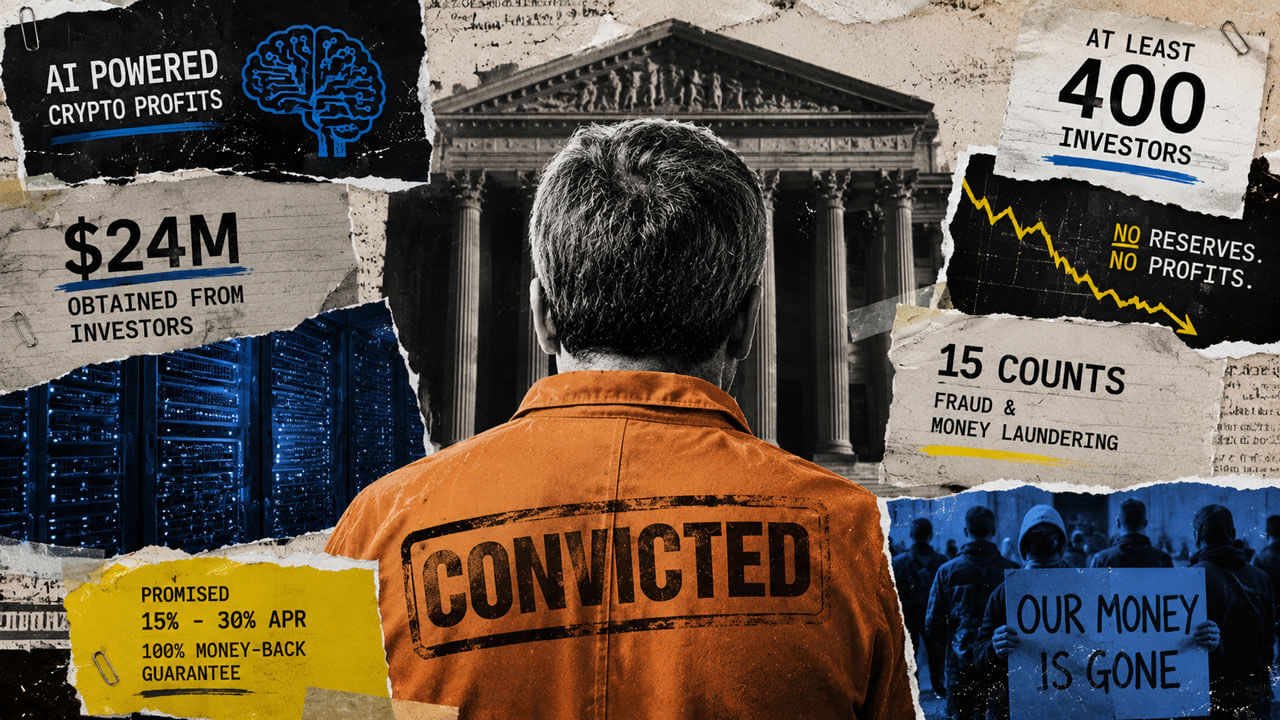
Brent C. Kovar, the man behind Profit Connect, has been convicted by a federal jury on 15 counts of fraud and money laundering, after prosecutors argued he collected $24 million from at least 400 investors by pitching an AI-powered crypto operation that never did what he said it did.
According to the Justice Department, the verdict followed a nine-day trial. Jurors returned guilty findings on 11 counts of wire fraud, two counts of mail fraud and two counts of money laundering.
What he told investors
Kovar’s pitch carried all the right buzzwords for its era. He told investors that Profit Connect ran AI software on a supercomputer to mine crypto and verify crypto transactions, per the Justice Department.
He described the company as profitable. He dangled fixed returns of 15% to 30% APR. And he tacked on a 100% money-back guarantee — the sort of line that ought to make anyone reading a pitch deck stop and go back over it.
He further asserted that Profit Connect was sitting on hundreds of millions of dollars in crypto reserves.
Prosecutors told a different story: the business was unprofitable, held no reserves, and had no legitimate means of funding either the advertised returns or the guarantee.
Where the money went
This is the part that separates a failed business from a fraud conviction. Investor funds, the Justice Department said, went toward operating Profit Connect, buying gifts for employees, purchasing a house for Kovar himself, and paying investors back.
Those payouts were pitched to investors as revenue from mining and transaction verification. They weren’t. They were other people’s deposits.
The Justice Department dated the conduct from late 2017 through July 2021 — the stretch in which Kovar marketed Profit Connect as a profitable technology business capable of producing what he had promised.
The numbers got bigger between 2021 and now
The SEC got there first. Its 2021 civil action alleged that Joy and Brent Kovar had raised more than $12 million from at least 277 retail investors since at least May 2018 through Profit Connect Wealth Services. The regulator said they promoted 20% to 30% annual returns tied to a purported AI supercomputer.

Set that against the criminal case and the gap is hard to miss. At $24 million, the Justice Department’s figure is roughly double the SEC’s earlier tally of more than $12 million, and the floor on the investor count climbed from at least 277 to at least 400.
A caveat worth holding onto: both are lower-bound estimates, and the two cases cover different periods and different legal questions, so they aren’t directly comparable. What the jump does show is that the publicly reported scope of the scheme had grown by the time Kovar was convicted. Establishing what investors actually lost, and how much they recovered, would take separate court or receivership records.
Sentencing is set for Nov. 30
Prosecutors said the convictions carry an aggregate statutory maximum of 280 years in prison. Read that as the legal ceiling stacked across all 15 counts, not a forecast.
The sentence itself rests with a federal judge, who will weigh the US Sentencing Guidelines along with other statutory factors — a calculation that in practice lands well short of the headline number.
The August 2026 jury verdict resolved Brent Kovar’s criminal liability on its own terms, separate from the SEC’s civil case against both Kovars.
For anyone sizing up a crypto venture today, the tell at Profit Connect wasn’t the AI claim or the supercomputer claim. It was the 100% money-back guarantee parked next to a 30% APR. No legitimate operation offers both, because no legitimate operation can.