

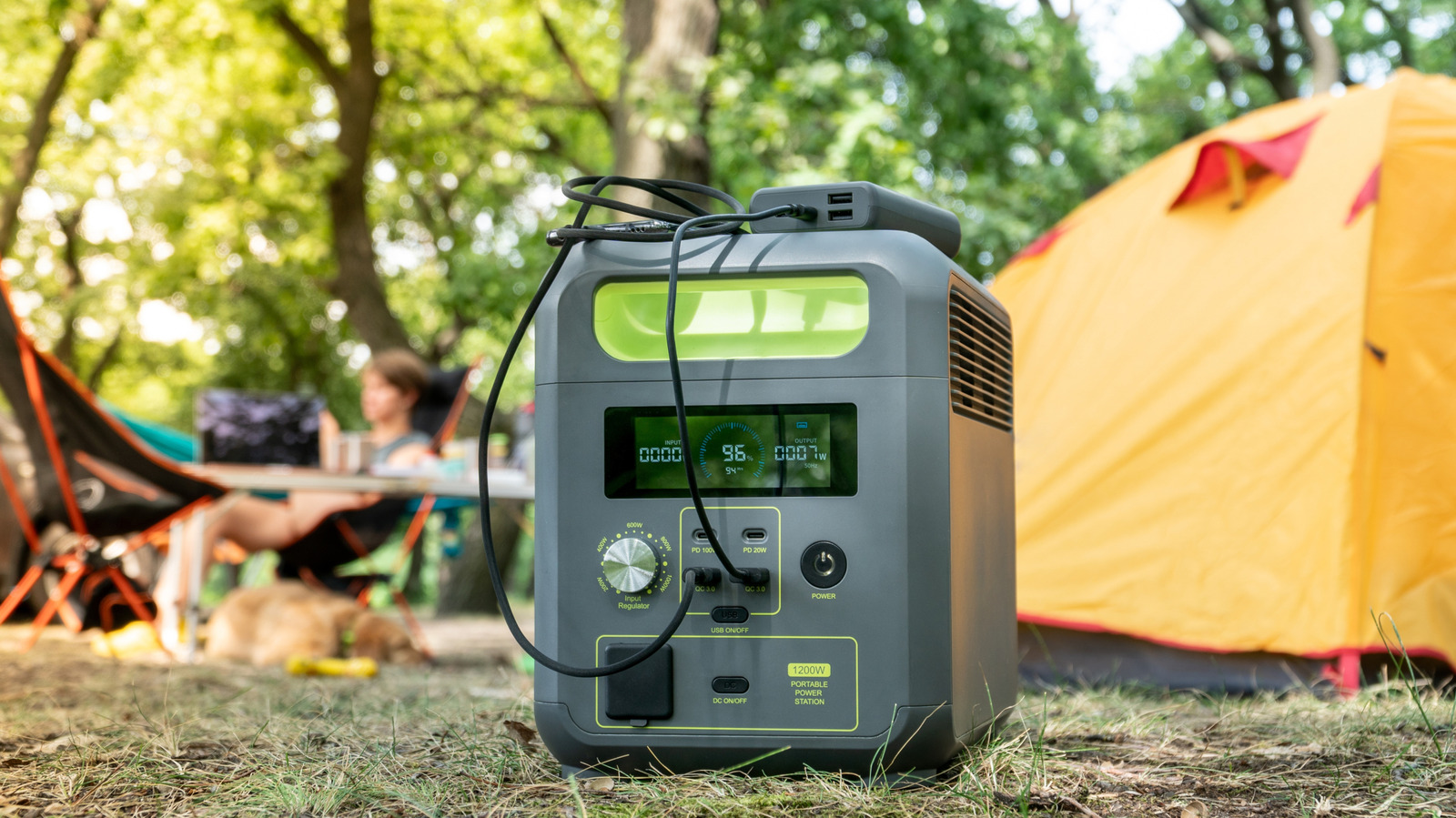
Do the sums and a 1,024Wh power station ought to run a 200W fridge for over five hours. Jackery makes a station with exactly that capacity, and it quotes four.
If you’re shopping for a portable power station, that gap is the first thing to understand. The capacity on the box is more than your devices will actually receive. How much less they get depends on the devices themselves, how hard they’re working and how efficiently the station converts its own power.
Simple division gives the wrong answer
The Jackery Explorer 1000 v2 is a good example. It has a 1,024Wh (watt-hour) rating and a maximum output of 1,500W. Split that capacity across the load and you’d expect a 200W fridge to keep going for more than five hours and a 65W laptop to manage well over 15.
Jackery’s published numbers are four hours for the fridge and 11 for the laptop. The company isn’t lowballing its own product. Those are the figures you’re left with once conversion losses are taken out.
The battery holds DC power, so the station has to convert it before anything plugged into an AC outlet can use it. That step wastes between 5 and 20 percent, and every inverter loses something. A phone or tablet charger plugged into the outlet adds a second loss, since the adapter converts the AC back into DC.
Label ratings are only a rough guide
A device’s rated consumption tells you little about what it pulls in practice. A gaming laptop might use a few dozen watts for web browsing and well over 200W when it’s pushed to the limit. A runtime estimate based on a single figure can miss by a factor of several.
Phones vary in the same way. Streaming a TV show over 5G draws far more power than logging crackers in a calorie counter app.
Plug into USB where you can
The easiest improvement is free. If the station has USB ports built in, use them for phones, tablets and other mobile devices whenever possible. You skip the wall adapter and the energy it wastes.
The AC outlets then stay open for equipment that needs them, such as the fridge.
Temperature eats into capacity
Spec sheets tend to understate how much temperature matters. Jackery rates the 1000 to deliver power between 14 and 113F (-10 to 45C), but its LiFePO4 (lithium iron phosphate) batteries perform best from roughly 59 to 95F (15 to 35C).
In very hot or very cold conditions outside that window, the battery gives you less. Putting the station in the shade, or somewhere air can move around it, can noticeably extend runtime.
A bigger station isn’t always the better buy
That brings you back to the first question: how much power do you actually need? Higher-end stations cost more, and they’re much bigger and heavier too. A unit with several kilowatt-hours can cost as much as the equipment it runs, or more, and lifting it may be a two-person job.
About 1,000Wh is a reasonable baseline for comparison. Small power banks can’t carry a household’s phones and laptops through a long outage, and stations in this class are also useful away from home, at campsites and job sites. Anker and EcoFlow both sell models that compete with Jackery’s at this size.
Each cycle costs some capacity
Capacity and battery lifespan are separate things. A power station loses usable capacity over time like any rechargeable battery, mainly as a result of how many full charge cycles (or the equivalent) it has gone through.
Wearing down a kilowatt-class battery takes a long time, but it does happen. Avoid running the station flat unless you have to, because every full drain uses up some of the capacity you paid for.