

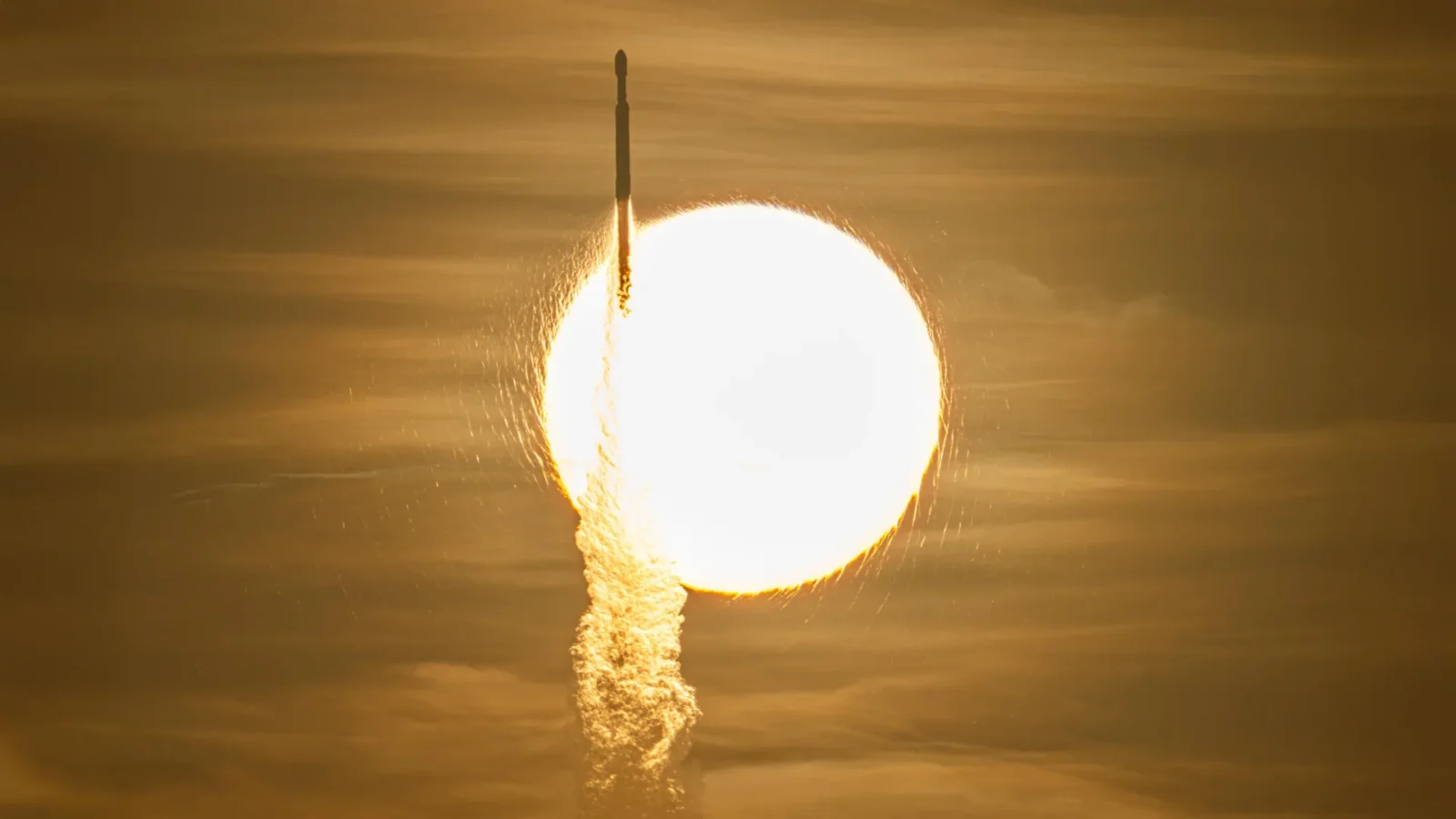
It took seven minutes from liftoff before controllers at NASA’s Goddard Space Flight Center in Greenbelt, Maryland, began receiving telemetry from the Nancy Grace Roman Space Telescope. Riding a SpaceX Falcon Heavy, the observatory departed Launch Complex 39A at NASA’s Kennedy Space Center in Florida at 7:26 a.m. EDT Sunday, and it now sits three months and about one million miles away from the orbit where its real work begins.
The launch clock isn’t the statistic to remember, though. This is: according to NASA, Roman is built to survey the universe roughly 1,000 times faster than the Hubble Space Telescope.
That claim carries a lot of weight, so it’s worth spelling out. Hubble captures exquisitely detailed images of comparatively small slices of sky. Roman is designed to produce views of similar sharpness across a far broader field. The detail is comparable; the sky covered per pass is not, and that’s the difference between examining galaxies individually and cataloguing them in vast numbers.
Why speed is the whole point
Engineers designed Roman to remain optically stable even as it slews rapidly between targets, eliminating lengthy settling pauses between observations. It’s an unglamorous design requirement, and it’s precisely what converts a capable infrared telescope into a survey machine.
Its headline science goals are dark matter, dark energy and exoplanets. NASA also anticipates that such sweeping observations will turn up plenty of findings beyond those three categories — the usual result of aiming a wide, sharp instrument at large swaths of sky.
"Roman will be a discovery machine that will bring us closer than ever before to answering humanity’s most profound questions about our cosmic history," said Nicky Fox, associate administrator for the Science Mission Directorate at NASA Headquarters in Washington. "With its large field of view and fast survey speeds, Roman will usher us into a new era of discovery and make the invisible visible, setting the foundation for humanity’s search for life beyond our solar system."
18 detectors the size of a saltine
Roman’s primary science camera, the Wide Field Instrument, powers up a few weeks into the cruise. The 300 megapixel infrared camera is assembled from 18 4K detectors, each roughly the dimensions of a saltine cracker. They gather photons from far-off objects and turn them into panoramas.
First, though, other hardware has to unfold. The team confirmed deployment of the solar panels and lower instrument sun shade one hour and 23 minutes after launch. The high-gain antenna and the visor-like deployable aperture cover come next over the following days, alongside the first of two course corrections and the activation of the Coronagraph Instrument.
Of all the hardware, the coronagraph has the longest tail. Photographing an Earth-like world directly is brutally difficult, since a host star can outshine the planet orbiting it by billions of times. A coronagraph screens out most of that starlight. Roman won’t be imaging Earth twins — its targets are closer to Jupiter in size — but it will mature technology that a future mission such as NASA’s Habitable Worlds Observatory concept could apply to the harder problem.
The handoff chain to L2
Falcon Heavy flew as planned, separating from the observatory 31 minutes after liftoff. Its two side boosters detached from the center core and returned to the launch site, where they can be refurbished. This marks the fourth primary NASA mission launched on a Falcon Heavy.
Communication with controllers initially runs through the Near Space Network, a combination of ground stations and relay satellites that handles tracking, telemetry and commands. Around 70 minutes post-launch, duties transfer to NASA’s Deep Space Network for the journey to the second Sun-Earth Lagrange point, L2, some one million miles away. At L2, the pull of the Sun and Earth allows a spacecraft to maintain its position while burning very little fuel.
The handover itself is a bit of choreography. Australia’s Canberra Deep Space Communication Complex takes the first shift. About six hours afterward, Madrid in Spain picks it up, followed by Goldstone in California. Three sites, uninterrupted contact, no gaps.
1.4 terabytes a day and not enough humans
With science operations underway, Roman will beam roughly 1.4 terabytes of data down to Earth every day — the highest daily rate of any NASA astrophysics mission to date, and more than conventional analysis can work through.
That’s why machine learning, artificial intelligence and citizen scientists will pitch in to comb the observations for anything noteworthy, leaving astronomers to chase down the most promising leads. Roman’s scientific yield hinges on triage every bit as much as on optics.
"We’ve never been able to view the universe with eyes like Roman’s before," said Julie McEnery, Roman’s senior project scientist at NASA Goddard. "There’s no telling what more we’ll know and have seen by this time next year."
The part NASA wants you to notice
Agency leadership is presenting the mission as a story about schedule and budget as much as about science.
"Roman is exactly the kind of success story we want to see across NASA," said NASA Administrator Jared Isaacman. "Delivered ahead of schedule and on budget, this mission reflects more than a decade of dedication from the NASA workforce and our industry partners. Now, Roman will give us a new atlas of the universe, push the boundaries of discovery, and demonstrate what is possible when America’s space program pairs bold ambition with disciplined execution."
The claim has support. NASA’s Launch Services Program collaborated with SpaceX earlier this year to move the launch date up, because work on the telescope wrapped ahead of expectations. Launches rarely shift in that direction.
The mission is managed by NASA Goddard, with participation from the Jet Propulsion Laboratory in Southern California, Caltech/IPAC in Pasadena, California, the Space Telescope Science Institute in Baltimore and researchers from a variety of institutions. BAE Systems Inc., L3Harris Technologies and Teledyne Scientific & Imaging serve as the principal industrial partners, while international contributions arrive from ESA, JAXA, the French space agency CNES (Centre National d’Études Spatiales) and Germany’s Max Planck Institute for Astronomy.
The three months ahead are given over to commissioning: instruments get tested and calibrated until the observatory performs precisely enough to begin genuine science. Circle early 2027 on the calendar. That’s NASA’s target for releasing the first images, and the first honest indication of whether a 300 megapixel camera surveying 1,000 times faster than Hubble lives up to the spec sheet.