

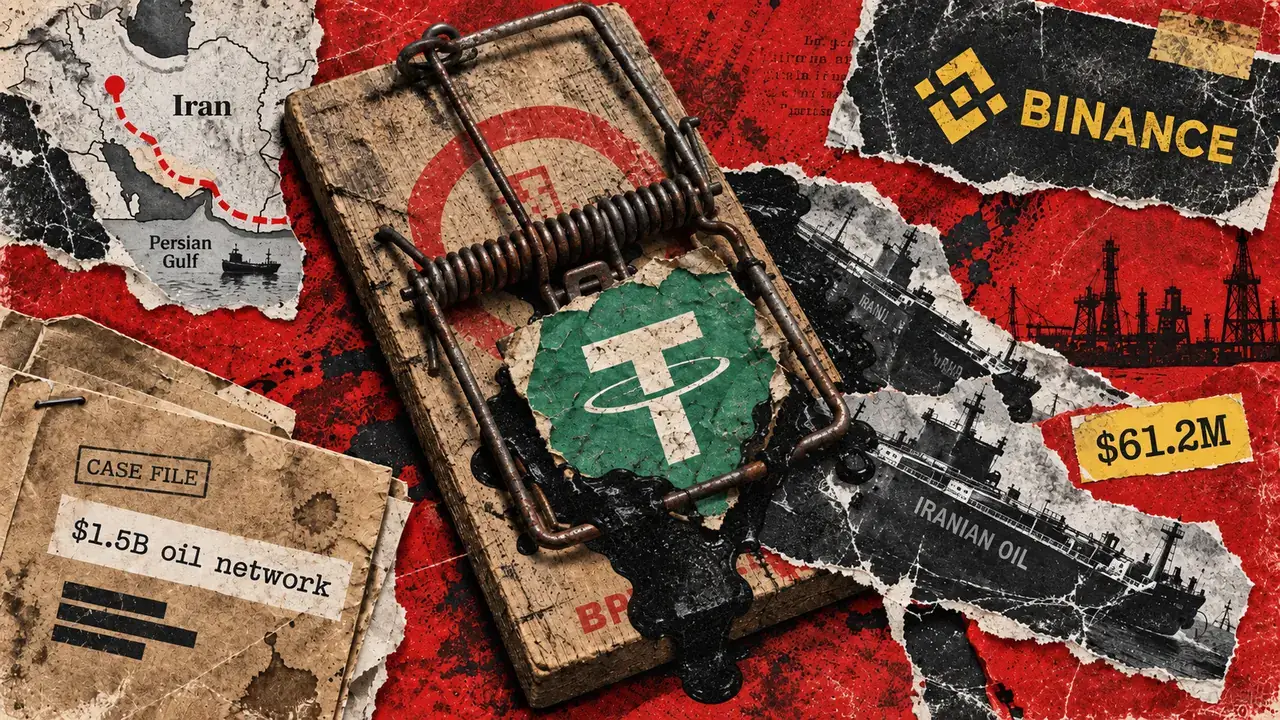
The number prosecutors are asking for is $61 million. The number they describe in the same document is north of $1.5 billion. That spread — roughly 4 cents on the dollar — is the sharpest available snapshot of what on-chain enforcement currently reaches, and what it doesn’t.
The US Attorney’s Office for the Southern District of New York lodged a civil forfeiture complaint on Sept. 14 aimed at about 61.2 million USDT spread across 10 Tron addresses. The government’s position is that the funds trace back to sales of Iranian crude and petroleum products intended to benefit Iran’s government and military, the Islamic Revolutionary Guard Corps included.
The money was already immobile. Seven of the addresses named in the filing were frozen by Tether in June 2025, with three more following in July. This week’s seizure warrant simply authorizes federal agents to take the value.
The part worth reading twice is how they take it
No private key gets broken in this story. The complaint describes Tether burning the frozen tokens, minting fresh ones of equal value, and routing those to a hardware wallet under FBI control.
That is the entire mechanism. The original wallets never move, their keys stay untouched, and the value slips out the back because the issuer controls the ledger that value lives on.
Anyone who has insisted stablecoins are bearer instruments now has a counterexample to answer. A token that can be destroyed and reissued on demand is not cash in a pocket. It is a row in a database that somebody responds to subpoenas about.
Entity A, and the money that isn’t being seized
According to prosecutors, a cluster of at least seven interconnected addresses — labeled “Entity A” in the filing — took in and passed along more than $1.5 billion in proceeds from the alleged illicit Iranian oil trade. Crypto from those addresses allegedly flowed to Nobitex, an Iran-based exchange, and to money transmitters in the Middle East that investigators believe operated as IRGC fronts.
What’s actually up for forfeiture — the $61 million — is whatever remained frozen and within reach by the time the paperwork arrived. Everything else is reconstruction after the fact.

Two Hong Kong companies and a lot of correspondent banking
Two Hong Kong-incorporated entities, Blessed Trust Limited and Hexa Whale Trading Limited, are accused of converting fiat proceeds from the oil sales into crypto and pushing the funds through trading accounts at Binance, the largest crypto trading exchange. Prosecutors said Blessed Trust marketed itself as a wealth-management or digital-asset custody operation, while Hexa Whale described itself as a commodities broker.
Not every rail in this network was a blockchain. The complaint states that one unnamed company wired roughly $37.15 million to Hexa Whale via US correspondent accounts across March and April 2024.
Between November 2024 and March 2025, that same company allegedly pushed a further $443.49 million to Blessed Trust, once more through correspondent accounts. Neither sum is part of the USDT being targeted for forfeiture; both appear in the filing to illustrate how the financing network was built.
Set those figures beside the headline number. Money crossing conventional US banking channels outweighs the crypto being seized by a factor of roughly eight.

Binance isn’t a defendant, and its CEO wants that on the record
The case levels no accusation of wrongdoing at Binance. Chief Executive Richard Teng said as much himself as soon as the filing hit the public record.
“This case was not filed against Binance and does not allege any wrongdoing by Binance,” Teng said.
He described the exchange’s stance on sanctions breaches and illicit activity as “zero tolerance,” and said Binance had been cooperating with law enforcement since the matter surfaced months earlier. Where sanctions or illicit-finance risks appear, Teng added, the exchange investigates, restricts or freezes accounts, offboards users when warranted and reports them to the authorities.
The distinction holds up. Alleged bad actors signing up for accounts at an exchange is not the same as an exchange knowingly shifting their money, and the complaint handles it accordingly.
Tether’s enforcement resume keeps growing
Shortly before the Iran complaint landed, Tether said the Justice Department had credited its assistance in an unrelated action covering more than $52 million connected to Xinbi Guarantee, described as a money-laundering marketplace. The two matters are not linked.
By its own count, Tether has cooperated with more than 340 law-enforcement agencies in 67 countries and contributed to freezing over $5 billion tied to suspected illicit activity.

Line those two enforcement capabilities up and the real map appears. Binance can restrict an account and shut a user out of its venue. Tether can reach the asset itself, wherever it happens to sit, and unmake it.
For anyone holding USDT on the theory that it is the internet’s neutral dollar, the detail that matters isn’t the $61 million. It’s that seven addresses were already dead in June and three more in July, while the court order to actually take the money didn’t arrive for another 14 months.