

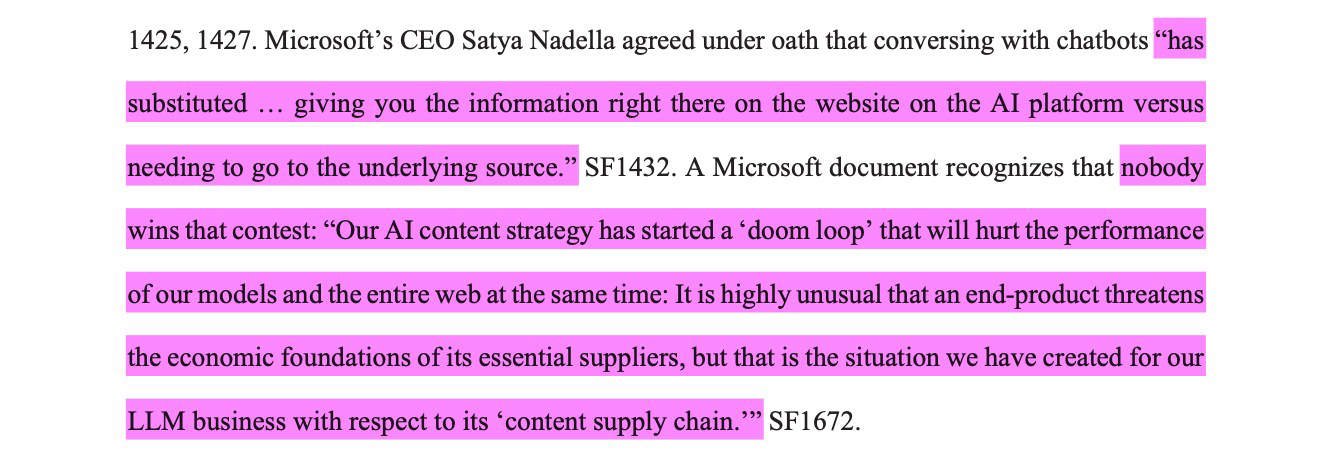
Newly unsealed documents from the New York Times’ lawsuit against OpenAI and Microsoft include a line that no corporation wants recited in open court. One internal Microsoft memo characterises the firm’s own strategy as having “started a ‘doom loop’ that will hurt the performance of our models and the entire web at the same time.”
No outside critic wrote that sentence. The supplier drafted the post-mortem itself, with the patient still alive.
Across all 92 pages, the filing keeps delivering material like this. The pattern running through it is awkward for both firms: the engineers and executives shipping these products grasped what they were doing to the web that sustains them, committed it to writing, and carried on regardless.
The quote Microsoft is trying to disown
Much of the bluntest phrasing traces back to Brent Hecht, Microsoft’s director of applied science. He described the data harvesting behind ChatGPT and Copilot as the “largest theft of labor in human history,” and argued that Microsoft’s defence makes a “complete mockery of the idea of ‘fair use.'”
![This case is about, as Microsoft’s Director of Applied Science [Brent Hecht] put it, “an astonishing theft of unprecedented proportions”; SF1437, perhaps the “largest theft of labor in human history.”SF1652. Defendants repeatedly copied millions of Plaintiffs’ copyrighted articles in their entiretywithout permission to produce substitutive commercial AI products. OpenAI’s Head of ChatGPTwrote that “[p]ublishers” face an “existential threat” from those products, SF1466, which, he said,“are largely substitutive, period” and “will get more and more substitutive as they get better.”SF1473-74. Such admissions eviscerate Defendants’ “fair use” defense because substitution is“copyright’s bête noire.” Andy Warhol Foundation for the Visual Arts, Inc. v. Goldsmith, 598 U.S.508, 528 (2023). For Defendants to prevail on this defense “would,” the same Microsoft executiverecognized, arguably “make a complete mockery of the idea of ‘fair use.’” SF1450.](https://egamers.io/wp-content/uploads/2026/09/microsoft-and-openai-knew-theyd-started-a-web-doom-loop-2.jpg "Court Filings Show Microsoft and OpenAI Called Their Own AI Strategy a Web 'Doom Loop' 28")
Rather than defend the remarks, Microsoft has moved to distance itself from its own director of applied science. “These comments reflect one employee’s individual perspective, are not a legal analysis, and do not represent the company’s views,” said Microsoft spokesperson Alex Haurek.
A separate filing takes the argument further. Jordan Usdan, GM for data strategy and ops at Microsoft AI, painted Hecht as something of an internal dissenter. Hecht “holds divergent, academic, and forward-looking views about how data ecosystems for AI should operate and is employed at Microsoft to bring asymmetrical, futuristic, and academic points of view … nor is he someone who speaks for Microsoft specifically as to his theoretical views on AI’s potential effect on content creators,” Usdan said.
Go over that again. The company is not claiming Hecht got it wrong. It is claiming he was hired precisely to say things like that.
Google Zero stopped being a theory
And this is where the “theoretical views” defence starts to buckle: it already came true. Google Zero is here. AI is consuming the web, and the evidence sits in your own analytics dashboard.
In the filing, Satya Nadella concedes that chatbots have largely taken over from search and eliminated the need to visit the original source for an answer. Microsoft’s internal document states the structural consequence far more directly: “It is highly unusual that an end-product threatens the economic foundations of its essential suppliers, but that is the situation we have created for our LLM business with respect to its ‘content supply chain.'”
Another passage quotes Microsoft conceding that “LLMs are a product that destroys its own supply chain,” since the model ends up standing in for the very training data that created it.
The referral numbers behind it
Even OpenAI’s own media and economic experts linked falling referral traffic at outlets such as the Times directly to AI-generated summaries, Google’s AI Overviews among them. Their estimate: search referrals could be off by as much as 60 percent.
OpenAI’s Nick Turley boiled the dynamic down to a single sentence — once the chatbot has answered you, there is “no good reason to click” through to the source. Internal material referred to ChatGPT as “the modern newsstand.” A newsstand, that is, that never pays the printers.
“Insanely good at regurgitation”
OpenAI was equally aware that its model could reproduce copyrighted text word for word. Staff noted that “prevention of memorization” was important to “minimize copyright violations,” before observing that GPT-4 “memorized a ton of data and therefore will be insanely good at regurgitation.”
The filing backs that up with evidence, listing instances of ChatGPT reproducing lengthy passages copied directly from pieces published by the Times, Mercury News, The Denver Post, LifeHacker and Eurogamer.
That distinction is the crux of the case. The question isn’t whether training on public text counts as fair use in principle, but whether a system capable of reciting an article on request functions as a replacement for reading it.
The paywall answer is the worst one
“Anything that is paywalled should be licensed,” Nadella is quoted as saying — a defensible stance. Yet an OpenAI representative conceded being “unaware” of any work to identify or strip paywalled material out of the training data.
The first of those is a statement of principle. The second is a description of operations, and it’s the operations answer that tells you what actually shipped.
About the altruism
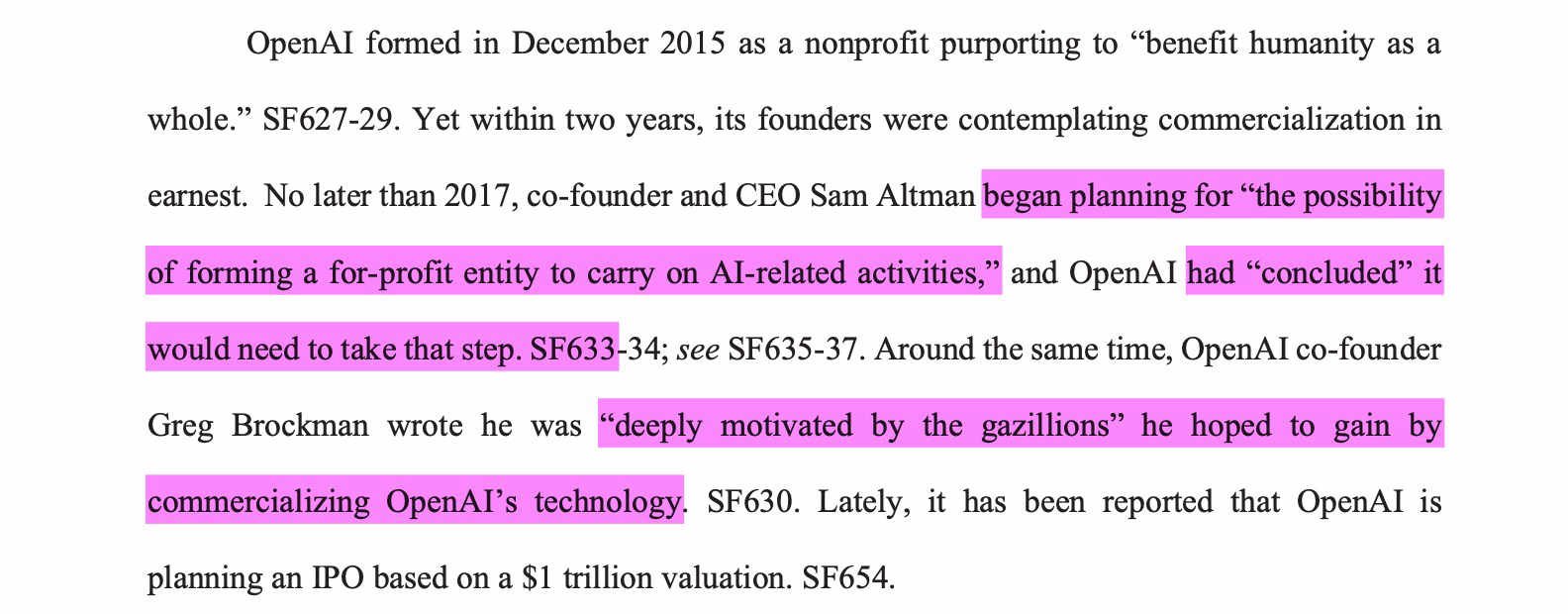
For years, both companies have presented this work as a benefit to society. The filing supplies a rather different vocabulary. OpenAI cofounder Greg Brockman comes across as more focused on the “gazillions” of dollars commercial AI might hand him.
Microsoft, for its part, had no illusions about how the scraping would be received by those on the receiving end, acknowledging that “almost no one intended for they [sic] content they created to be used in this fashion, nor are they compensated for its use.”
OpenAI policy director Jack Clark looked further down the road than most, cautioning that the company was “creating systems that substitute for the labor of the people that define the ‘culture’ of society.”
The defense, and what it leaves out
Haurek’s caveat: “Satya’s testimony and Microsoft’s position in this case are perfectly consistent. He spoke to broad principles and changes underway in how people find and consume information. Those observations should not be confused with conclusions about copyright questions before the Court, which Microsoft addresses in its filings.”
Granted — the legal conclusions are the court’s to draw. But legal conclusions aren’t what this filing is mainly about. It’s about what was known, and on that point the documents leave little room for interpretation. Both firms recognised they would inflict lasting harm on the publishing business and the “millions of people” it employs, recognised that the harm would circle back and degrade their own models, and proceeded anyway.
For anyone running a site that lives on search traffic, the lesson here isn’t to be angry. It’s that the organisation with the best view of your traffic collapse already ran the numbers, typed “doom loop” into a document, and shipped the thing regardless. Build your next two years around the assumption that no one is riding in to repair the referral figures — the people who wrecked them tallied the price and judged the gazillions worth it.