

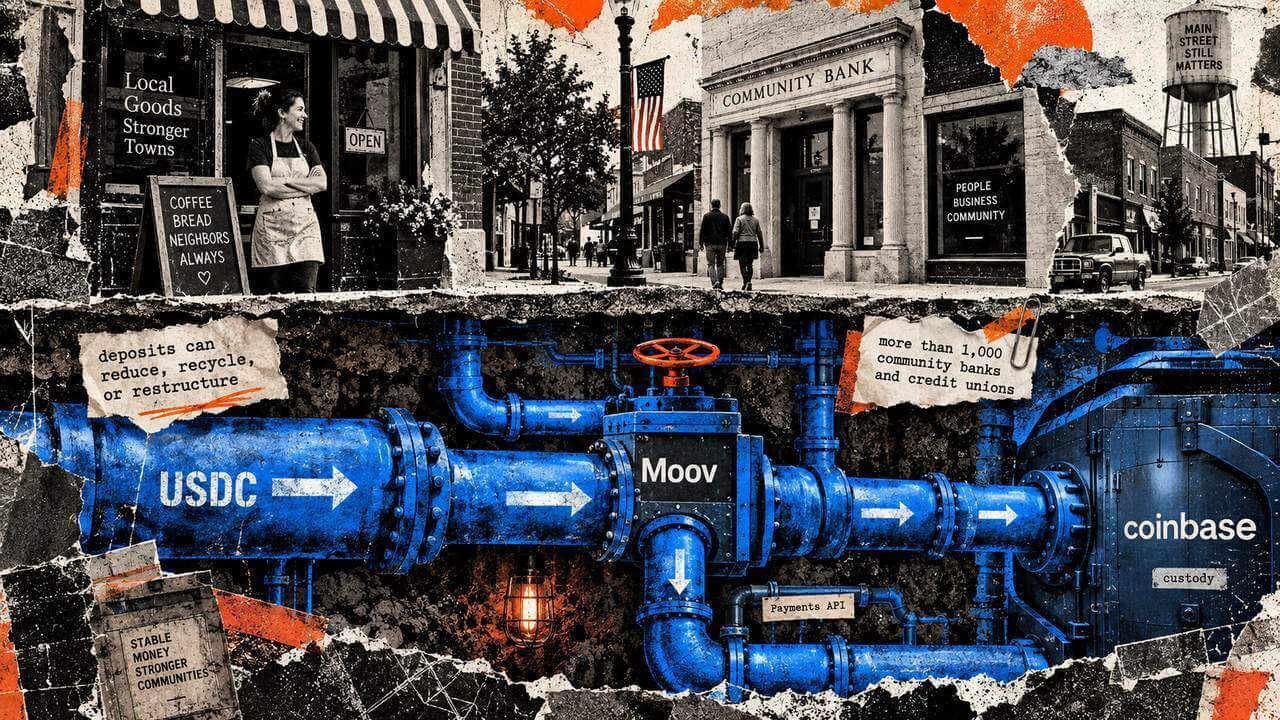
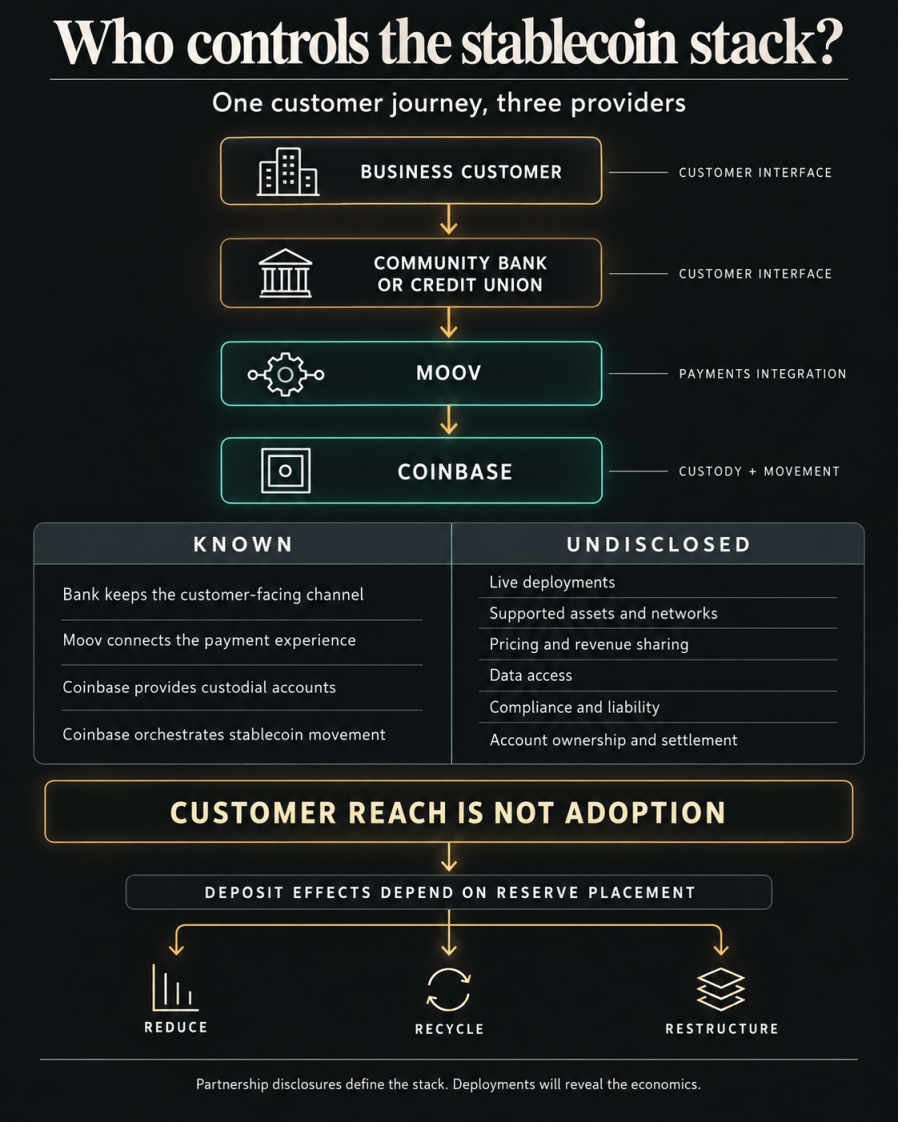
A small-town business reaching a stablecoin rail now has three parties standing in the path. The customer relationship belongs to the bank or credit union. The payments-platform link comes from Moov. Custody and movement components come from Coinbase, per its announcement. To the customer, it all looks like a single bank-branded product.
That is the architecture of the arrangement Coinbase unveiled Sept. 10 with payments platform Moov — and the architecture is the real story, not the press release.
What lands on the banks’ side
Coinbase’s stablecoin payments infrastructure is being folded into the platform Moov already operates for financial institutions. According to Coinbase, fund custody will run through its CDP Custodial Wallet accounts, while its Payments API handles the orchestration of stablecoin movement. Moov’s job is wiring those pieces into the systems its bank and credit-union clients are already running.
For a community institution, the sales logic is simple enough. The account relationship stays yours. In exchange, you offer a service that would otherwise mean standing up a crypto stack in-house.
Moov CEO Wade Arnold framed the demand without hedging: business customers asked to accept stablecoins currently go outside their primary financial institution. What Moov and Coinbase are after is relocating that service inside the payments experience the institution already provides.
The headline figure is not the meaningful one
Per Coinbase’s announcement, Moov serves a customer base of more than 1,000 community banks and credit unions. Read that as reach, not uptake.
How many institutions are live, how many have signed and how many are piloting all go unstated. No implementation schedule came from either company. The 1,000 number therefore measures the doors Moov is able to knock on — and says nothing about which ones have swung open.

The docs tell you more than the quotes
Laid out in Coinbase’s standard payments documentation is a custodial-account stack in which crypto can arrive in an account, sit and be reconciled there, then exit via fiat or crypto transfers. A separate set of custodial wallet documentation states that Coinbase custodies the assets in those accounts on behalf of the CDP entity.
Those references cover the general platform. Still, they are the sharpest public signal of just how substantive Coinbase’s role is behind whatever interface the bank presents.
The list of omissions runs longer than the list of disclosures. Which stablecoins and networks each institution supports, who owns the custodial balances and how fiat settlement is routed — none of it is specified. Pricing, revenue sharing, access to transaction data, how compliance duties are divided and where liability lands are all invisible from outside.
Each of those gaps decides who ends up capturing the value.
Wrapping it in bank branding doesn’t rewrite the legal claim
This is the piece that ought to slow down a community bank CFO. Dropping a stablecoin into a bank channel does nothing to move the stablecoin’s legal status.
The Federal Deposit Insurance Corporation, in a proposed rule issued in April 2026, said deposits held at banks as reserves for a payment stablecoin would be insured as corporate deposits of the stablecoin issuer, subject to applicable limits. Under that proposal, no pass-through deposit insurance would reach the holders of the stablecoin.
Tokenized deposits get a boundary of their own in the same proposal. If an instrument satisfies the statutory definition of a bank deposit, it remains a deposit — whatever technology or recordkeeping sits behind it.
The upshot: a payment stablecoin and a tokenized deposit can deliver an identical digital-dollar experience to a customer while embodying entirely different legal claims. A tokenized deposit that qualifies is still a liability of the issuing bank. Routing a customer to a third-party stablecoin keeps the payment experience within the bank’s channel, yet the converted funds may cease to be a deposit at that bank.
Deposit outflows don’t follow a script
The apocalyptic telling of this story presumes deposits leave dollar for dollar. That is not the Federal Reserve’s reading.
Stablecoins can reduce, recycle or restructure deposits, according to a Fed analysis published in December 2025. Which of the three plays out turns on who the buyers are, which assets get converted and where issuers park their reserves.
Deposits can shrink when domestic customers convert transaction-account balances, an effect that intensifies if issuers park reserves outside the banking system. Keep those reserves in bank deposits and more funding stays put — though it may drift away from dispersed retail accounts and into concentrated, uninsured wholesale balances.
Any individual community bank faces a tighter version of the question: does that reserve money circle back to it, or does it collect at the bigger custodial and settlement banks?
The Fed already described this playbook
That same analysis catalogued partnerships, custody services, settlement accounts and white-label infrastructure among the routes banks can take to stay attached to digital payment flows. What Moov has built is that catalogue turned into a product.
The Fed flagged the underlying strain as well. Stablecoins may separate the payment relationship from the deposit-funded lending model banks have historically used to serve households and businesses.
One product design here contains both outcomes at once. The customer conversation may remain with the bank. Coinbase may pick up transaction and custody activity as customers reach stablecoins by way of their primary institution. Which side ends up with the deposits and the revenue is still an open question.
The signals to track once banks start going live
Whether Moov’s network turns into genuine demand will show up in adoption counts. Whether stablecoin activity feeds value back to the same institution or diverts it elsewhere will show up in supported assets, account ownership and settlement paths.
Commercial disclosures matter just as much. Whether the bank actually earns from the service or simply provides distribution comes down to pricing and revenue sharing. Who gets to strengthen the customer relationship — and who absorbs the cost when monitoring or processing goes wrong — comes down to data access and compliance responsibilities. And liability terms set how much of that operational control converts into financial risk.
What Coinbase has extended to community banks is a bridge into stablecoin payments, with its own custody and payment infrastructure holding it up. The design may well stop the bank from disappearing from the customer’s field of view. The real test is how much of the payment relationship, the balance-sheet value and the decision-making authority remains with the bank once customers get their stablecoin access through it.