

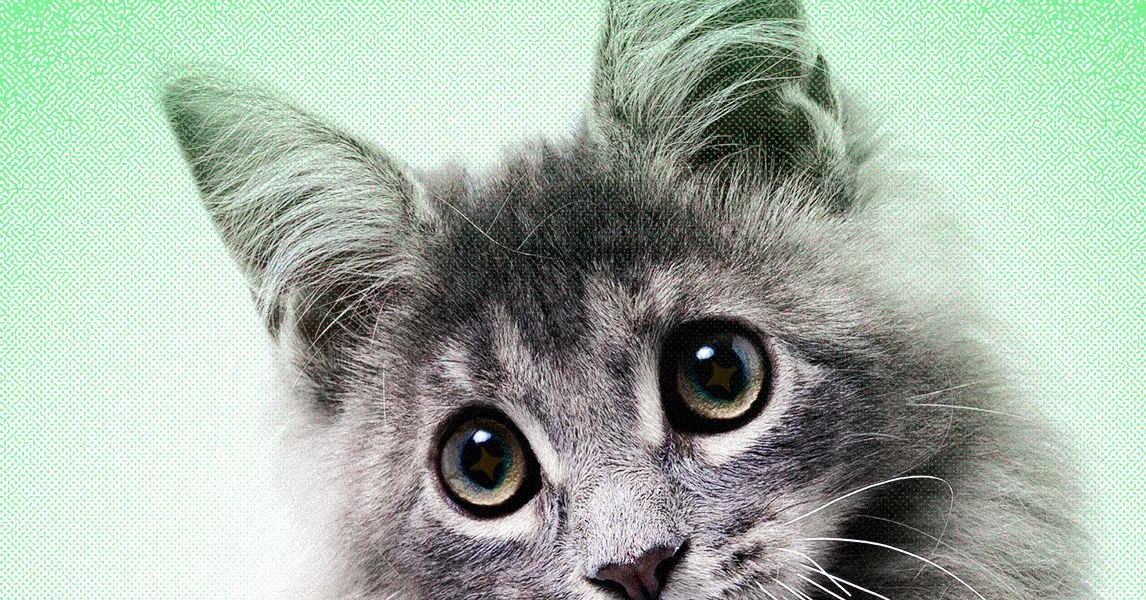
In April, Mibbby Butler believed Brooklyn had finally turned up. A stranger texted her a photo of the cat perched on a kitchen counter, cradled in a girl’s arms — four days after her roommate’s boyfriend allegedly took him and abandoned him a half-hour away in the Los Angeles suburbs.
Then came the request: cash up front, supposedly to cover Brooklyn’s temporary care.
That pushed Butler to study the image more closely. The cat’s pose matched, exactly, the photo she had used on the missing poster she’d shared to social media. The same Torani syrup bottle stood in the background. The same microwave. But the lettering on the bottle had dissolved into gibberish, the most familiar AI giveaway there is.
She kept her money. Four months on, Brooklyn is still gone.
The scam that runs on grief
“I didn’t know people scammed for lost pets,” Butler says. She never went to the police either, since she couldn’t tell whether an actual crime had taken place.
Roughly once a month, another deepfake arrives from someone new insisting they have found her cat. In testing conducted by WIRED, ChatGPT acknowledged that it had produced at least one of those images — the one showing a purported Brooklyn eating in front of a doorstep. WIRED then fed in the original missing-poster photo along with a 29-word prompt and got back a picture nearly identical to the scammer’s.
Twenty-nine words. That is the entire barrier to entry for turning someone’s lost pet into a weapon against them.
Now the real footage is under suspicion too
The nonprofit We Animals has published work by 175 photojournalists chronicling alleged abuse and other harms inside farms, circuses and scientific labs. The material is meant to shock, which has always invited doubt, says Eva von Jagow, the group’s marketing manager.
Consider the drone video the group shared of row upon row of hutches allegedly used to house calves separated from their mothers at an Arizona dairy farm. The composition is so unrelentingly geometric that it reads as synthetic.
Critics once charged We Animals with staging its photos or running them through Photoshop. The accusation now is AI — even though the group forbids its photographers from touching the technology. “How to prove it’s not AI?” one Instagram user commented beneath the dairy farm video earlier this month.
There’s the trap. Proving a negative offers no clean route when the audience has been burned often enough to stop extending the benefit of the doubt.
What it costs to defend yourself
We Animals expects it will need to begin releasing behind-the-scenes clips and spelling out how its staffers verify submissions. It also plans to adopt technology that embeds provenance and editing history directly into the digital files.
Victoria de Martigny, the group’s director of visual content, says that trust is worth protecting because losing it would “open up the door to people questioning all of the work,” and “we don’t ever want to be in that position.”
Weigh the asymmetry. A photojournalist makes the trip to a farm, secures access, captures the footage, then assembles a second layer of documentation purely to establish that the first layer happened. Meanwhile, someone with a chatbot subscription conjures a fake rescue in under a minute and collects the ad revenue.
Cheap fakes crowd out expensive truth
Genuine, emotionally charged imagery is how conservation and welfare projects bring in donations. For the operators of AI slop accounts, synthetic pictures are merely a shortcut to likes and ad money.
Because fakes cost so much less to make, they appear to be drowning out real clips in social feeds and search results, says Oscar Horta, a philosopher and leading animal activist who recently helped direct a short film about how AI could affect wildlife.
What worries Horta most are the far-fetched rescue videos: wild animals plucked from fires and floods, that sort of thing. He believes the likely AI-generated content will push audiences to doubt legitimate rescue tactics and undercut fundraising for them later — a bad trade at a moment when extreme weather events are becoming more common.
The risk is physical, too. Fake footage can teach people to do dangerous things. “There are deepfakes of polar bears drowning and people on boats coming and rescuing them,” Horta says, calling the scenes “ridiculous” and “unrepresentative of what it means to help animals.”
The fixes on the table are partial
This month, Jeff Sebo, director of the Center for Mind, Ethics, and Policy at New York University, began pressing AI developers to write language into their model guidelines that would steer the systems away from generating responses potentially harmful to animals.
The goal, Sebo says, is to “emphasize the importance of staying grounded in evidence and reason” around the possible suffering of individual creatures, without being “overly preachy, overly moralizing, or refusing reasonable user requests.”
New laws in California and the EU now oblige the most popular AI image generators to embed invisible tags identifying content as machine-made. Social platforms, in turn, must read those tags and publicly label the pictures and videos.
ChatGPT, Gemini and Meta AI each offer features that reveal whether an image originated with that particular chatbot. Useful on paper. In practice, nobody uploads every animal photo they scroll past, and limits apply, including caps on how many images you can check.
Wiring verification into messaging apps and browsers, switched on by default and with privacy protections in place, would close most of that gap. None of it exists yet.
Where she goes instead
Butler’s iPhone might have flagged that first photo as probably fake before she allowed herself to believe it. It didn’t, and no setting she could have changed would have helped.
Every account that puts an AI cat video in front of her gets blocked. New ones keep appearing.
So she has been spending more time in a Facebook group for artists who oppose AI, some 300,000 members strong, where she can look at work she knows a person made. That is the sanctuary now — a walled-off corner of the very same platform, where she waits for Brooklyn.