


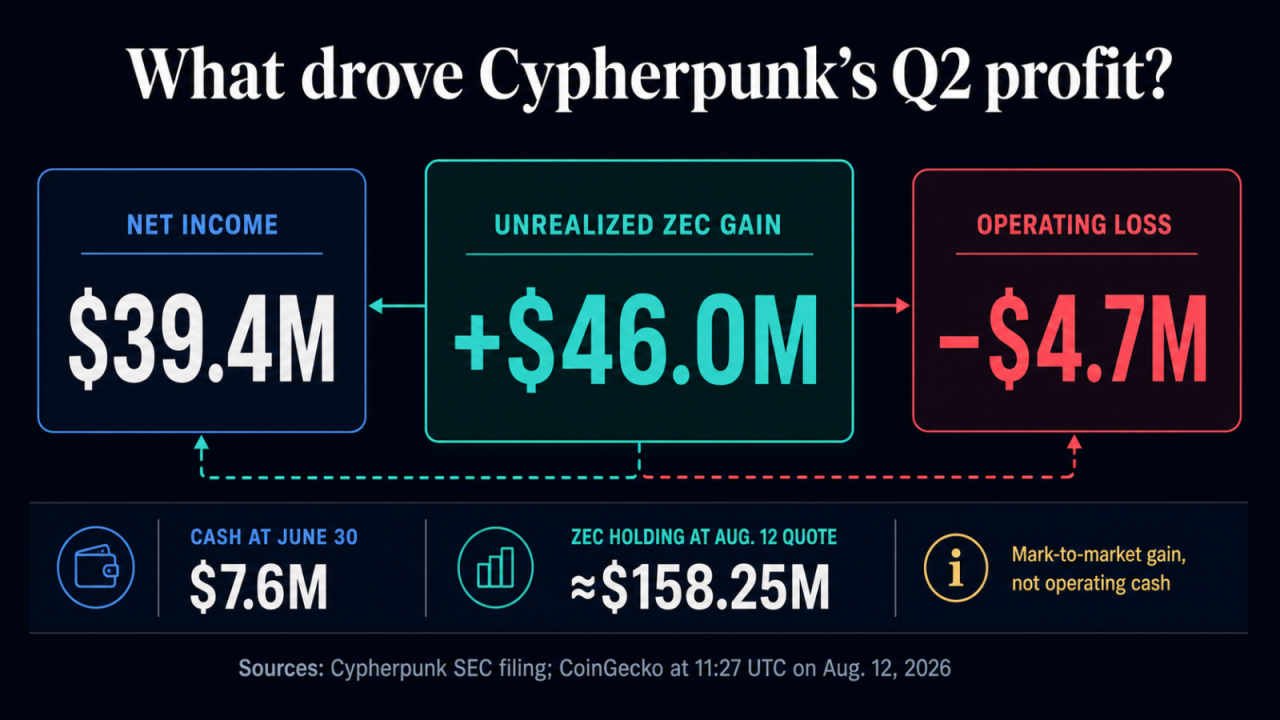
Remove a single accounting entry and Cypherpunk Technologies would be reporting a rough quarter. Leave it in place and the company shows $39.4 million in net income.
The entry in question is a $46 million unrealized gain on the firm’s Zcash treasury. Strip it away and the Zcash treasury company, which also owns Leap Therapeutics, was running a $4.7 million operating loss in the second quarter.
Neither figure is fabricated. They simply track different things, and only one of them required the company to sell anything.
Set against last year, the reversal looks stark: a $16.6 million loss then versus a $39.4 million profit today. That shift wasn’t produced by the operating business. It came from the token price.
Where the $4.7 million went
Of the quarter’s expenses, research and development came to just $0.2 million. General and administrative costs ran to $4.5 million.
That is the entirety of the operating loss, and the proportions deserve a pause. G&A outweighed R&D by a factor of more than 20.
Before the ZEC revaluation ever reached the income statement, the company was already losing money at the operating level. Every line above the treasury entry trends downward.

The gain nobody sold anything to get
At every reporting date, Cypherpunk marks its Zcash stack to market. Under that treatment, price swings are recognized without the company having to part with a single token.
The $46 million, then, is an accounting outcome tied to one specific moment in time. Cypherpunk applied a ZEC price of $400.09 as of June 30, which valued the treasury at $129.4 million on the balance sheet.
Choose another date and the quarter changes shape. That isn’t a knock on the methodology — it’s simply how mark-to-market functions — but it does mean the headline profit captures a price rather than documenting a business.
What they actually hold
As of Aug. 11, the company said its holdings stood at 323,394.38 Zcash, acquired at an average price of $341.83. That works out to roughly 1.92% of circulating supply.
Do the arithmetic and the total acquisition cost comes in near $110.5 million.
CoinGecko had ZEC at $489.34 as of 11:27 UTC on Aug. 12, valuing the stack at roughly $158.2 million. Zcash is up 2.11% over 24 hours and currently sits at rank 12 by market cap.
Measured against that $341.83 average cost, the position is comfortably in profit at today’s prices. It is also a position whose stated value has swung by tens of millions across two dates roughly six weeks apart.
The $7.6 million that isn’t Zcash
One number tends to disappear beneath the nine-figure treasury total. Cypherpunk listed $7.6 million in cash and cash equivalents as of June 30.
It is held separately from the ZEC balance, which the company recorded as a digital asset receivable. Bills get paid with cash. Written-up tokens don’t cover them until someone actually sells.
And $7.6 million set against $4.5 million of quarterly G&A alone is worth keeping an eye on.
Leap goes looking for money
Alongside that cash position sits a separate move in the biotech arm. Leap Therapeutics, Cypherpunk’s wholly owned biotechnology subsidiary, has begun a process aimed at securing the resources required to push sirexatamab into Phase 3 development.
According to Leap, that process might involve funding the program as a standalone entity or striking a deal with a pharmaceutical or biotechnology partner. Options on the table include a partnership, a license, a collaboration, a sale, or some other business combination.

It’s an expansive menu. Menus that wide generally signal a company holding every door open because it can’t yet tell which will swing.
No timetable was provided, and Cypherpunk warned that neither financing nor a transaction is guaranteed. The company also drew no connection between Leap’s search for resources and its Zcash strategy.
Two companies wearing one ticker
Investors are effectively holding a profitable quarter driven largely by an unrealized token gain, bundled with a drug program whose next phase still hinges on finding additional resources.
The quarter demonstrates how much the price used to revalue the treasury can shape reported earnings. That works in both directions — and last year’s $16.6 million loss serves as the reminder.
When the next filing arrives, bypass the net income line and look at two things: the ZEC price applied in the revaluation, and whether Leap has identified a partner or a financing. Those two figures reveal more about Cypherpunk than the profit printed at the bottom.