

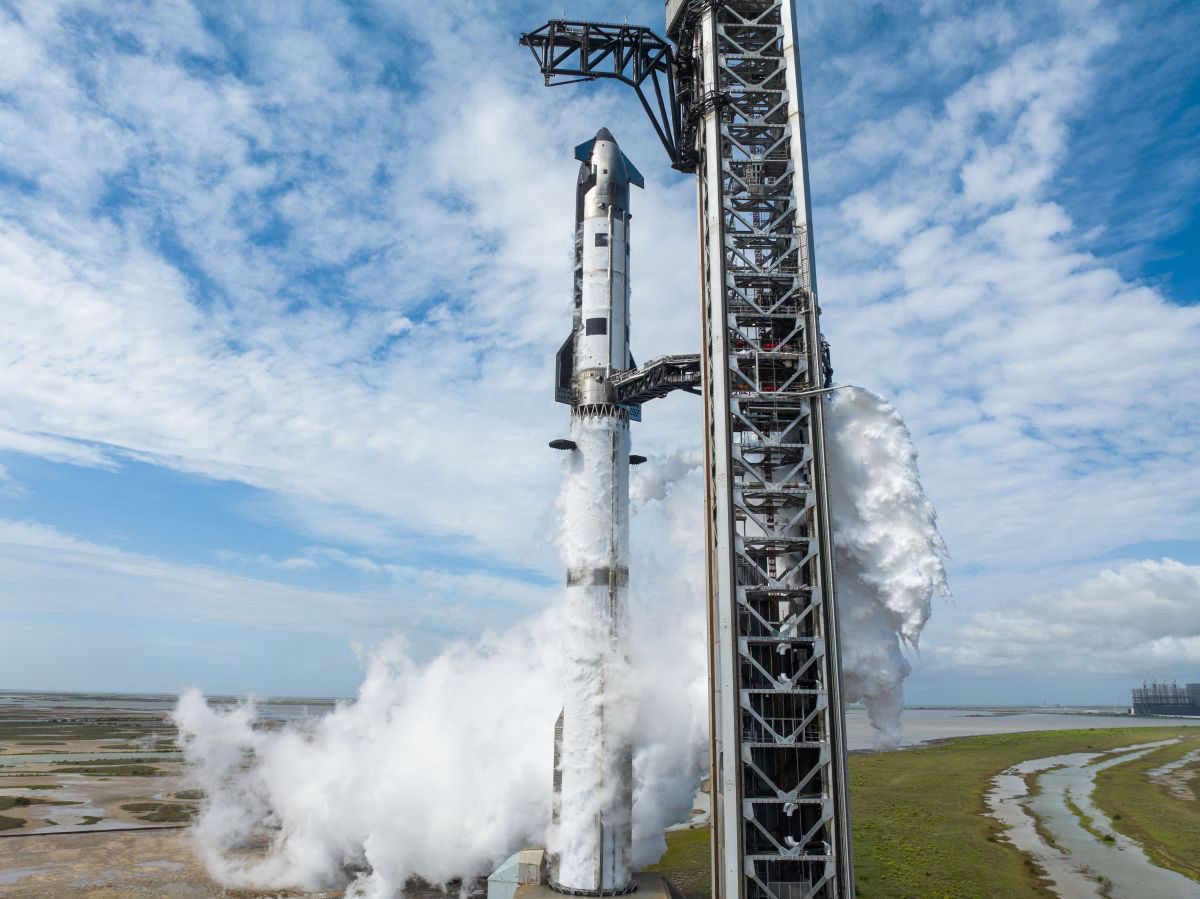
After seven years of searching, the site that won out was a former Exxon tract in the marshland of Vermilion Parish. SpaceX intends to pour $100 billion into a second spaceport there, sitting west of New Orleans and roughly a 10-hour drive from the original Starbase in South Texas. Ground breaks in 2027, and the company says a Starship will lift off from the location in 2029.
One detail deserves a second look: the milestone this entire $100 billion wager rests on still hasn’t been achieved.
The rocket hasn’t earned the spaceport yet
Since 2023, Starship has completed 13 test flights. That’s a genuine tally of genuine launches, and SpaceX has ticked off no shortage of development milestones in the process. What it has never managed is returning the booster and the upper stage to the pad on the same flight. That isn’t some ambitious extra — it’s the fundamental bar a reusable rocket has to clear, and the company hasn’t cleared it.
Flight 14 is on the way, and it may carry Starship’s upper stage to orbit for the first time. Success there still leaves the tougher work ahead: catching the vehicle, refurbishing it, and cycling it back around quickly enough to fly several Starships in a single week. That cadence is a target SpaceX chose for itself. No one has approached it with any vehicle, never mind the biggest and most powerful rocket ever flown.
Committing $100 billion to a launch complex built for a vehicle that hasn’t yet made a complete round trip is a particular flavor of confidence.
The state’s timeline doesn’t match SpaceX’s
Louisiana Economic Development, the state agency managing the arrangement, is hedging in the fine print. LED puts the start of construction by the close of 2027, with “initial operations expected to come online in 2030.”
The company’s number is 2029. The state’s is 2030. A full year separates the figure SpaceX is promoting publicly from the one the agency drafting the economic impact projections will actually attach its name to.
Interpret that spread as you see fit. It’s the sort of detail that usually proves more telling than the surrounding press-release copy.
Musk is killing Falcon for this
Rather than hedge the bet, SpaceX is doubling it.
Founder and CEO Elon Musk said this past week that the Falcon rockets will be retired once Starship is flying multiple times per week. His comments back up earlier Bloomberg News reporting that SpaceX had already begun signaling to prospective customers that the Falcon program was being wound down.
Falcon 9 and Falcon Heavy do the heavy lifting. They are the proven, reusable vehicles that built SpaceX into what it is today. Swapping them out for a rocket that hasn’t yet recovered both stages on a single flight is a real gamble — and Musk is giving customers the news up front instead of after the fact.
The tab so far: over $8 billion spent on Starship development, according to SpaceX’s own filings with the Securities and Exchange Commission.
This is really about Starlink
Set the spaceport framing aside and the reasoning clarifies. Starlink is the sole profitable piece of SpaceX's business, and sustaining its growth requires lofting far more satellites than Falcon can deliver at a workable cost.
On top of that, SpaceX is mapping out a whole satellite constellation devoted to AI processing. Launching that will take Starship as well.
Operating two spaceports isn’t ambition for its own sake — it’s the throughput a satellite business needs in order to keep scaling.
What Louisiana actually gets
LED forecasts 3,000 direct new jobs across 10 years, with an average annual salary of $92,600, plus more than 30,000 construction jobs at peak buildout.
“We are very excited to be in this position to receive one of the best opportunities of a lifetime which will bring not only a variety of jobs to our Parish but will offer opportunities to our grandchildren allowing them to stay home for employment,” Vermilion Parish Police Jury President Chad Vallo said in a statement.
SpaceX frames the project as a “self-sustaining spaceport” featuring “propellant production, power generation, deep-water shipping capabilities, vehicle processing facilities, and an airport.”
Left unanswered is whether the company plans to grow a company town around the facility, as it did in Texas. That Texas municipality went by Boca Chica before taking the name Starbase. It has a ZIP code of its own and a volunteer fire station, and it’s standing up a police force and a community library. SpaceX employees — or their relatives — fill its local government posts.
The safety record follows the company here
The Texas Starbase functions as a launch complex and an active construction site simultaneously, and its injury rates over the past decade have been extremely high. Of everything SpaceX runs, it’s the most dangerous site. Hundreds of injuries there have been reported to the Occupational Health and Safety Administration.
A construction worker employed by a third-party contractor died in a fall at Starbase in May.
Now picture that same construction setting scaled to more than 30,000 workers at peak buildout. In Vermilion Parish, that’s the figure to keep an eye on — not the salary number.
The environmental pitch, and the history behind it
SpaceX has weathered years of criticism and courtroom fights over its handling of the ecosystem surrounding the Texas site. It comes to Louisiana carrying that history and taking a different tack.
Per LED, the company has “already engaged the Louisiana Department of Wildlife and Fisheries, Coastal Protection and Restoration Authority and other appropriate state agencies to proactively address potential impacts to wildlife, fisheries and their supporting habitats.”
SpaceX adds that it is “partnering with state and federal agencies to expand Louisiana’s Coastal Master Plan and Coastal Wetlands Planning, Protection and Restoration Act projects, including Gulf shoreline protection breakwaters designed to reduce wave energy” and limit shoreline erosion locally.
Approaching the wildlife agencies before any dirt is turned marks a shift in posture. Whether the practice shifts too is something the flight schedule will reveal, not the announcement.
The number that decides all of it
For anyone following this story, set aside the $100 billion and the 2029 date for the moment. Keep your eyes on flight 14.
Should Starship’s upper stage make orbit and SpaceX begin recovering both stages on the same mission, the Louisiana spaceport becomes infrastructure catching up with a vehicle that works. Should it not, the company is laying concrete along the Gulf Coast for a rocket that still can’t do the one thing that would justify building for it twice.