

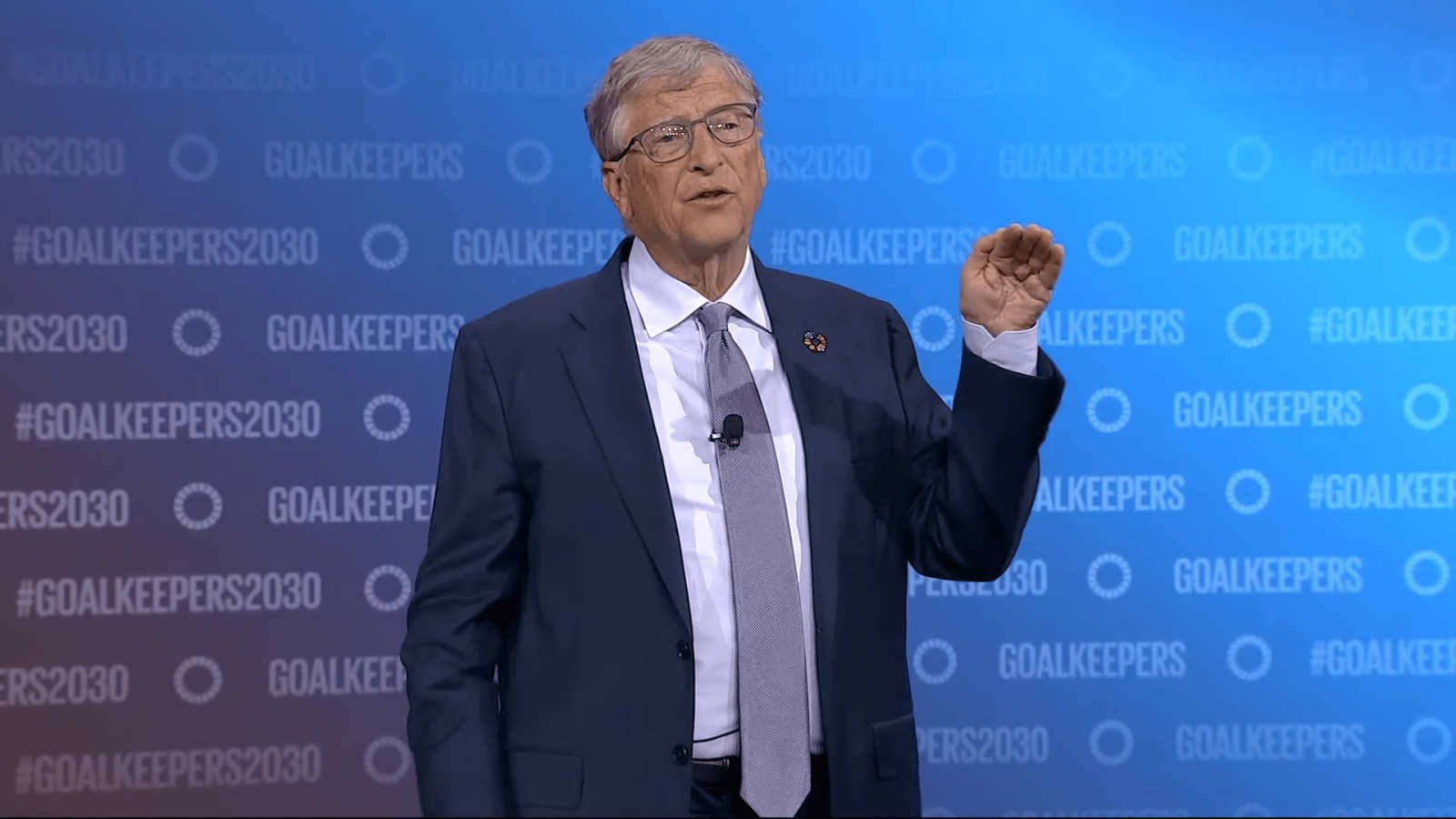
Bill Gates built a career convincing the world to buy computers. He is now telling the New York Times that his own industry is misleading the public about what happens next, because the next trillion dollars is riding on it.
The Microsoft co-founder made the case in an essay running close to 6,000 words, alongside an interview, and he doesn’t soften it. The move into the AI age, he says, ranks as “one of the most turbulent times in human history.” Preparation is inadequate, in his view, and no plan exists at all.
The weight of it comes from the source.
The quiet part, on the record
The harshest thing Gates says is aimed at the people he has worked alongside for decades. They understand exactly how capable these systems are, he argues, and they are playing down the dangers on purpose, because the sums involved are too large.
“In private, people who understand how good this stuff is, and how much better it’s getting, they’re very worried,” he told the NYT. In public, they tell each other, “Hey, man, don’t say that. It’s bad for us – the next trillion dollars we’re trying to raise.”
That is a pointed accusation rather than a hazy anxiety about tomorrow. He is describing a room he has sat in.
Why the usual reassurance doesn’t apply
The familiar consolation runs as follows: every earlier technological shift added more jobs than it eliminated, so this one will follow suit. Gates rejects the analogy.
The AI age, in his words, is “utterly, absolutely, completely, totally different.”
The reason is mechanical. Reshaping work took the PC two decades, because people had to purchase new hardware and pick up new skills. AI already lives on the devices people own and accepts instructions in ordinary language. “We don’t have to adapt to it because it can adapt to us.”
On top of that, a technology can for the first time not merely substitute for human thinking but exceed it, across industries, within a single decade rather than over generations. That pace is what the rest of his argument rests on.
Entry-level work goes first
Permanent job losses top the list of his concerns, hitting hardest at entry-level and mid-level positions across sales, customer service, software development and legal support. Blue-collar roles are in the firing line as well, as soon as agile robots become far cheaper. A large share of that robotics development is taking place in China.
None of this is framed as prediction. As evidence that the change is already underway, he points to a Stanford study: since AI became widespread, employment among young workers in the most exposed occupations has fallen noticeably, while their older colleagues have so far been left alone.
The generational split is the detail that deserves attention. That is precisely the signature you would see if firms quit hiring juniors instead of laying off seniors, and it is far harder to detect in a top-line unemployment figure.
The bioweapons problem has no clean fix
His second worry ranges well beyond employment. AI smooths the path for cyberattacks, fraud and disinformation, but what alarms him most is how far it drops the barrier to producing bioweapons. A handful of people with access to advanced AI could engineer new pathogens, Gates cautions.
The difficulty is that the beneficial capabilities cannot be neatly pried apart from the dangerous ones. A model that locates a security flaw so it can be patched is the same model that helps somebody exploit it.
He notes as well that AI systems may increasingly act on their own in ways that run counter to human interests.
Chatbots that never disagree with you
Danger number three is intimate. According to Gates, AI companions that are permanently available and never object carry genuine potential for addiction.
He points to research out of Stanford and Carnegie Mellon: the more intense and emotional a person’s use of these chatbots, the worse their wellbeing. This isn’t “some users reported.” It is a dose-response relationship.
Children concern him particularly, as does the wearing away of critical thinking, which he treats as a survival skill in a world of deepfakes and custom-built disinformation.
Tax the robots, reserve the jobs
Gates is not dismissing the technology. He sees vast potential in science, healthcare, farming in poor countries and education. Those gains, though, will not materialise by themselves. They have to be secured through policy, and he does not believe the industry will manage that on its own.
“Self-regulation on the most dangerous tool ever invented? No, thanks!”
His preference is for a democratic process plus new national and international bodies, modelled on the oversight regimes covering nuclear weapons, aviation or the protection of the ozone layer.
The most concrete measure he puts forward is a modest tax on AI use and on robots, and his reasoning is accounting rather than ideology. Employ a person and payroll taxes follow. Purchase a robot and it can be written off immediately. In effect the tax code nudges companies toward trading people for machines. He also contends that some occupations, caregiving among them, ought to remain in human hands, a concept he labels “Human Reserved.”
The moment that changed his mind
Why, then, is the man who helped create the computer industry the one sounding the alarm? Because it arrived at the thing he knows best.
Programming is his own territory, and Anthropic’s Claude Code stunned him. “The idea that now these things are in a meaningful sense better than I am is like: What the hell?”
He does openly declare his conflict of interest. Financial ties to the tech sector remain, although the profits go to the Gates Foundation.
Track the drift since 2018
The change in tone is what makes this notable. Back in 2018, Gates described AI as essentially better software and held out the promise of longer holidays and more employment in social fields. By 2022 his line was that workers displaced by machines would be wanted in fields such as elder care and childcare, with retraining and a fairer distribution of wealth being the key issues.
Even in September 2024 he was sceptical that AI would fundamentally alter the disinformation problem. That position was already strained: studies of the period found GPT-4, supplied with personal information, could raise agreement with arguments by 81.7 percent relative to debates between humans.
Two years on, he is calling for an international oversight body. That is not an adjustment. It is a reversal.
He’s not the only one saying it
Dario Amodei, Anthropic’s CEO, sounded a warning in 2024 about AI-generated bioweapons and forecast in 2025 that as many as half of entry-level office jobs could vanish, pushing unemployment to 10 to 20 percent. The idea of a token tax came from Amodei too.
The proposal for international institutions also has precedent. In 2023, researchers Gary Marcus and Anka Reuel called for a global nonprofit AI agency built on the model of the International Atomic Energy Agency. A US report released in 2024, meanwhile, recorded anonymous safety concerns raised by staff at leading AI companies, including unease about the incentives driving their leadership.
Set that final item beside Gates’s line about the next trillion dollars. Anonymous employees were saying the same thing from inside those buildings two years before Gates said it publicly with his name on it. What separates them is that he can afford to.