

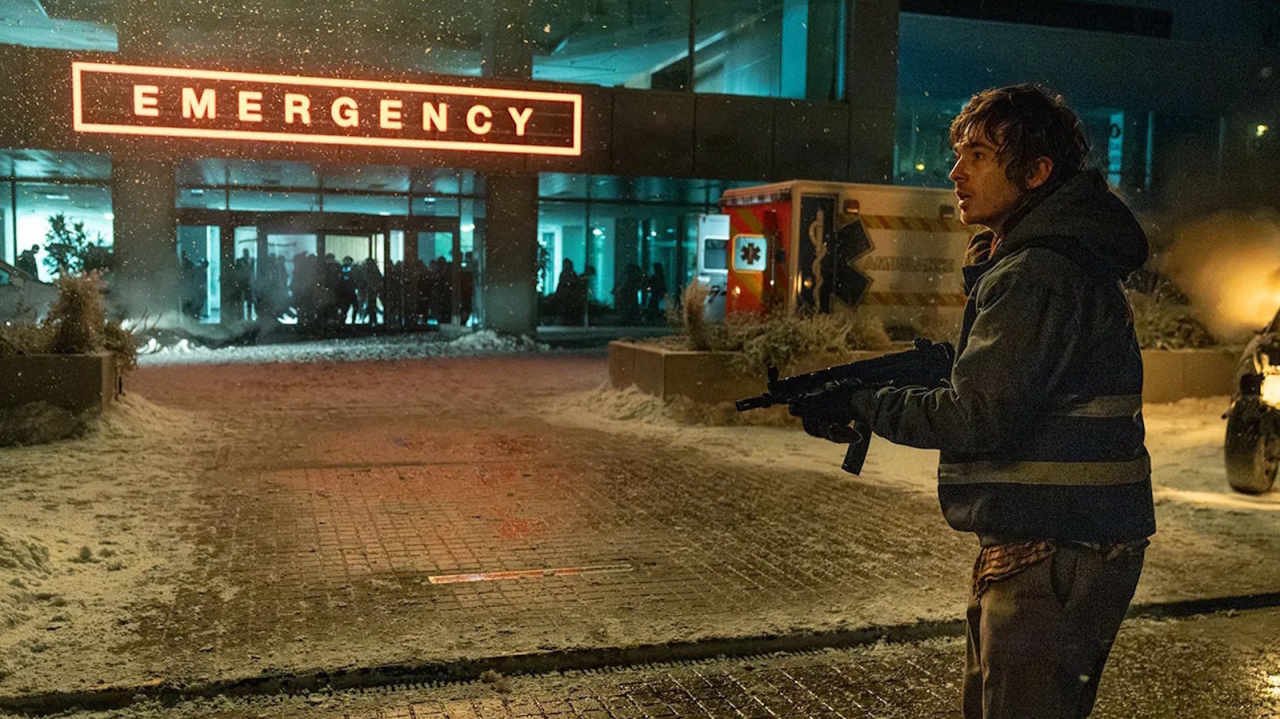
It took seven films, but the smartest move any Resident Evil movie has pulled off is simply aiming the lens at the back of a character’s skull.
That’s the whole trick. Zach Cregger, who made Barbarian and Weapons, didn’t solve the adaptation puzzle by stuffing the runtime with references. He solved it by framing the movie as though a controller were in your hands.
Milla Jovovich’s six entries were chasing action-picture status. They borrowed the title and threw out everything that actually makes the games tick: the dread of stepping into a room you haven’t swept yet, the arithmetic running in your head once you’re down to four shells and half a health bar. Scarcity is what Capcom’s series is built on. Those films were built on detonations.
The camera does the work the script can’t
Austin Abrams plays Bryan, a medical courier handed a last-minute delivery to an isolated town up in the mountains. Raccoon City, naturally. He’s also carrying the low hum of possible fatherhood, his girlfriend having just learned she’s pregnant. A flawed everyman — precisely the shape this story needs.
A wreck on an icy road sends the film into first person as Bryan walks toward a wounded woman, an unmistakable echo of the camera inching toward the first zombie in the original Resident Evil. She isn’t a zombie at all, though, but some kind of deranged creature, and the framing switches into something like an over-the-shoulder chase circling an overturned police car.
Interactivity is something no movie can actually give you. Cregger sneaks up on it anyway, further than seems fair. Long stretches park us immediately behind Bryan or tucked in at his shoulder — the Resident Evil 4 angle — and every so often the camera lurches as if a thumb were mashing a gamepad’s right stick.
The ammo count is the tension
A pistol turns up right where Bryan needs one, and the deranged woman goes down. That’s the opening beat, not the payoff.
A rabid dog chases him into a barn, where a textbook ladder puzzle defeats him. An equally convenient shotgun surfaces while he’s holed up in an abandoned farmhouse, and the thing is useless weight until shells finally materialize. One room holds nothing but a typewriter — among the handful of open nods, filling in for the save rooms of old.
The crucial part is that Bryan is always aware of exactly how many rounds he has left, which means you are too. The guns arrive early. They help far less than you’d assume. Resource scarcity remains the engine from start to finish, exactly as it is in the games.
Fan service isn’t the point, and Cregger knows it
A heap of dreadful CG Resident Evil movies exists already, assembled purely from references, alongside the failed 2021 live-action reboot Welcome to Raccoon City. Staging the things fans are hoping to see was never the assignment.
What gives Cregger the edge is that he occupies two roles simultaneously: a horror director capable of writing people worth watching and building a scare you haven’t already sat through, and a fan who grasps what survival horror is actually up to. Arrive with zero knowledge of the games and the film still lands. Arrive knowing them, and each fresh doorway registers as a room you haven’t cleared.
Both ways of getting it wrong are thoroughly on record. Slavish recreation hands you the atrocious Super Mario Galaxy or the forgettable Uncharted. Tossing the source entirely hands you the terrible ’90s Super Mario Bros. picture. Modest doses of creativity and effort were all it took to make the Sonic and Minecraft films watchable.
A Legend of Zelda movie is gearing up at Nintendo, and Hollywood at large is hungry to lift from games. Whoever’s on that Zelda set ought to study what Cregger managed with a shotgun and an empty shell count.