

Cumulative trading in Coinbase’s stock tokens has reached roughly $1.02 billion. That figure seems comforting until the moment you want out. On Sept. 23, the pools that would take the other side of a sale held a combined total of about $12.97 million.
The two numbers are not measuring the same thing. Volume tallies trades that have already been completed. A pool balance reflects capital that is present in the market at this moment. For anyone holding one of these tokens, it is that second figure that determines the payout, particularly while US stock markets are shut.
A $100,000 sale received a price. Depth is another matter
In a premarket check on Sept. 23, KyberSwap was asked for indicative routes to buy and to sell roughly $100,000 of each of Coinbase’s 10 stock tokens on Base. A quote came back for every token.
For sells, projected proceeds landed between 0.06% and 0.71% under KyberSwap’s own dollar valuation of the tokens on offer. For orders that large in pools this small, that is a narrow spread.
The quotes have a boundary, though. Each route prices a single order at a single point in time. Not one of them reveals how the market would cope with many holders trying to leave at once, and not one captures an executed trade.
The size of the order made a difference. With about $10,000 per token, sell-side quote gaps sat between 0.01% and 0.12%. Stepping up to $100,000 tended to widen them.
A few of the stronger $100,000 prices were assisted. Several routes drew on Aerodrome and additional liquidity sources simultaneously, meaning the quote shows how far the router can stretch rather than what any one pool can absorb. That external liquidity is supplied by market makers and providers whose offers can shift fast.
The limits of $12.97 million in pools
At the time of the check, the 10 main Aerodrome stock/USDC pools spanned from about $818,700 for MSFTc up to $2.11 million for NVDAc.
Every one of those balances combines two assets: the stock token and USDC. A top-line total cannot reveal how much USDC stands ready to buy your tokens within a particular price band. The $12.97 million figure is therefore a starting point for analysis, not a conclusion.

The volume figure comes with a caveat of its own. On Sept. 23, Dromos Kitchen’s stock-token dashboard showed cumulative volume near $1.02 billion and total tokenized value of $19.82 million. The dashboard is community-built and warns that its data may be incomplete. Turnover also accumulates with each trade, so it should not be read as a new queue of buyers ready to absorb a big sell order.
How the data was collected
The quote gap described here is internal to the router. It captures how far KyberSwap’s estimated output value fell short of its own valuation of the input. It does not compare the token against the exchange price of the underlying share.
Pool balances were taken from the 10 corresponding Aerodrome Slipstream 3 stock/USDC records at approximately 08:00 UTC. KyberSwap GET route summaries were recorded between 08:02:01 and 08:02:42 UTC. Sell sizes approximated $100,000 based on displayed token prices, and KyberSwap’s own input marks differed slightly.
Figures are rounded and gas is not included. No trades were submitted. Building an actual transaction through KyberSwap’s API requires a separate step.

The liquidity is there because someone pays for it
Those pool balances did not appear by accident. What liquidity providers earn is part of what holds them in place.
Aerodrome’s gauge rules force a trade-off. Providers who stake their pool positions to collect AERO emissions forgo direct swap-fee rewards, which instead flow to the voters steering those emissions. Fees and the AERO stream are distinct pieces of the pool’s economics.
Launch subsidies layered on more. At the August launch, Beefy said Coinbase was providing USDC incentives through Merkl in two-week periods, with Beefy adding its own boosts on top of Aerodrome emissions. That explains how liquidity was attracted at launch. It is not a confirmed current return for every stock pool.
Providers go where the rewards are. Should incentives or votes shift, they can rethink their positions, and a billion dollars in historical trading will not hold them back.
Once markets close, the price reference stops moving
All of this matters most when the tokens continue trading after the underlying stock market has closed.
According to Base, Coinbase’s tokens are backed by underlying shares kept in regulated custody and are offered only in eligible jurisdictions outside the United States. Its developer documentation describes secondary trading of the tokens as permissionless, subject to address controls. Primary minting and redemption of the underlying shares are limited to authorized participants.
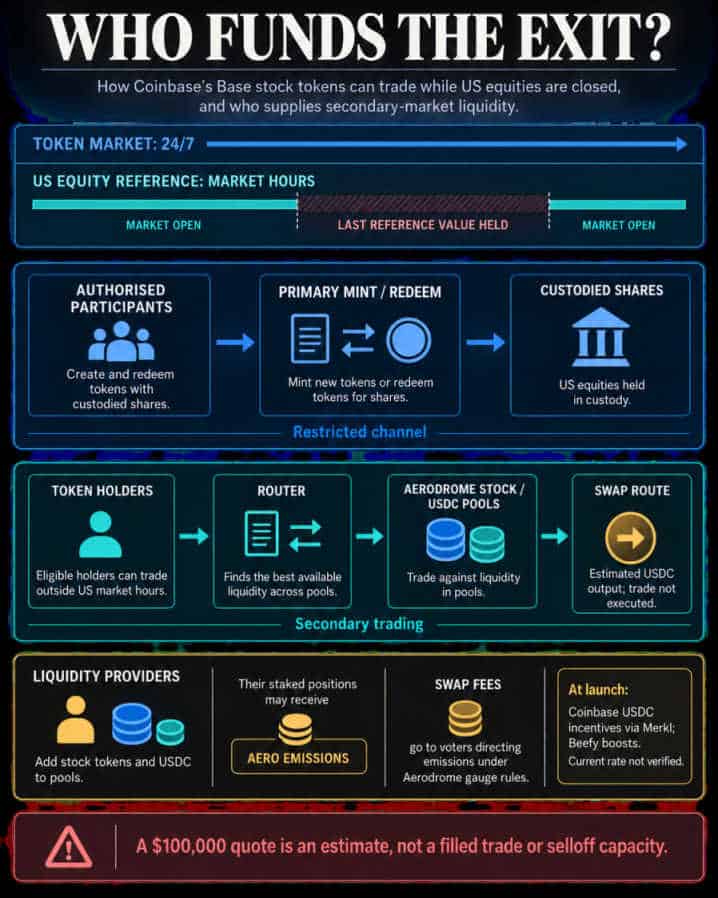
That documentation also notes that the Chainlink equity feed keeps its last value outside market hours, even as onchain token trading carries on. A nighttime sale therefore happens in a live token market while the equity reference may still reflect the previous session.
Redemption is not an escape route either. Authorized participants handle share creation and redemption, so it falls to secondary-market liquidity providers to price any immediate exit.
Checks to make before selling
The Sept. 23 routes demonstrate that individual $100,000 orders received indicative prices despite modest displayed pools. That is one snapshot, taken during a quiet premarket window.
A change in AERO votes, a retreat in provider capital or stock news after hours could reshape those routes while the equity feed stays fixed on its last value. Anyone holding NVDAc or MSFTc outside US trading hours should look up the live route for their real order size before selling. The volume chart will not reveal what that sale is going to cost.