

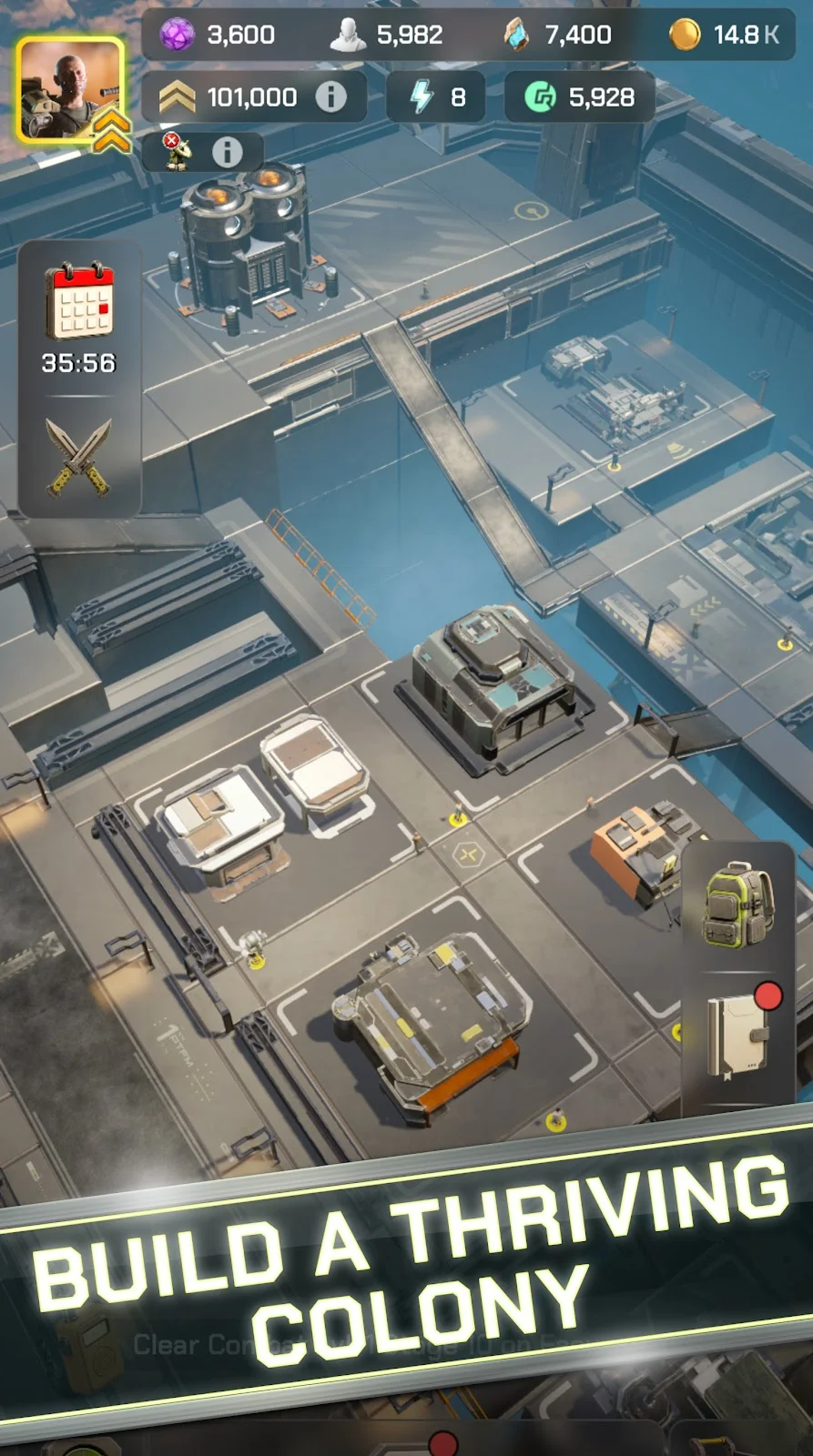
In Brief:
- Parallel Studios has laid out how the Fabricator works in Colony: Survival, the system that takes a written description and returns an equippable 3D weapon or helmet, with credit going to the studio’s partnership with Atlas3D AI and Google Cloud.
- The flow: describe an item, see a 2D preview within seconds, tweak the wording, then pay Weave — an in-game currency handed out through story chapters or sold in the Colony Store — to fabricate the finished asset.
- After nearly a year of restricted testing that began on Solana’s Seeker phone, Colony opened up worldwide as a free-to-play title on iOS and Android on Sept. 3.
Parallel (official site) Studios put out a breakdown of Colony: Survival’s crafting this week, walking through the way the Fabricator turns a player’s typed text into gear a Colonist can genuinely wear.
It is a tight loop. The player writes a description, a preview comes back within seconds, the wording gets refined, and the system then fabricates the result as a fully equippable in-game asset. Parallel’s term for this is AI-assisted UGC.
CRAFTING IN COLONY
Learn how the Fabricator is taking player creativity and item crafting to new heights in Colony, thanks to our partnership with @Atlas3DAI and Google Cloud.
LINK: https://parallel.life/blog/crafting-in-colony…Colony: SurvivalView on X ↗
The machinery underneath comes from Atlas3D AI and Google Cloud.
What it costs, and what it makes
Weave is what fabrication burns. Players pick the currency up from story chapters or buy it in the Colony Store, and each generated item eats into the balance.
Whatever comes out is cosmetic. There are two categories — weapons and helmets — and a 2D version is shown for approval before the player commits to the 3D object, which can then be equipped to a Colonist.
Generated content therefore never touches game balance. Functional equipment arrives by a separate route: an interactive character named Skipjack works with players to come up with weapons and tools targeted at particular colony problems, and those pieces run through the traditional crafting system, complete with resource costs, production queues and completion times.
There is a third AI layer as well. Generative Dilemmas allows a player to type an original response to a scenario rather than choose from a preset list, and then see how the colonist plays it out.
The Atlas partnership
Atlas — the Vienna-based company that makes Atlas3D AI — went public with a Google Cloud partnership on Aug. 18, 2025, naming Parallel among its collaborators at the time.
What Atlas sells is an agentic 3D content creation platform pitched at professional studios, built on Google Cloud infrastructure, with Vertex AI handling orchestration and connectors into Unreal Engine, Unity and Houdini pipelines. It is available through the Google Cloud Marketplace too. According to the company, the technology can accelerate development workflows by as much as 200 times.
Tommy Alvarez, who heads 3D and immersive content at Parallel, said the studio intends to “embrace technologies that empower creativity, expression, and ownership,” adding that the Atlas collaboration allows it to build experiences that are “more immersive, more personal, and powered by truly unique, player-driven content creation.”
Atlas CEO Ben James pointed to Google Cloud as the source of the compute foundation and orchestration support. Jack Buser, Google Cloud’s global director for games, cast Atlas as a way to make AI-native game development possible through agentic design systems.
What Google Cloud runs
Colony has served Google Cloud as a reference customer for the category it labels living games. The title runs on Google Kubernetes Engine, Cloud Run and Cloud Functions, a stack Google says delivers the scale and low latency demanded by a world that never switches off.
Gemini drives the autonomous colonists. They carry persistent memories, personalities and shifting ambitions, and they go on socializing and collecting resources even after the player logs out. The generative crafting engine, in Google Cloud’s description, runs on Nano Banana.
Parallel Studios CEO Sascha Mojtahedi characterized Colony as a world in which “player intent, generative creation, and autonomous agents meet in a world that keeps evolving long after you log off.”
An earlier public demo of the Fabricator took place at the Google Cloud booth, No. 1227, at GDC.
Background
Set in the Parallel TCG universe on an Earth ruined by war between the five Parallel factions, Colony: Survival is a sci-fi 4X mobile strategy game. The opening move is a Reactor, and from there players expand outward with structures like the Barracks and Canteen, harvest raw materials, recruit Colonists and take part in lane combat.
Early Alpha Access opened on Sept. 22, 2025, limited to people who owned Solana’s Seeker smartphone, before the worldwide free-to-play release on the App Store and Google Play on Sept. 3. Solana is the chain behind Colony, and PRIME is its token.
On March 28, 2024, Parallel Studios closed a $35 million round backed by Distributed Global, The Operating Group, Solana Ventures, VanEck, the Base Ecosystem Fund, Collab + Currency and The Spartan Group, with angel participation from Solana co-founders Anatoly Yakovenko and Raj Gokal, Pudgy Penguins PENGU $0.007756 ▼ -18.6% CEO Luca Netz and Yield Guild Games co-founder Gabby Dizon. That came after a $50 million raise led by Paradigm in 2021 at a reported $500 million valuation, taking total funding to $85 million.
Work on the Fabricator continues. One recent patch introduced helmet rotation in 90-degree increments, cleared up a number of fabrication issues and sped up the Fabricator and Inventory screens.