

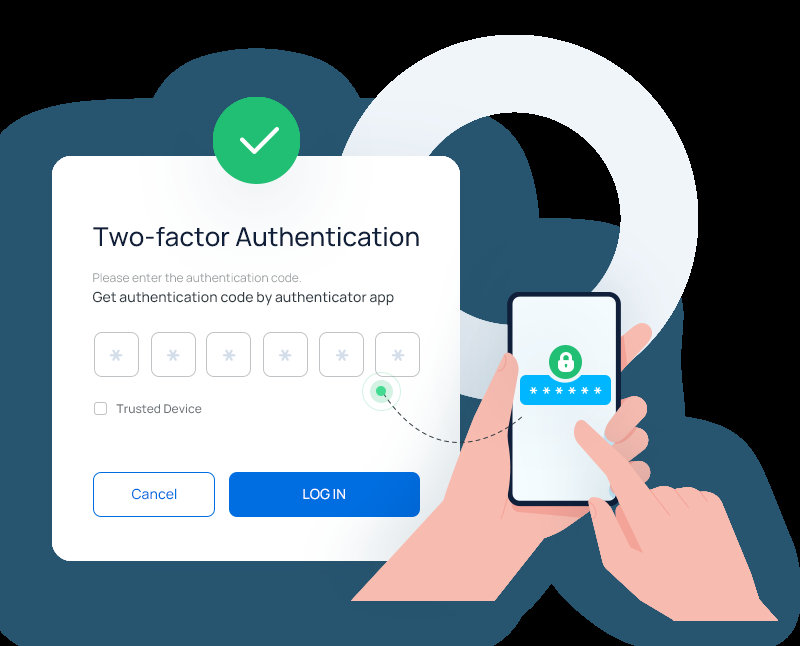
If your password is exposed in a data breach or handed over through a phishing scam, it can’t keep your accounts safe by itself. A two-factor authentication (2FA) app closes that gap. It adds a second check: you enter a short code generated on a device you control, which means an intruder who has only your password still can’t log in.
Below, we cover how authenticator apps work, what to look for when choosing one, how to connect it to your accounts, and what to do if the codes stop working or you switch phones.
Why a password alone isn’t enough
A password is the first line of defense for many online accounts, and sometimes it’s the only one. Reusing passwords and falling for phishing both raise the chance that a stolen password will be used to reach your personal data.
An authenticator app requires a second code that it creates independently on your mobile device. Even with your password, no one can sign in without that app or device.
Start by enabling it on the accounts that matter most, such as email, cloud storage and online banking. Attackers often go after these because breaking into them can expose your identity or your money.
Why an authenticator app is safer than SMS codes
The two options you’ll see most often when enabling 2FA are SMS codes and an authenticator app. Each one adds protection, but not the same amount.
Text-message codes can be intercepted, and the account they’re sent to can be hijacked. An authenticator app generates its codes on your device, so they never pass over the cellular network where someone could intercept them.
The codes are time-based one-time passwords (TOTP). Each one can be used only once and typically refreshes every 30 seconds.
Understand the terms in your security settings
You may run into several different labels in your account’s security settings:
- Two-factor authentication (2FA): an extra step after your password that confirms it’s really you.
- Multifactor authentication (MFA): frequently used as another name for 2FA, though it can also cover methods like biometrics or hardware tokens.
- Authenticator app: the phone app that produces the time-based codes.
- Backup codes: single-use codes issued when you set up 2FA, used to regain access if you lose your device.
Choose an authenticator app for Android or iOS
Choose an app that suits the way you use your devices day to day. These features are worth looking for:
- Easy setup
- Organized account management, so a long list of entries stays easy to search
- Easy recovery options
- Cloud backup, so your codes can be restored if your phone is lost (some apps keep codes only on the phone itself)
- Multi-device support, if you rely on more than one device
- Offline access, so codes are available without an internet connection
Set up 2FA with an authenticator app
Each service words things a little differently, but the steps generally look like this:
- Log in to the account you want to secure and open its settings.
- Find the security or authentication section.
- Select the option to turn on two-factor authentication.
- Open your authenticator app and scan the QR code displayed on screen. If scanning doesn’t work, enter the manual code provided by the service instead.
- Type in the time-based code now showing in the app to complete the link between the app and your account.
- Label the entry clearly in the app so you know which code belongs to which account.
- Store the backup codes the service provides in a safe place.
Keep your backup codes safe
Regaining access to accounts secured by an authenticator app can be difficult if your phone is lost or reset. Backup codes are how you get back in.
Every backup code is single-use. Keep them somewhere secure that you can still get to, so you aren’t permanently locked out of your accounts.
Move your codes when you change phones
Before wiping or handing off your old phone, follow these steps:
- Transfer your accounts to the new phone using the authenticator app’s export or migration tool, or set up 2FA again for each account on the new device.
- Confirm that the new phone produces working codes.
- Only then erase the old phone.
If you’ve already changed phones without transferring your codes, use your backup codes or reach out to the service’s support team to recover access to your accounts.
Fix authenticator codes that don’t work
When a service keeps rejecting the codes from your app, your device’s clock may have drifted out of sync. Enabling automatic time synchronization on your phone usually solves the problem.
With several logins at the same provider, it’s easy to enter the code meant for a different one. Give every entry in the app a distinct name so you always choose the correct code.
What to do if a service only offers SMS or email codes
Some services don’t work with authenticator apps and provide 2FA only through SMS or email. In those cases, rely on a strong, unique password and enable the service’s other account recovery features.
Should the service add authenticator app support down the line, move over to it for stronger protection.
Check your 2FA setup regularly
From time to time, confirm that 2FA is still active on your key accounts, that your backup codes are stored somewhere accessible, and that switching to a new device hasn’t disrupted your setup. Staying on top of this lowers your exposure to phishing attacks and to credential stuffing (where attackers try leaked usernames and passwords on other sites).
Frequently asked questions
Is an authenticator app safer than SMS codes?
In general, yes. SMS codes can be intercepted, or the account receiving them can be hijacked, whereas authenticator app codes are generated on your device and never travel over the cellular network.
What’s the difference between 2FA and MFA?
People often use the two terms interchangeably. MFA can also cover other methods, such as biometrics or hardware tokens.
What happens if I lose my phone with my authenticator app on it?
Get back into your accounts with the backup codes you saved when setting up 2FA. If you don’t have them, the service’s support team may be able to assist.
Why does my authenticator app show the wrong code?
Most likely your phone’s clock is out of sync. Enabling automatic time synchronization usually resolves it.
 CryptoGames.GG