


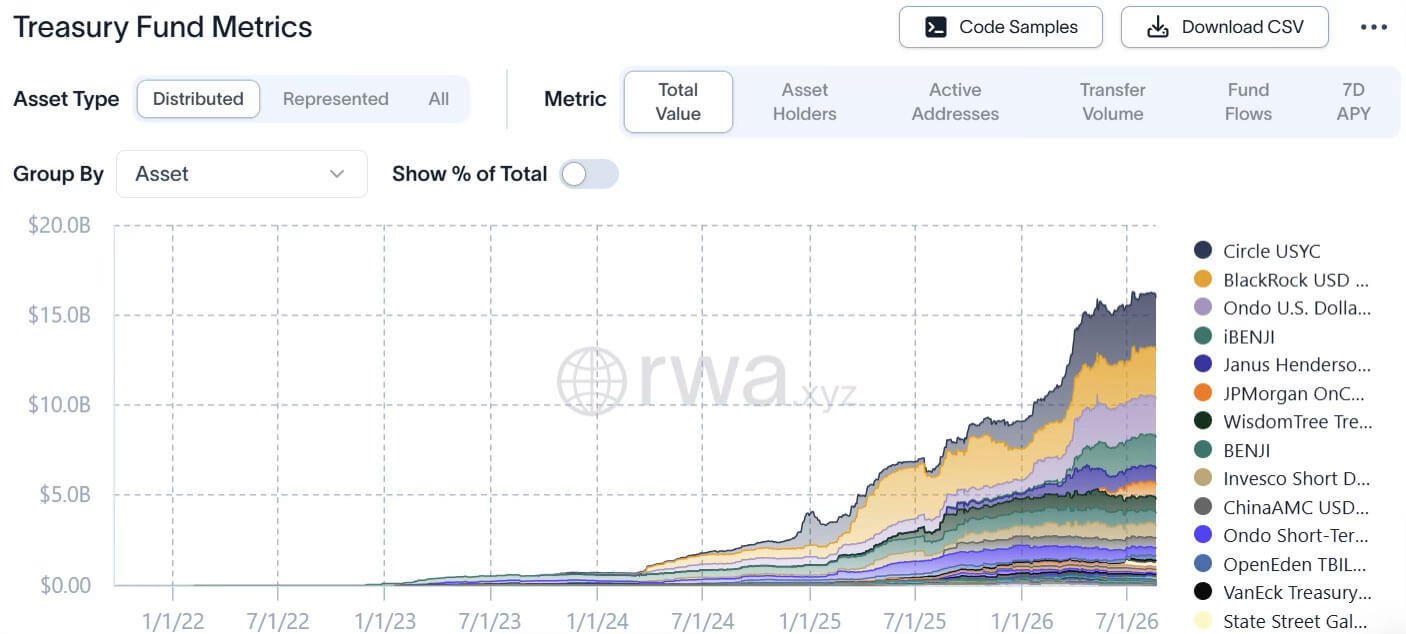
Tokenized US Treasury funds currently hold something in the neighborhood of $16 billion. The bulk of that capital simply sits there.
Someone holds it. It moves occasionally. At some point a redemption happens. For the average tokenized fund that is the entire arc of existence, and it explains why the sector’s preferred yardstick — total value issued onchain — has slowly lost its meaning.
Getting assets issued is no longer the challenge. Look at who is already issuing, and you’ll find most of the heavyweights of traditional asset management. The tougher question, one that rarely makes it onto a pitch deck, concerns what an asset is permitted to do after it lands onchain.
Redeeming versus borrowing looks the same on paper and isn’t
Picture an investor holding a tokenized fund backed by $100 million of bonds who suddenly needs cash. The standard playbook: redeem, sit through settlement of the underlying assets, take the proceeds, then put the money back to work.
Yes, the plumbing moves quicker than its offchain equivalent. But nothing about the economics shifts. Liquidity came at the cost of the position itself.
Route that same requirement through a lending market instead. The token goes up as collateral, stablecoins get borrowed against it, and the credit exposure — plus its yield — stays put. Nothing is sold. The balance sheet entry is identical; the result is not remotely the same.
Vincent Maliepaard, vice president of marketing at Sentora, describes that divide as the difference between tokenization as a quicker distribution channel and tokenization as financial infrastructure. Conventional markets already operate a vast apparatus dedicated purely to mobilizing the value trapped inside assets rather than to owning them. Rebuilt as programmable code, that apparatus is now the prize.
DeFi liquidates in minutes and credit settles in days
This is the point at which the sales pitch collides with reality. No lending protocol can afford to treat every tokenized asset as equivalent.
Should ETH slip past a liquidation threshold, the protocol offloads it into a market that never shuts and whose depth is visible onchain to anybody who looks. A tokenized credit portfolio is a different animal entirely. Its underlying bonds change hands during traditional market hours. NAV might be struck at intervals rather than continuously. Getting redeemed can stretch across days.
Putting a token wrapper on it doesn’t bridge that gap. The bridging has to be engineered around the token rather than within it. The implication is that an asset designed for distribution and one designed to serve as collateral warrant very different standards — and today a fair number of issuers are shipping the former while pitching the latter.
What mWIN gets right, and who’s grading it
mWIN, which launched in August 2026, deserves attention precisely because the collateral question shaped it from the start instead of being bolted on later.
The token comes from Midas. Wellington Management operates the underlying credit strategy, and Northern Trust custodies the assets. Rather than wrapping a pre-existing fund after the fact, the strategy was issued natively onchain, with a portfolio covering investment-grade CLOs and other asset-backed credit yielding roughly 6.9% at present.
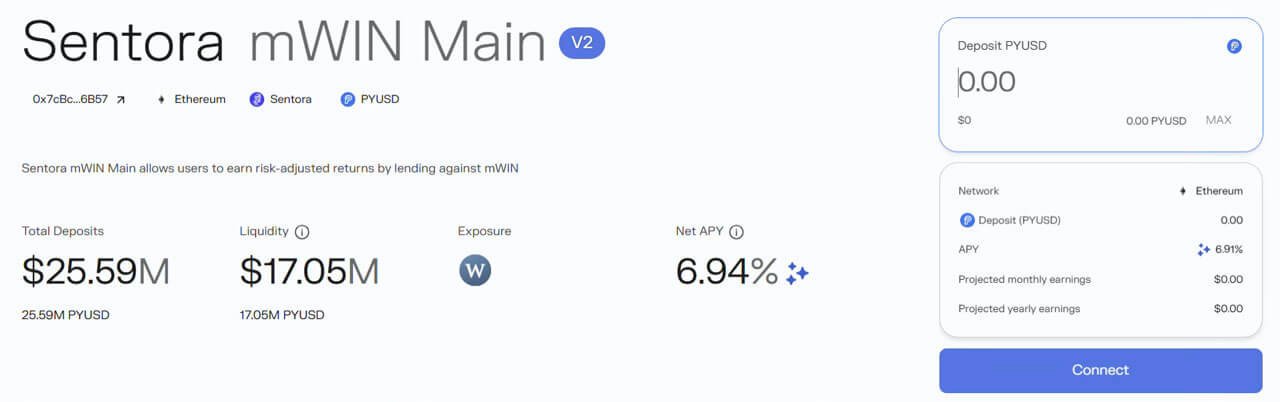
What counts here is the mechanics, not the yield figure. Minting and redemption of mWIN happen daily on a T+1 basis, drawing on multiple competing liquidity sources instead of leaning on secondary market depth as a rescue.
Sentora, for its part, curates a Morpho market in which mWIN backs loans denominated in PayPal’s PYUSD. Parameters are drawn from a dossier covering historical NAV, previous market stress episodes, liquidity and redemption mechanics. All that groundwork exists to set a loan-to-value ceiling low enough that a forced sale can complete before the collateral falls below the value of the debt.
One caveat deserves mention: Maliepaard is employed by the firm curating that very market, so the case study should be read as an argument from an interested party. The design principle underneath it holds up regardless. Programmability comes from the token; what makes that programmability safe to use is everything constructed around it.
Better numbers than total value issued
Tallying assets issued onchain throws dormant tokens into the same bucket as productive ones — hence a number that climbs steadily while the utility question goes unanswered.

Sharper questions are already trackable. What volume of tokenized collateral is backing loans? How much stablecoin liquidity can be sourced against tokenized securities? What quantity of collateral shifts between venues without the underlying asset being sold, and what share of that settles without ever leaving the shared infrastructure?
The early evidence is encouraging. Growth in Figure PRIME on Morpho has topped 200 million this year. Aave rolled out Horizon in August 2025 with the explicit aim of letting institutions borrow stablecoins against tokenized assets, and it now holds a TVL north of $250 million.
Additional Morpho markets continue to spring up around tokenized credit, and tokenized equities are landing on those same rails.
The internet didn’t become important because documents were digitized; it became important once they were networked. Financial assets appear to be traveling the same path — representation, then distribution, and now utility — and the scoreboard that will ultimately matter measures what markets can construct with these assets, not how many of them exist. So the next time you size up a tokenized fund, look past the AUM figure and ask what a lending market is prepared to lend against it.