

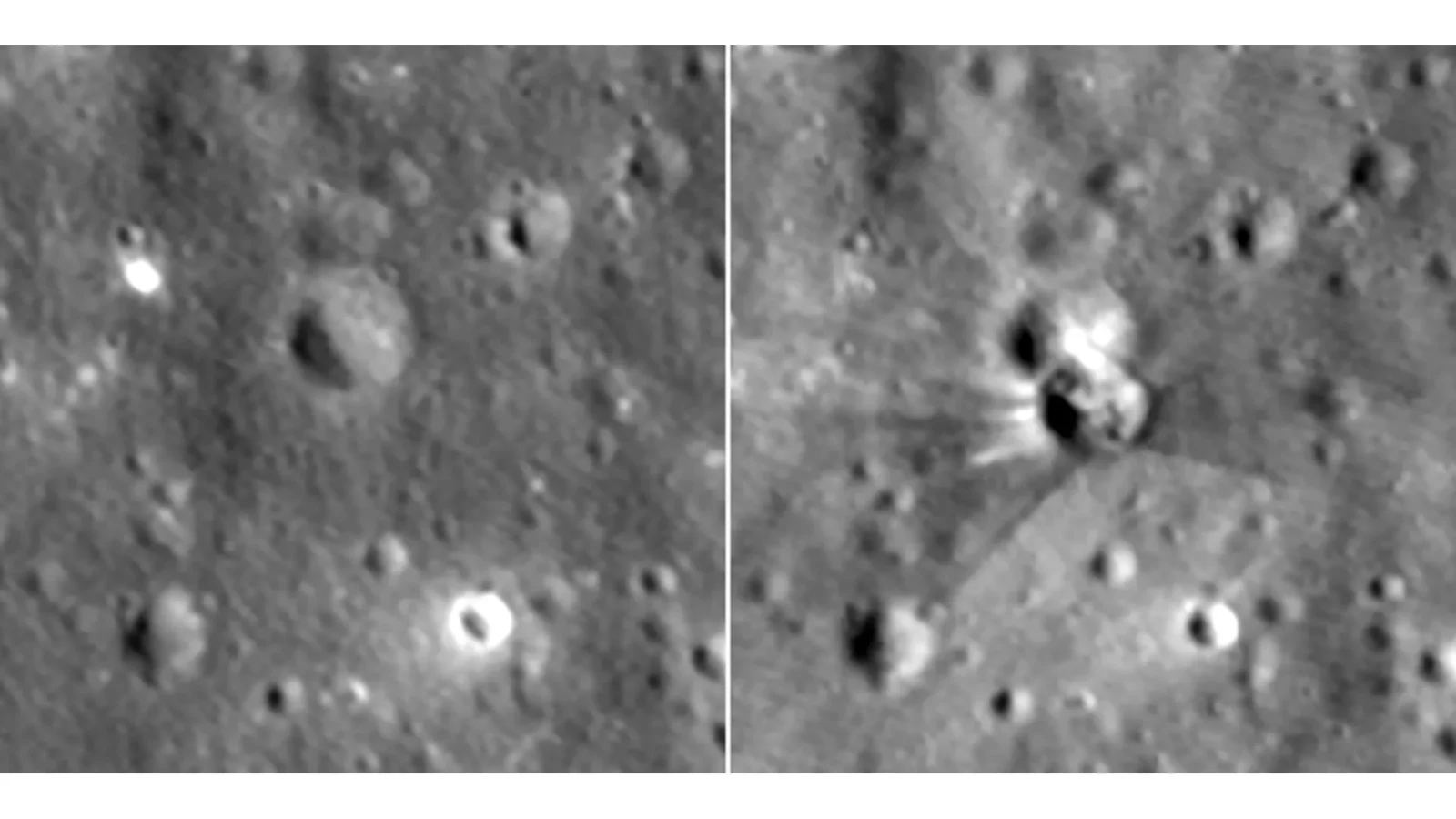
Six days of orbital patience were needed before NASA could get a clean view of the mark left when a rocket stage — one that departed Earth back in January 2025 — slammed into the Moon on Aug. 5.
The result measures roughly 60 feet across and doesn’t even reach 10 feet deep. That’s the whole story. The Falcon 9 upper stage responsible was the same piece of hardware that carried the Firefly Blue Ghost 1 mission aloft, and its arrival on the lunar surface produced a pit you could fit a couple of cars into.
The Lunar Reconnaissance Orbiter finally captured it sometime between Aug. 11 and 12.
Getting the shot meant tilting an entire spacecraft
There’s no swivel mount for LRO’s cameras. Aiming at the impact zone required engineers to angle the entire orbiter, all while it traveled at roughly 1 mile per second some 60 miles above the surface.
And then the timing issue — the piece of this that rarely gets its due. Fire the shutter 10 seconds too soon or 10 seconds too late and your subject ends up roughly 10 miles from the middle of the frame.
Every two hours the orbiter completes a pole-to-pole loop as the Moon rotates beneath it. Flying to a target isn’t an option; you sit tight until the target swings into view. One usable pass cost six days of waiting.
The measurements came from a shadow
The team shot the crater repeatedly, varying the angle and the lighting, since features emerge differently depending on how the light falls. The 60-foot width came from frames in which the rim stood out clearly.
Nailing down depth proved harder. To reach the sub-10-foot number, researchers measured how long the crater’s shadow stretched and reasoned backward from there. The principle is decidedly low-tech — and it does the job.
Behind the imagery is the Narrow Angle Camera, capable of resolving objects as small as 3 feet, which explains how a 60-foot scar remains readable from 60 miles overhead.
The dark streaks are the interesting part
Study the rays radiating out from the strike and you’ll notice material of two kinds, bright and dark. That dark debris consists of dust and rock that spent ages being weathered by solar wind, galactic cosmic rays and micrometeorite strikes.
The impact hurled that battered material upward from depths of as much as 1.5 feet. Nearer the rim sit the brighter streaks — newer material, excavated from farther below the surface.
What the crater amounts to, then, is a cross-section: a spent rocket handing scientists a free excavation of the Moon’s uppermost layers.
Amateurs found it first
The rocket’s trajectory was pieced together by independent astronomers relying on openly available information. No classified tracking feeds were involved. Public information.
For NASA’s Center for Near Earth Object Studies — a group that typically monitors natural objects capable of threatening Earth under the agency’s Planetary Defense program — the episode doubled as a live exercise. Forecasting the impact point of a known object is precisely the capability you’d want proven ahead of a situation that actually counts.
Operating out of NASA’s Jet Propulsion Laboratory in Southern California, the center kept sharpening its calculations until an expected impact site emerged. That forecast was passed along to the Republic of Korea and the team behind its Korea Pathfinder Lunar Orbiter, Danuri.
The prediction was off by about 0.6 miles
Within a few hours, Danuri’s operators aimed the spacecraft’s high-resolution LUTI camera at the location and secured the crater. As it turned out, NASA’s predicted site was accurate to roughly 0.6 miles.
Danuri then returned the coordinates to the LRO team, which leaned on them to sharpen the aim of its own imaging. Korea located it, NASA tightened it up, and each side walked away with something.
By matching the fresh frames against images of the same terrain taken before the impact, the LRO team fixed the crater’s center at 19.4759°N, 266.7138°E, sitting at an elevation of 511 meters.
Keep those coordinates handy. A fresh 60-foot dent now marks the Moon, and its precise location is known — which is more than can be said for much of the hardware humans have abandoned up there.