

In Brief:
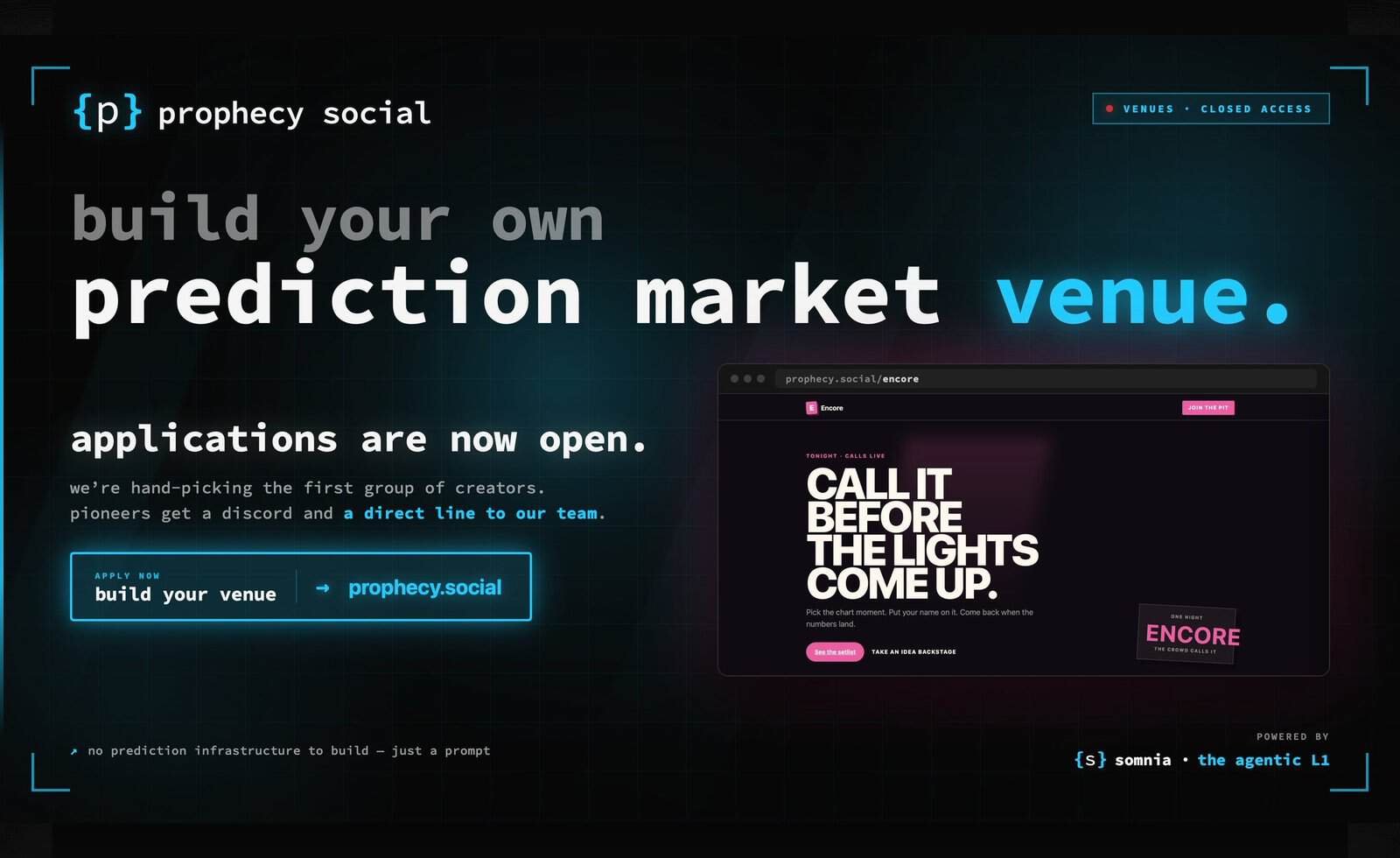
- With Prophecy Social Venues, creators and communities can now spin up branded prediction market venues that run on the same infrastructure powering the platform’s flagship app.
- Branding, categories and curation sit with the operator, while Prophecy takes care of resolution, settlement and liquidity — and liquidity is shared protocol-wide, whichever venue a market originated in.
- Days later, Somnia put out a breakdown of the architecture underneath it all, highlighting AI agents that settle markets inside the execution environment instead of relying on an external oracle.
Announcing Prophecy Social Venues this week, Prophecy Social has thrown its prediction market stack open to outside operators.
Communities and creators are able to launch a venue of their own, complete with custom branding, markets and categories, all sitting on the infrastructure that runs Prophecy Social itself. According to Somnia, a custom venue can be spun up by projects and communities using an agent, with both market creation and resolution handled agentically. For now, the rollout is limited to a closed beta.
Earlier this week, @ProphecySocial_ announced Prophecy Social Venues, giving creators and communities the ability to build their own prediction market experiences on top of the same infrastructure powering their platform.
This article breaks down how that infrastructure works@SomniaView on X ↗
What operators get
Resolution, settlement and liquidity are Prophecy’s responsibility. Curation stays in the hands of whoever owns the venue.
Fragmentation isn’t part of the model. Liquidity is pooled across the whole protocol no matter which venue spawned a given market, which turns venues into branded front ends and curation layers instead of siloed pools.
The same logic applies to points. Prophecy Points carry across every Prophecy Social venue, and trader counts are tallied as distinct wallets that hold points anywhere in the system. As for the daily PST bonus, it’s a single claim per day covering every venue in the Somnia ecosystem.
How resolution works
Neither human moderators nor a dispute committee are involved. Once the trading window shuts, several independent AI agents gather evidence from news APIs, price oracles and public data feeds, weigh it against the market’s resolution criteria, and each returns a vote with its reasoning attached.
Before anyone takes a position, the consensus threshold is displayed on the market. Hit that threshold, and the outcome gets written to Somnia, at which point winners can claim right away.
The full resolution trail is open to inspection once a market has closed — the sources the agents consulted, what those sources yielded and how each agent voted.
The docs are explicit about the edge case. Should the agents fail to reach consensus or come up short on evidence, settlement happens at the last known price position, meaning a trader’s PST payout reflects what their shares were worth when resolution was attempted rather than a refund of the original stake.
Somnia’s architectural pitch rests on the agent running inside the execution environment under the same consensus guarantees that cover any other onchain transaction. Because execution happens across validator nodes, the network verifies the outcome instead of a single service. Somnia argues that most AI-based resolution systems attach the AI externally, and that this is precisely where slowdowns and trust gaps creep in.
There’s also a quality score attached to every market at creation, known as the Caliber, which rates how reliable the sources are and how precise the question is. In week one, the higher-rated markets drew meaningful participation. The lower-rated ones did not.
The token is play money
Being soulbound, PST cannot be transferred, traded or cashed out. Signing up earns a one-time grant that travels across venues, topped up every 24 hours and supplemented by correct predictions and market creation.
Playing costs nothing, since Prophecy Social and Somnia sponsor the trading fee. Users sign up via FaceID, email, Google or X, and a Somnia wallet is spun up automatically with no gas to think about. At the close of each season, SOMI rewards are distributed based on leaderboard standings.
Week one numbers
In under a week from launch, the platform picked up more than 5,000 users and saw over 2,000 markets go live, every one created and resolved with no manual intervention. Points counting toward SOMI rewards totaled 3.6 million in that first week.
Markets are created from prompts. The user types one, and Somnia agents handle structuring the market, defining resolution criteria and publishing it onchain — no human anywhere between prompt, validation, creation and resolution.
The range of what users can build has been expanding. “We’re starting off the week with some good news: public market creation is back! You can now make your own crypto and football markets. The points are awarded when a market closes, not when they’re created (so metrics like volume can be counted too). More categories coming via verified partner status. Keep an eye out!” the project said in a post on X. Stocks markets came next, giving users the ability to frame questions around whether a ticker finishes above or below a target price.
Background
Since its mainnet went live in September 2025, Somnia has handled more than 2 billion transactions. It began life as a high-throughput chain built for metaverse and consumer applications, then repositioned itself as an Agentic L1 for AI agents, working from the thesis that agents operating onchain will define the internet’s next phase. MultiStream consensus and the IceDB state database are part of its stack.
Leadership changed in March 2026, when Peter Lipka — co-founder and former chief operating officer of Improbable — took over as chief executive officer, joined by Harry Lang as chief marketing officer and Kevin Zia as chief operating officer. Founder Paul Thomas is still involved, though his attention has moved to long-range direction. Thomas summed up the prediction protocol’s design as follows: “This concept gives us the market of markets.”
At Prediction Conference 2026 — held April 22 to 24 at MEET in downtown Las Vegas, where Somnia was a platinum sponsor — Lipka made the infrastructure case in a keynote titled “Prediction Markets in the Age of AI Agents.” “Prediction markets are where AI and crypto converge in a way that actually works… The next phase isn’t about better interfaces. It’s about better infrastructure,” Lipka said.