

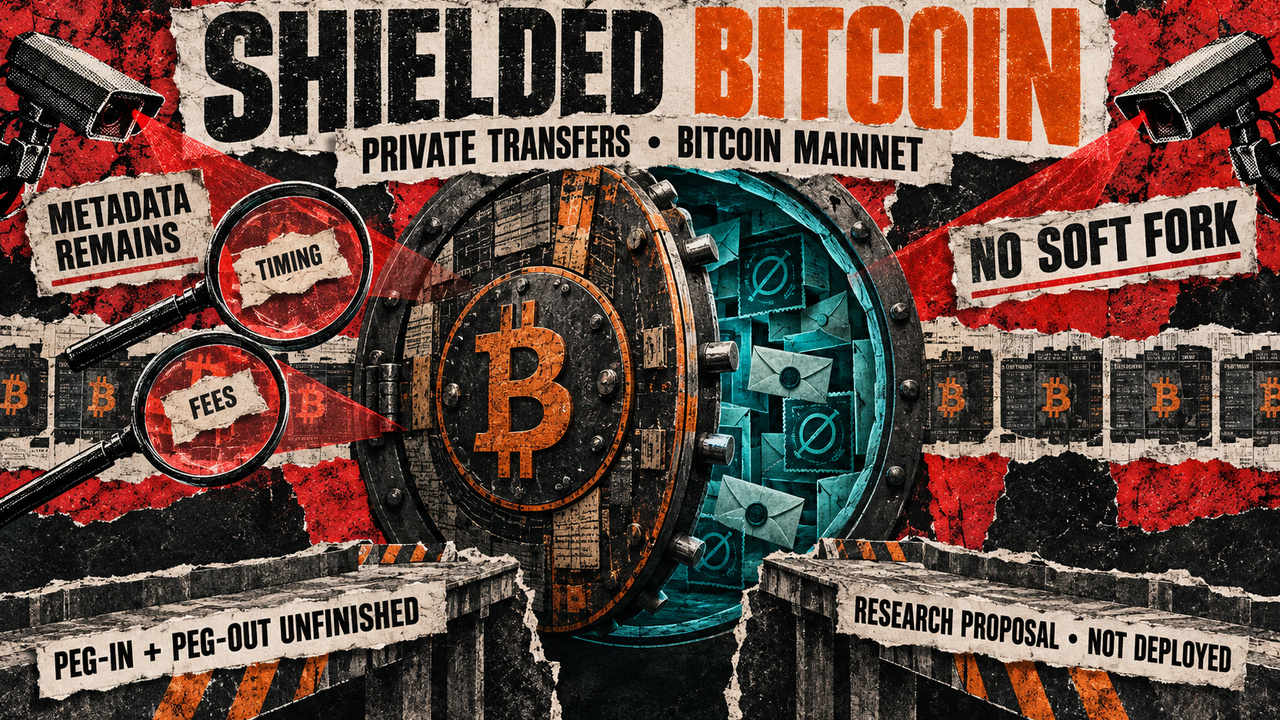
Investors pushed ZEC past $1,600 this week because they decided privacy is worth paying for. A group of Bitcoin researchers now argues that holders may be able to get that privacy without leaving BTC.
Shielded Bitcoin is set out in a Sept. 24 paper by Clara Shikhelman, Mikhail Komarov and Aleksei Moskvin of [[alloc] init]. The metaprotocol is built to conceal transaction amounts, senders, recipients and the connections between transfers, while its protocol data is still published through Bitcoin mainnet.
The interesting part is what the design does not require. It needs no soft fork and makes no change to Bitcoin’s consensus rules. All of the privacy logic runs on top of the network, so nobody has to wait for an upgrade that might never happen.
Borrowing from Zcash without building a new chain
The design reuses techniques that Zcash pioneered: encrypted notes, public nullifiers and zero-knowledge proofs. It does not launch a separate blockchain, though. Bitcoin serves as the layer that publishes and orders the data, and participants rebuild the private transaction state from what gets recorded there.
A transfer would run like this. Your BTC-denominated value would be held as encrypted notes. To send funds, you would publish an envelope with three parts: encrypted outputs, public nullifiers that mark your old notes as spent, and a zero-knowledge proof that you own the funds and that value was conserved.
Neither the amount nor the identities of the two parties are revealed.
None of this would be checked by miners or nodes. Software that follows the Shielded Bitcoin rules would scan BTC blocks and replay the accepted transfer envelopes in the order they were recorded. Every participant would end up with the same note tree and the same set of spent notes. Bitcoin supplies the timestamped history and the ordering. The metaprotocol keeps track of encrypted balances and confirms that transfers are valid.
That is a real architectural break from Zcash. On Zcash, the network’s own consensus rules decide whether a shielded transaction is valid. Shielded Bitcoin leaves BTC consensus alone and builds a separate private state from data anchored to the chain.
Under the current implementation profile, the encrypted transfer data is published with OP_RETURN. The researchers say other publication methods remain possible.
Beyond what CoinJoin could do
Bitcoin users already have some privacy tools. CoinJoin, PayJoin and Silent Payments can make tracing harder or reduce address reuse. None of them hide the amount, and other transaction details stay public as well.
Shielded Bitcoin would go further than those tools, but it would not make transactions invisible. Observers could still learn something from transaction timing, fees, input and output counts, and the traits of the Bitcoin transaction that carries the encrypted data. Don’t assume the cover is perfect.
The paper also describes viewing capabilities. These could let users disclose selected transaction information without giving up control of their funds, so auditors or compliance teams could get access where the rules require it.
The hardest piece hasn’t been built
Skeptics should focus on this gap: the specification does not explain how ordinary BTC moves into or out of the shielded system.
Peg-in and peg-out mechanisms are outside the current spec. They would have to lock Bitcoin on mainnet, represent that value inside the private note system, and later release the matching BTC when a user exits. [[alloc] init] expects these flows to use its PIPEs v2 work, but the researchers have not yet published the detailed construction.
This is a central problem, not a side detail. Nobody yet knows whether entry and exit can be trustless, private and resistant to linkage. However well the middle is hidden, a distinctive deposit amount, withdrawal amount or timing pattern could link your activity at either end.

Several other choices are still open: the final proof system, the publication format, and how light clients could verify shielded state without replaying all of the relevant Bitcoin history.
Bitcoin maximalists call it a moat, not a race
Sam Callahan, director of strategy and research at Bitcoin treasury company OranjeBTC, said the work supports a wider view: Bitcoin can add functionality over time without matching other chains feature for feature.
“People still misunderstand Bitcoin’s moat. Bitcoin doesn’t need to win every feature race. Privacy, speed, and functionality can be built over time. The moat is its decentralization, security, and credible monetary policy,” Callahan said. “And on those dimensions, nothing else comes close.”
André Dragosch, Bitwise Europe Head of Research, described Shielded Bitcoin as a “potential headwind for privacy coins.” His concern is simple. Features that used to require separate networks could more and more be rebuilt around Bitcoin, without touching its monetary rules or base-layer consensus.
Why this matters for Zcash holders
The timing is significant. Investors are paying attention to privacy-focused cryptocurrencies again, which revives an old debate over whether dedicated privacy networks have a lasting technical edge over Bitcoin.
Privacy is the entire reason for Zcash’s recent revaluation. ZEC rose above $1,600 this week as shielded activity increased and investors returned to the idea that Zcash offers native transactions that hide senders, recipients and amounts.
Network usage has moved with the price. Weekly shielded transactions recently hit 62,379, the highest level since 2022. This month, nearly 5 million ZEC was held in shielded pools. Last week the network settled more than $23 billion in transfer volume, its best weekly total since 2021.

Shielded Bitcoin challenges that story because it aims for similar confidentiality while keeping BTC as the underlying asset. Bitcoin itself is up 0.07% over the past 24 hours and remains No. 1 by market cap.
If you’re considering buying a privacy coin today, the paper doesn’t change the calculation yet. There is nothing usable until [[alloc] init] publishes the PIPEs v2 peg-in and peg-out design, and that is the document to watch for. If it works as designed, it would give you a way to get stronger privacy without leaving BTC.