

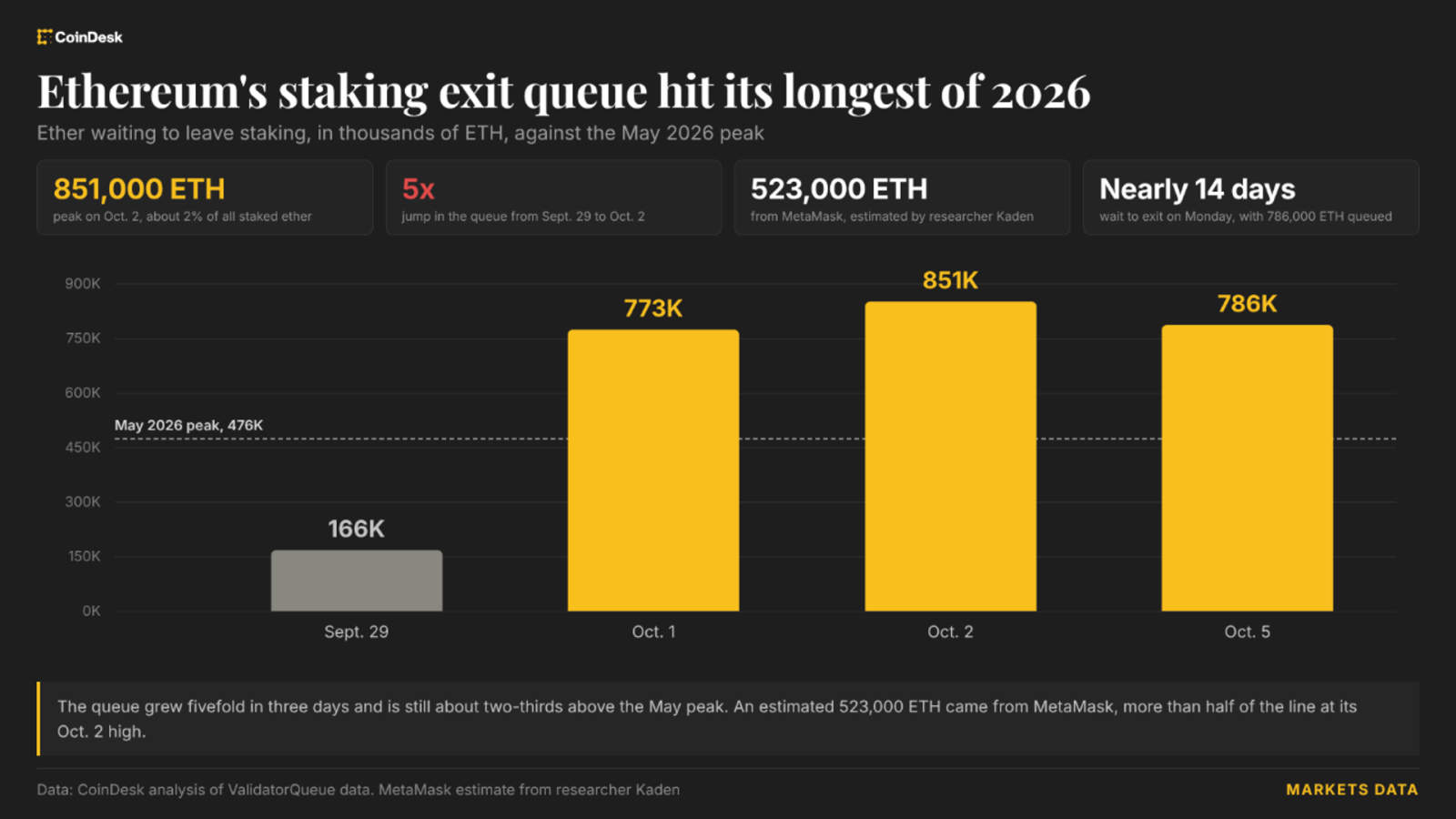
Close to 14 days. That was the wait to withdraw ether from Ethereum’s staking system as of Monday morning in Asia. No exit line has been longer in 2026, and most of it comes from one company that pulled back as a precaution after a security scare.
Last week, the exit queue grew more than five times larger in just three days. On Sept. 29 it held about 166,000 ETH. By Oct. 2 it had reached roughly 851,000 ETH. With ETH trading at $2,719.38, a large amount of capital is sitting in that line.
At its peak, the queue held about 2% of the 43.6 million ETH that is staked. That also beat the previous 2026 record of roughly 476,000 ETH, which was set during a surge in May.
One operator, most of the line
The queue traces back to MetaMask. The company is best known for its cryptocurrency wallet, but it also offers staking services. That includes running validators for Lido, a service that pools users' ether for staking.
On Sept. 30, MetaMask said a security incident had affected part of its infrastructure. As a precaution, it then began withdrawing the affected validators. In an update on Oct. 1, the company said its investigation had found no indication that wallets or customer funds had been affected.
Nobody has confirmed exactly how large the withdrawal is. At the time, Ethereum security researcher Kaden estimated that the precautionary exits covered roughly 17,000 validators holding about 523,000 ETH. MetaMask has not confirmed those numbers, so they should be read as one researcher’s count, not an official figure.
The bottleneck is built in
Ethereum has a queue because it was designed to have one. Staking means committing ether to validators, which are the computers that check Ethereum transactions, and earning rewards in return. The network limits how fast validators can join or leave so that its security can’t change all at once.
Under the current limits, about 57,600 ETH can enter staking each day, and about 57,600 ETH can exit. Any large move therefore becomes a queue. Reaching the end of the exit queue also doesn’t put coins in your wallet right away, because a separate withdrawal process comes after it.
The line had shrunk a little by Monday. About 786,000 ETH, worth just over $2 billion, was still waiting to exit.
A round trip that takes weeks
Most of this ether isn’t leaving Ethereum. These are one operator’s coins taking a temporary detour. Lido expects the ether to come back gradually: the affected validators exit, their balances are withdrawn, and the coins are staked again.
That round trip has a cost. Lido estimated the full process could take up to about 45 days, and the affected validators earn no rewards while they’re offline. Lido expects the last affected MetaMask validators to stop staking by Oct. 7. Their coins will then join the queue to start staking again.
Lido kept its message to users short. “No action is required from stETH holders,” Lido said last week. stETH is the token that represents a user’s stake in the service.
The entry line tells a different story
Separately from the MetaMask situation, demand to start staking has been cooling. On Monday, about 1.5 million ETH, worth roughly $4 billion, was waiting to enter, with an estimated wait of roughly 25 days.
In early September, the entry queue held about 2 million ETH and the wait was about 35 days. So the line to get in is shorter than it was a month ago, while the line to get out is the longest it’s been all year.
For stETH holders, the official guidance is that nothing needs to be done. They should just expect MetaMask’s returning coins to join the back of an entry queue that is still about 25 days long.