

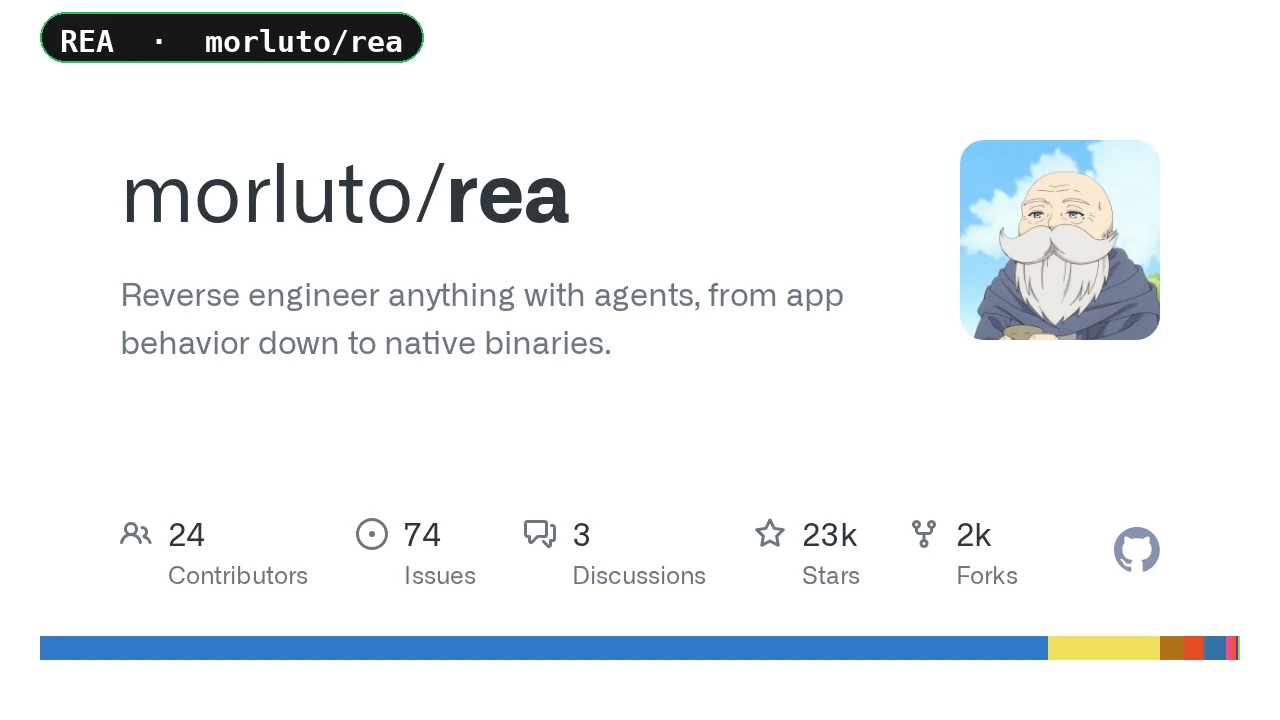
A GitHub repository named REA counted fewer than 10,000 stars on October 6. By Monday, that figure had climbed past 100,000. October 11 alone brought in more than 30,000 of them, quite a turnaround for a project that had gone largely unnoticed since it was created in April.
The acronym stands for Reverse Engineer Anything. That is an overstatement, and the project’s own documentation admits as much. Still, the things people are making with it, and with the methods behind it, should leave any subscription-based software company feeling a bit uneasy.
What REA does
Games and applications are distributed as machine code: the raw instructions a processor understands and people largely cannot. Decompiling attempts to convert that back into a readable form. Picture tasting a cake and then reconstructing the recipe from the flavor.
Reverse engineering covers more ground. It is the work of figuring out how something functions without access to its blueprints, whether by observing an app’s behavior and the data it transmits or by studying its code.
The heavy lifting isn’t done by REA. Instead, it links AI coding assistants such as Claude Code or OpenAI’s Codex to the professional tools that handle it, including Ghidra, the reverse-engineering suite the NSA made public in 2019. The bridge between them is MCP, the Model Context Protocol, a standard Anthropic built so that AI models can hook into external tools. Think of it as a universal adapter.
In use, you aim an agent at a program and ask it how a particular feature works. It then digs from what appears on screen all the way down to the binary. Desktop apps, Android apps and websites are all supported.
The readme is more honest than the hype
The star count obscures one thing. According to REA’s readme, the project “does not claim to recover original source code or automatically clone an application.” It doesn’t even include a decompiler of its own.
That restraint carries some legal weight too, albeit in a gray area. The reasoning behind these projects is that the developer never looks at the original code and instead releases an alternative with similar code that performs the same function without being identical. Legal(ish) is the most accurate way to put it.
Development shows no sign of letting up, either. Between October 3 and October 11, REA put out eight releases.
Spider-Man in Gotham, creepers in Elden Ring
The first results look exactly like what happens when modders get a skeleton key. Spider-Man has been seen swinging across the Gotham of Batman: Arkham City. One person crammed roughly 1,600 Minecraft items into FromSoftware’s Elden Ring, meaning creepers can now take on Malenia.
A different modder brought Escape from Tarkov’s weapons and menus into Skyrim and named the result “Escape from Skyrim lol.” Hard to argue with that.
Console exclusives are slipping out as well. In September, a fan relied on an open-source AI model and a recompilation toolkit to bring Fable 2 to Windows; it is the only mainline Fable entry that never came out on PC. The AI had it booting within about an hour. What followed was a lengthy period of manual fixes, a detail the viral clips usually leave out.
The most eye-catching case came from developer C22 (@c22_dev), who wrote on October 9, 2026: “gta v running natively on ios (a recent fun project of mine).” It runs smoothly, which is more than Rockstar Games ever made the effort to offer.
The free Photoshop isn’t ready
Developer Brandon Thomas applied the concept to software people pay for monthly. Relying on these techniques, though not on REA itself, he turned to Claude Opus 5.5 to create ArtCraft, a collection of free, open-source apps written in Rust that replicate Photoshop, Illustrator, Premiere, Lightroom and other Adobe programs across Mac, Windows and Linux.
According to Thomas, he reached his breaking point after Adobe hit him with its cancellation fee one time too many. He is far from alone in that frustration. In March, Adobe agreed to a $150 million settlement with the Justice Department, which had accused the company of concealing early termination fees and making subscriptions difficult to cancel. Adobe denied any wrongdoing.
Thomas describes ArtCraft as a clean-room rebuild. Its code is written from the ground up based on public documentation and observed behavior, never the original source. Compaq relied on the same legal strategy to clone IBM’s PC BIOS in the 1980s.
Expectations should be kept in check, though. On the project’s site, the apps carry “early alpha” or “in development” labels, and one pixel artist has already described the Photoshop clone as “completely unusable.” Thomas has also retreated from his pledge to match Adobe’s feature set within a month, and now says it will take months.
Studios are reaching for lawyers
The larger change is this: anything running on your own device can now be read by an AI agent given enough patience and tokens. That erodes the oldest form of copy protection in software, which was simply how painful it is to read machine code.
On the plus side, that means cheaper clones and stronger game preservation. On the minus side, piracy gets easier. Security flaws also have fewer places to hide, which works in both directions.
Publishers are paying attention. Activision has already taken down footage of an AI-decompiled Call of Duty: Modern Warfare 2. Bethesda issued a cease-and-desist letter over Fallout: New York, a browser game made with AI.
The game’s creator, Chris First (@chrisfirst), posted on October 4, 2026: “UPDATE: Due to copyrights I had to take down this game. BUT I will have an updated version of the game up and running soon!” He followed up by offering to DM the new link to anyone who replied.
For now, takedown notices appear to be the only weapon studios have against a trend that could easily force open source everything. Modders may want to check out REA today. Adobe subscribers hoping to cancel should keep paying for the time being, since ArtCraft’s own developer has just said it will be months.